Friday, July 31, 2009

I'm Your Moon

The logical followup to my post about the Guitar Nebula is something with actual guitar in it. Thankfully I have a perfect astronomy song to kick off your weekend.

As I mentioned earlier in the week we are coming up on the three year anniversary of the IAU's decision to demote Pluto from planet to dwarf planet.

Shortly after that event Jonathan Coulton wrote this song. He explains it better than I can. So watch and listen to this clip from his DVD BEST. CONCERT. EVER.


I know of lots of love songs that mention our moon, but this is the only one that I know of that was written as one celestial body singing to another. It is really masterful and the most creative thing I know of to come as a result of the IAU's decision. You should enjoy this song no matter which side you are on of the Pluto dwarf planet debate.

Tip of the dome to Jeff P. who alerted me to this.

Guitar Hero

The supernova explosion of a star is sometimes symmetrical and sometimes not. When the explosion is not symmetrical some of the energy of the explosion gives the resulting neutron star a kick sideways. The results of that can be spectacular.

The Guitar Nebula is indeed a spectacular example of what can happen when a neutron star gets a sideways kick:


Back in 1992 a group of researchers from Cornell University used the Hale Telescope at Palomar Observatory to discover a unique nebula associated with a high-velocity spinning neutron star (also called pulsar) known as PSR 2224 + 65. This pulsar is flying through a gas cloud and producing shock wave in the gas very much like the wake of a boat moving through water. The result is the Guitar Nebula.

The pulsar is flying through a gas cloud at an amazing speed of about 800 km/s (1.8 million miles per hour!), fast enough that it will eventually escape the Milky Way galaxy. It is also fast enough that it is possible to watch the neutron star move in just a few years time.

Given the Guitar Nebula's distance (about 6,500 light years away, in the constellation of Cepheus) and apparent size in the sky (1 arc minute) astronomers estimate that the neutron star has been traveling for 300 years.

Thursday, July 30, 2009

Palomar in Ads - II

It has been a while since I posted an advertisement featuring Palomar Observatory.

This full-page magazine ad for Kodak film ran in back in 1948 or 1949 sometime after the dedication of the 200-inch telescope.

Kodak produced the photographic plates that were used at Palomar for years. The last photographic plate shot with the Hale Telescope was taken in 1989. We continued to use Kodak plates for the Second Palomar Observatory Sky Survey, performed with the 48-inch Schmidt (aka the Samuel Oschin Telescope) all the way up to the year 2000.

The first CCD photography at Palomar began in the 1970s and everything is 100% digital now. Of course our reach into space is a lot farther now than the "billion light years" quoted in the ad.

Rawhide

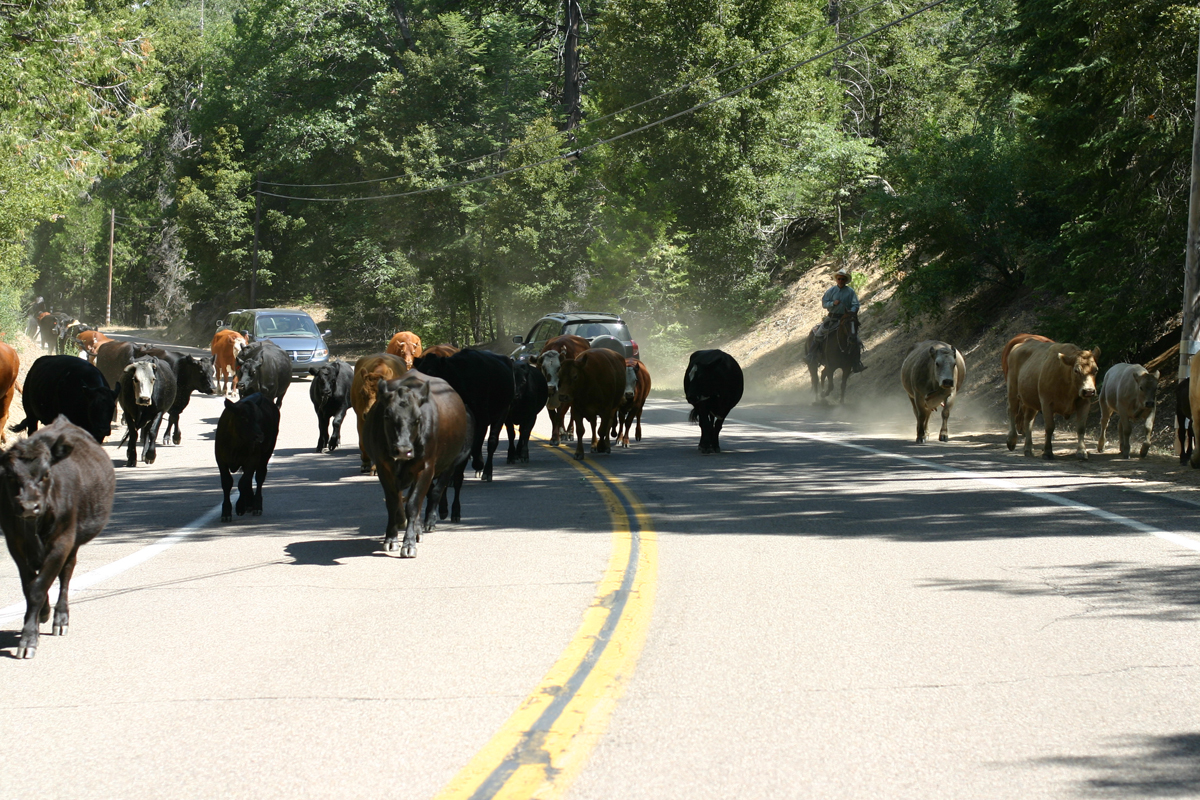
People often ask me about the cattle guards and the cattle signs up on Palomar Mountain. They are often astonished to hear that there are real, live cows up here. Once in a while the evidence is obvious:

About twice a year the ranchers on Palomar Mountain put on a real cattle drive. The last one took place just about 2 weeks ago. I managed to miss it completely, but did see the after affects lying in the road to the observatory.

Thankfully, the folks at HPWREN captured the above image on their way home after a meeting with me and made it their Image of the Week for July 18, 2009.

Wednesday, July 29, 2009

First Light for Cosmic Web Imager


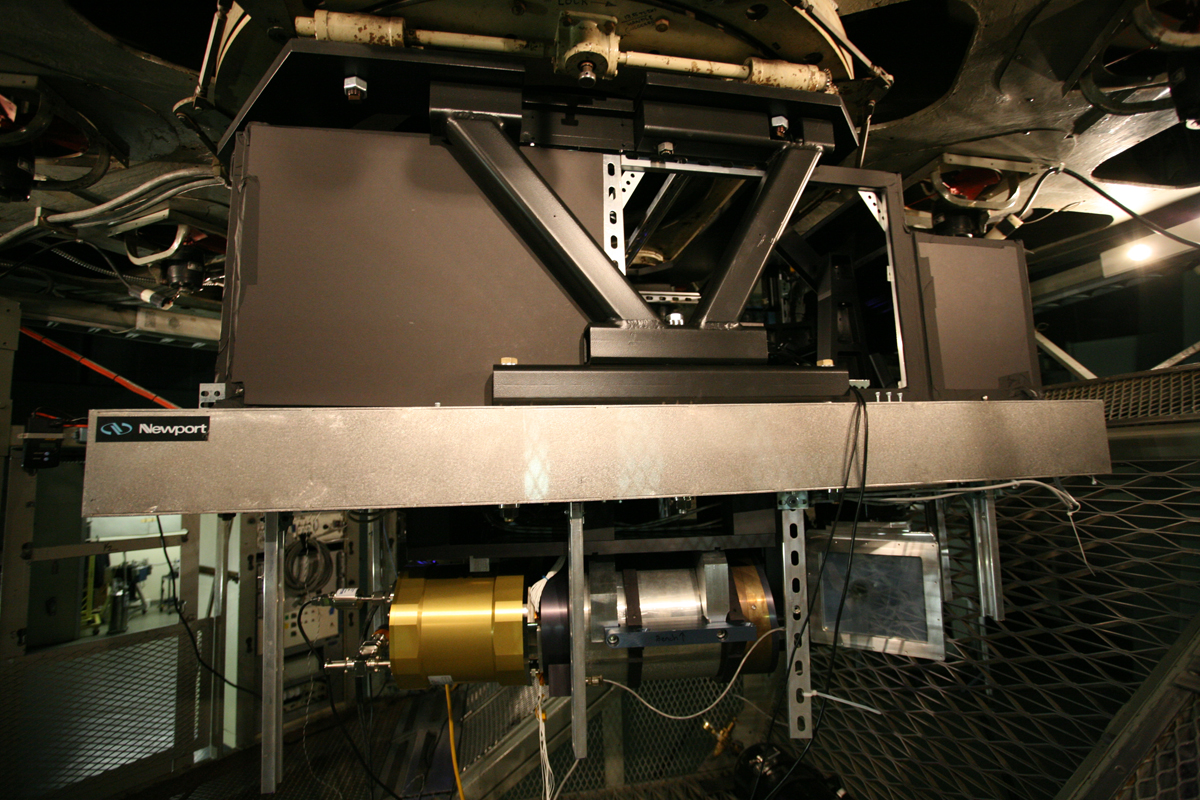
Back at the end of May Cosmic Web Imager, the newest instrument for the 200-inch telescope, got a test fit. Actually, back then it wasn't even built. Last night the finished instrument achieved first light.

The Cosmic Web Imager (CWI) was built to help astronomers explore the intergalactic medium. It will be used to map ultraviolet emissions from the low surface brightness universe and tell us where gas is located out between galaxies. Up until now, astronomers have had narrow keyhole-like views into the universe where they have been able to map intergalactic matter. By studying how the light from a distant quasar is affected as it passes through clouds of matter located between Earth and the quasar, astronomers have been able to map the location of these clouds, but only those in the same line of sight as a quasar. CWI should provide astronomers with a much richer view of where this material is and provide new insights on the formation of galaxies and the presence of dark matter.

The image above shows the new instrument mounted in the Hale Telescope's Cassegrain cage. Congratulations to Chris Martin and his team at Caltech for bringing this new instrument to life! They have 2 more nights of commisioning before the instrument returns again in October.

Daytime Open Dome

It isn't often that the dome of the 200-inch telescope is open in the daytime. Normally, the dome is sealed up tight so that we can maintain nighttime temperature inside the dome. This keeps the telescope and its instrumentation at the temperature it will be used during the night.

Once in a while, if there has been a big swing in temperature, we need to open in the day to allow for the telescope and dome air to equalize in temperature with the outside air.

Today, we opened the dome to allow our crew to perform maintenance on the rails that the dome shutters ride on.

For me that meant that I had another opportunity to take photos of the Hale Telescope in lighting that is different from what is normally found in the dome. Below are some of my favorite photos from today. Remember you can click on them to enlarge the view.

Here is the view from the catwalk south of the telescope with the dome fully open and the shutters pointed just east of north:


This image is from the catwalk, positioned just south of west of the telescope, with shutters fully open:

For scale, note the person walking across the dome floor. He is a little to the left of the telescope and a bit further away.

It seems that my favorite lighting is with the shutter only partially open. That way there is some natural light, but the lights within the dome add some color to the view. For this photo I was again on the catwalk, but directly southwest of the telescope. As you can see the shutter is just cracked open a little bit:


This photo was taken from the east side of the telescope, directly above the visitors' gallery. It was also taken with the dome just barely open:


This shot was taken from the dome floor and is perhaps my favorite from this morning. The shutter is cracked open a little bit giving a nice mix of natural and artificial lighting:

In this shot you can see what looks like a human figure on the observing floor. That is actually one of the heated electric flight suits that the astronomers used to wear when riding in prime focus. We have it on display for our many visitors.

Finally, the experience would not be complete without showing you the view from outside the dome. This was taken along the visitors path that leads up to the dome:


The time to perform the maintenance was limited because we do not allow direct sunlight to fall onto the telescope. When the Sun is high enough in the sky it is time to close the dome. Because of that the work is not yet finished.

We do expect to have the dome open again on Thursday, July 30 from about 8 to 10 a.m. PDT. It might make for a nice time to plan a visit or to look in via our webcam.

Video Tour pt. 2

Here is part 2 of my tour with Thunderf00t. This one covers aluminizing the 200-inch mirror. You can watch it here or embedded below.


You might also enjoy his video visit to Mt. Wilson Observatory.

Eris Anniversary

Four years ago today the discovery of dwarf planet Eris was announced. Eris was found using Palomar's Samuel Oschin Telescope. Of course back then it didn't even have a proper name. Eris helped to push the issue of Pluto's planetary status forward and nearly three years ago the International Astronomical Union (IAU) decided to create the new dwarf planet category and put both Pluto and Eris into to it (along with the asteroid Ceres).

The IAU meets again this summer. While the issue of Pluto may not come up again there, it certainly hasn't gone away. NewScientist has as story Is Pluto a planet after all? that is worth reading if you are interested in this issue.

Also Mike Brown, the discoverer of Eris, has some book reviews on his blog that cover the events related to the whole dwarf planet / Pluto issue. Click on over to see what he has to say about The Pluto Files: The Rise and Fall of America's Favorite Planet by Neil DeGrasse Tyson and The Hunt for Planet X: New Worlds and the Fate of Pluto by Govert Schillng. Both books are on my reading list, but I haven't gotten around to them yet.

Video Tour pt. 1

Last week I got to meet Thunderf00t, a YouTube broadcaster with a channel known as beautyinthuniverse. I gave him an inside look at the Hale Telescope and you can see his first of two videos here or below.


Saturday, July 25, 2009

Lost History?

Years ago the late Walter Cronkite had a TV series called You Were There. In the show important events from history were recreated but with modern reporters on hand to ask questions and bring the accounts to listeners (when it was on radio) and to viewers (when it was on TV). The first run of the series ended before I was born, but it came back in the early 70s on Saturday mornings and at least once I turned my head away from the Bugs Bunny Roadrunner Show to watch Walter Cronkite as he brought me back to 1609-10 and the discoveries Galileo made with his new telescope.

It was a great show and just perfect for me as I was already very interested in astronomy. The show attempted to capture and show in a modern format what could not have been captured as it happened.

Thankfully, in modern times we have many ways of recording history as it happens. It has been my pleasure working at Palomar to receive examples of this from the observatory's past. Many photos and other accounts have come my way in recent years and each of them is a treasure.

June 3, 1948 was the dedication of the 200" telescope, naming it for the late George Ellery Hale.

On the reviewing stand was Ira Bowen. In an oral history recorded 21 years later this is part of what he had to say about that day:

We had a thousand people seated on the main floor of the dome, with a speakers’ stand to the west. We could get in a thousand chairs, we found, on the main floor without using the balcony; and they were practically all filled.

The photographers were out in force that day and many fine photos of the day still exist and should continue to for years and years to come. But the photos taken that day reveal that moving pictures and audio recordings were made too. Where are they?

A closer look at the photo above reveals a movie camera on the observing floor pointed at the speakers' stand:


In a second photo you can see that there was also a movie camera on the catwalk:


Here's the chairman of the Board of Trustees of the California Institute of Technology, Mr. James R. Page, giving one of the speeches at Palomar on June 3, 1948:


In front of him are a few microphones, including one from KFI in Los Angeles. KFI was also on hand the day the 200-inch mirror made its way up Palomar Mountain. You can read about it here. One of the observatory's docents recently contacted KFI to see if any tapes remain from either event. It seems that they are quite likely lost.

KWKW from LA was also on hand and from this photo they obviously made a recording of the speeches given during the dedication.

Google tells me that they are now a Spanish language station. They have not yet been contacted, but who knows what may have been tossed out duirng the conversion.

I know that the producers of The Journey to Palomar documentary performed an extensive search and came up empty handed, but it may be that somone out there knows where some of these things are. If so, I would certainly love to be in contact with them.

It would be a terrible tragedy if they were recorded for history and then lost. The media was there. The people and their voices should be heard. Walter Cronkite would have wanted it that way.