Wednesday, March 31, 2010

Guided Tours Return

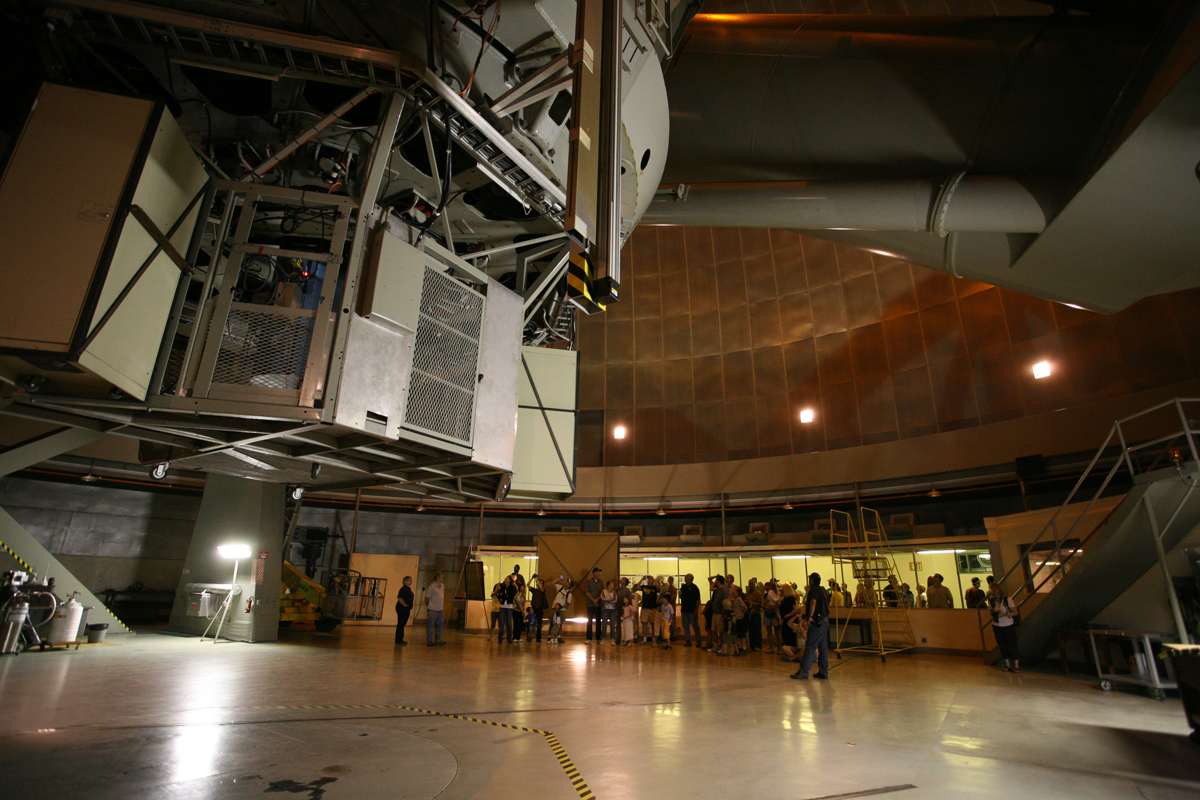
It is almost April. That means that guided tours of the Hale Telescope will soon be here. Weather permitting, they should begin this weekend. Do keep in mind that we are expecting snow on Palomar tonight & Thursday. There is always a chance that the weather could intervene with the tours. I will post an update on the weather & tour status here later in the week.

One thing for sure is that it will likely be in the 30s inside the dome as the interior of the 200-inch dome is kept at nighttime temperatures (for an elevation of 5,500 feet!). Dress accordingly.

These one-hour-long tours are held on Saturdays & Sundays only during the months of April through October. Tour tickets are sold in the gift shop the day of the tour on a first-come, first-served basis. The gift shop opens at 10:00 a.m. No prior reservations are taken.

Tours are offered at 11:30 a.m., 1:00 p.m. & 2:30 p.m. Tickets are $8.00 per person for all ages. The tour is not recommended for children under six years of age. Sorry, no pets.

Tours cover the history and current scientific research of the Palomar Observatory, with a special emphasis on the 200-inch Hale Telescope. High-heeled shoes are not recommended for the tours.

Alas, there is no viewing through the Hale Telescope as a part of the tours. Even the astronomers do not look through the telescope. That isn't the way research is done.

Tuesday, March 30, 2010

What is This?

I took this photo inside the dome of the Hale Telescope earlier today.

What is it? It is the reason why Electronicers have to wear gloves. What is an electronicer? It is the Palomar name for those who work with electronics, specifically electronic instruments that are mounted on our telescopes.


The photos above show a frosty valve that has a temperature cold enough to cause frostbite - hence the need to wear gloves.

If we take a slightly wider view you can see what it connects to:

It controls the feed from a tank of liquid nitrogen. The liquid nitrogen is used to cool instruments, such as the one on the right-hand side of the photo - the Hale Telescope's Wide-field Infrared Camera (WIRC). Unlike digital cameras used at home or in your phone, our cameras need to be cooled. Liquid nitrogen, which boils at a temperature of 321 degrees below zero °F is actually a bit too cold. So inside the camera we heat things a bit to bring the electronics to the optimal temperature for this camera, WIRC.

By the way, WIRC was the instrument used to take the image for last week's Astrophoto Friday image. and it goes back into service at prime focus on Wednesday night.

Monday, March 29, 2010

Palomar History Photo of the Week - March 29, 2010

This week's Palomar Observatory History Photo of the Week was taken in the machine shops at Caltech on October 15, 1935.


It shows three people (I am not sure who they are) with a steel model of the "tube" of the Palomar 200-inch telescope. They are testing the model for its rigidity.

The tube of the 200-inch telescope is what is known as "Serrurier truss". It was known at the time of design that the steel of the telescope would bend and flex as the telescope moved. Mark Serrurier designed the truss to ensure that from any position that the telescope might be pointed the optical elements would remain on axis with each other and there would be no deflections greater than 0.01 inches.

Later, Mark Serrurier would move on to other endeavors and eventually earned a star on the Hollywood Walk of Fame.

Saturday, March 27, 2010

Neugebauer Wins Bruce Gold Medal

Congratulations to Gerry Neugebauer, former director of Palomar Observatory, for winning the 2010 C.W. Bruce Gold Medal from the Astronomical Society of the Pacific.

Dr. Neugebauer joins an exclusive list of the many top astronomers over the last century or so to have won the prize. This list includes many people who also had an association with Palomar Observatory including (but not limited to) George Ellery Hale, Walter S. Adams, Edwin P. Hubble, Walter Baade, Ira S. Bowen, Rudolph Minkowski, Horace W. Babcock, Jesse Greenstein, Allan Sandage, Olin C. Wilson, Maarten Schmidt, and Wallace Sargent.

LIght Pollution Stories & Earth Hour Tonight

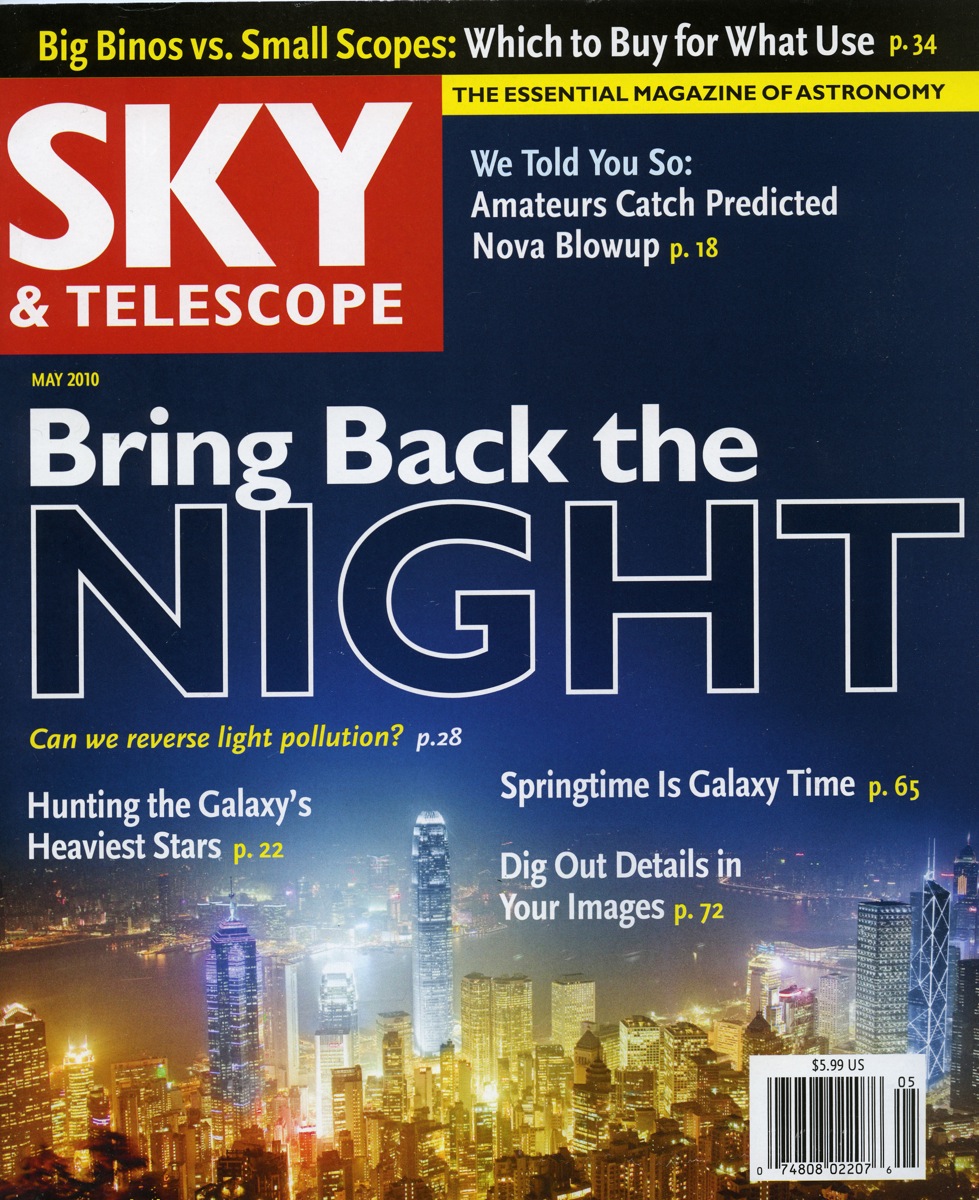
The May issue of Sky & Telescope magazine has hit the mailboxes sporting a cover story on light pollution. Kelly J. Beatty gives an overview of the light pollution problem with some startling facts and possible solutions. Also, look for the opinion piece by Constance Walker where she argues that education is key to solving the problem of light pollution.


In another publication, be sure to check out my article "Dimming the Lights: Astronomy and light pollution" in the current issue of the on-line Glimpse Journal. Alas, a subscription is required to read entire thing.

Finally tonight is Earth Hour. While this is billed as an event to fight global warming, it is a great opportunity to highlight how much unnecessary light at night can be found in our cities and that the world will not devolve into chaos if some or all of it is shut off. Last year there wasn't much of a change from Palomar Mountain. This year's event takes place under a bright moon, but there may actually be larger participation in the event.

Friday, March 26, 2010

Astrophoto Friday: The Flame Nebula


The Flame Nebula, also known as NGC 2024, is a stellar nursery located about 1,500 light years from our solar system. The nebula is a region of star formation that is in the process of forming a star cluster. It is visible through small telescopes. It is located in the constellation of Orion near the star known as Alnitak, the easternmost star of Orion's Belt.

This image was captured by David Thompson then of the California Institute of Technology. He used the Palomar Observatory's 200-inch (5-meter) Hale Telescope with its Wide-field Infrared Camera (WIRC).

Monday, March 22, 2010

Dark Skies Podcast

Just a reminder that the 365 Days of Astronomy podcasts continue. Just last weekend there was a new one released by Constance Walker: Dark Skies Crusader Sheds Light on Light Pollution.

I confess that I have fallen somewhat behind on them, but many of the podcasts are quite good and if you aren't listening to them I recommend giving it a shot.

Continuing on the topic of light pollution, remember that Earth Hour is Saturday, March 27.

Palomar History Photo of the Week: March 22, 2010

This week's Palomar Observatory History Photo of the Week is another picture from the Lee A. Farnsworth collection. It is a construction photo from 1936 showing the lower structure of the building which would eventually house the 200-inch telescope.

This was one of 61 photos from this collection that were scanned last week. There are many fantastic shots still to come.

Friday, March 19, 2010

Astrophoto Friday: An Edge-on Sprial Galaxy


This week's astrophoto is a composite image on an edge-on spiral galaxy known as NGC 891. NGC 891 is located some 10 million light years away in the direction of the constellation Andromeda. It has a large dust lane that is typical of spiral galaxies.

It was obtained using the 200-inch Hale Telescope's Wide-field Infrared Camera at Palomar Observatory by Kevin Bundy formerly of the California Institute of Technology and at the 10-meter W.M. Keck Observatory's Low Resolution Imaging Spectrograph (LRIS) by Patrick Shopbell and Judy Cohen of the California Institute of Technology. Yellow colors in this composite correspond to the near-infrared image which was obtained at Palomar. The blue colors correspond to the visible light image which was obtained at Keck.

This kind of representation is useful because it demonstrates the utility of observing at many wavelengths. Because the central bulge of NGC 891 appears yellow in the composite, it is clear that the infrared does a better job penetrating the dust lane of this galaxy, which almost completely obscures the bulge in the optical image.

The Palomar image is the result of the addition of twenty separate frames taken in the Ks filter at 2.2 microns, this observation required a total exposure time of 15 minutes.

Tuesday, March 16, 2010

Space Art on Exhibit in Borrego Springs

I haven't had the chance to see it in person but there is an exhibit of space art called "dark skies, luminous space" on display in Borrego Springs now through April 4.

More information is at the link above and at the artist's site deepspacepaintings.com.