Monday, May 17, 2010

Palomar History Photo of the Week - May 17, 2010

Once again we have a pair of photos for our Palomar Observatory History Photo of the Week.

Once again they again come from Lee Farnsworth.

The first shot shows a view of the dome for the 200-inch telescope taken while it was under construction. The photo was taken September 29, 1937.


This is a pretty nice, but typical, photograph showing dome construction. Notice the crane inside the dome what was used to lift the huge steel pieces into place.

The companion photo was taken by Mr. Farnsworth just nine days earlier. What is unique about this shot is that it was taken from inside, on the ground floor looking up at the dome structure and sky.


It is one of the very few such shots that I know of. The dark part on the sides is the ground floor ceiling and (from the other side) the observing floor. All of the parts for the telescope, which when these were taken would not arrive for another 13 months, came up through this opening.

Friday, May 14, 2010

Palomar Flies Its Colors

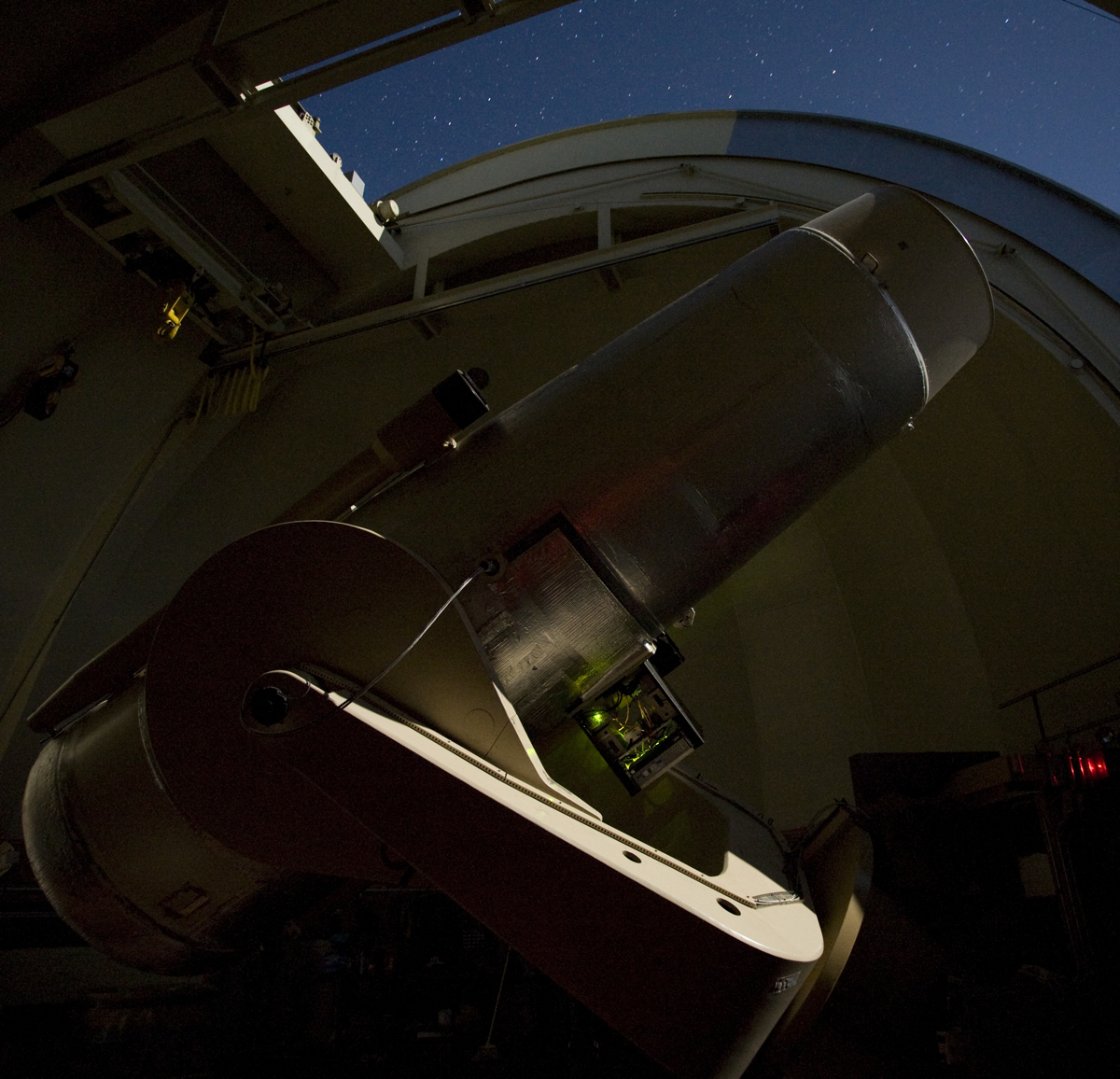
Check out this pic of the dome of the 200-inch Hale Telescope taken yesterday:

The photo was taken with an iPhone by Scott Calman, the observatory's IT guy (I don't know his real title). I am reasonably sure that the photo shows what may be a circumzenithal arc circumhorizon arc. Have we got any atmospheric scientists to lend some more info on this?

Update: Thanks to commenter jg for pointing me to a circumhorizon arc, which seems to be the correct name for this.

Astrophoto Friday: MWC 1080

This week's Astrophoto Friday image is of the young, massive star known as MWC 1080.


The image was taken with the 200-inch Hale Telescope armed with adaptive optics by Stanimir Metchev.

The image reveals fine details of the cluster of young stars that surround MCW 1080 and the nebula that they have formed from.

Tuesday, May 11, 2010

Palomar Transient Factory Hits High Gear

Last Thursday there was an Astronomer's Telegram issued about a new supernova discovered earlier that day by the Palomar Transient Factory team.

How does that happen? Wide-field images of the sky are made with Palomar's 48-inch Samuel Oschin Telescope. A new portion of the sky is photographed approximately every 90 seconds. Data is beamed away via High Performance Wireless and Research and Education Network to the Internet and then on to Lawrence Berkeley National Laboratory and the National Energy Research Scientific Computing Center. Once there computers using an "autonomous inspection code" identify new sources and transmit the findings back to Palomar where the robotic 60-inch telescope gets called upon for follow-up observations. Once confirmation of the object is obtained from the 60-inch telescope (and in this case also from PAIRITEL) the next wave of observers is alerted.

In last week's discovery all of this happened as expected. Ultimately a spectrum was obtained with the 10-meter Keck I telescope which was used to identify the transient. The new object was found to be "a peculiar Type Ia supernova". The really amazing thing is that from discovery to spectrum less than half an hour had elapsed! That is an amazingly short period to time to photograph, identify and garner observations from multiple telescopes.

Since it began last year the Palomar Transient Factory has so far discovered and spectroscopically classified 432 supernovae. There should be plenty more discoveries to come.


The 48-inch Samuel Oschin Telescope, where the Palomar Transient Factory begins.

Monday, May 10, 2010

Palomar History Photo of the Week - May 10, 2010

Sixty two years ago today it was announced that the 200-inch telescope atop Palomar Mountain would be named the Hale Telescope.

In honor of that, our History Photo of the Week is made up of photos of the visitor's entrance to the dome of the Hale Telescope. The foyer has this tribute to George Ellery Hale:


What else is there to say?

Friday, May 7, 2010

Astrophoto Friday: M16 the Eagle Nebula

Today's entry for Astrophoto Friday is Messier 16, the Eagle Nebula.

The photo was taken in 1965 with the 200-inch Hale Telescope. M16 is an emission nebula and associated open star cluster located about 7,000 light years distant in the direction of the constellation of Serpens.

Thursday, May 6, 2010

I Can See for Miles and Miles . . . .

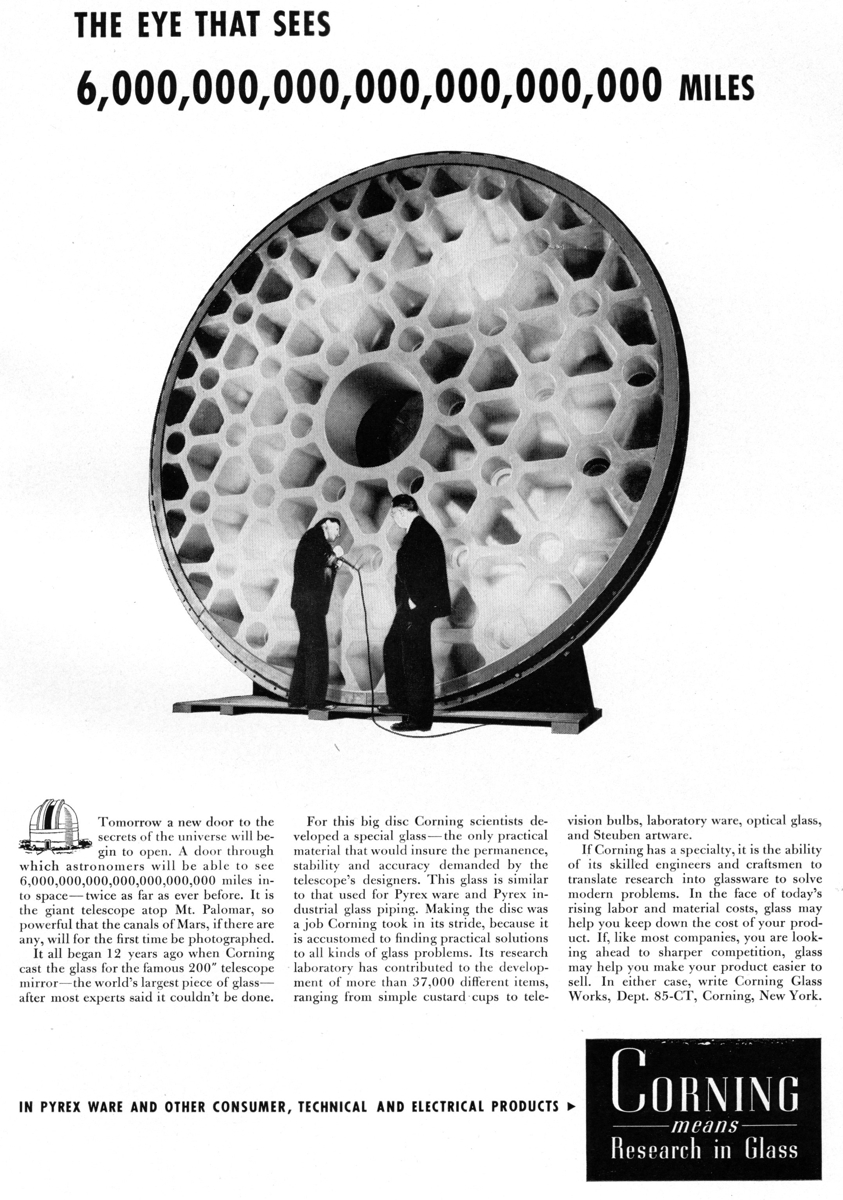
Here is another ad that features Palomar Observatory. This one, from Corning, was run in the 1948 Caltech yearbook, The Big T.

Click to embiggen and you'll be able to read the text of the ad. The photo shows the honeycombed back side of the 200-inch disc. Standing with it is Dr. George V. McCauley (left) and Dr. J. C. Hostetter. Dr. McCauley directed the project of the casting the huge Pyrex disc.

The ad includes some interesting copy with lines like "the giant telescope atop Mt. Palomar, so powerful that the canals of Mars, if there are any, will for the first time be photographed."

Of course in 1948 just about every astronomer was already convinced that the "canals of Mars" were nothing more than an optical illusion. Curiously enough the Chief of Aviation and Optical Division of the Corning Glass Works, Dr. O. A. Gage gave a radio address in April 1936 (about twelve years before this ad came out) on the 200-inch mirror. In the address he said that there will be "no inroads on the inhabitants of Mars" - meaning no one was going to see any canals. Too bad the person who wrote the ad didn't check with Dr. Gage. His speech was printed in the Journal of the Royal Astronomical Society of Canada and contains some interesting stuff. You can see it here.

Oh, and 6,000,000,000,000,000,000,000 miles is a little over a billion light years. With modern digital detectors astronomers using the 200-inch telescope can see at least eleven times further than that.

Wednesday, May 5, 2010

New Kica Mic Overlook on Palomar

The Cleveland National Forest has installed a new overlook near the top of Palomar Mountain's East Grade Road.

The National Forest Service has added interpretive signs that provide interesting information on the view and the great attractions in the area.

The greatest attraction in the area, aside from nature itself, is none other than Palomar Observatory.

It was wet out when I stopped, so my photos don't do justice to the displays. Some of the astrophotos used in the display were processed by Davide De Martin of SkyFactory.org. He processed black and white pictures, taken with different color filters, from the Second Palomar Observatory Sky Survey and turned them into wonderful color images. Be sure to check out his site for a close look at his fine work.

The Kica Mic Overlook offers a majestic vista of the lands south of Palomar Mountain. I didn't pick the best day to stop and visit. The cloud layer was about 100 feet above Palomar, but the view below was still quite impressive.

The next time you are driving on East Grade Road (aka S-7) be sure to stop and check out the view here and at the Henshaw Overlook a little further down the road (especially while it is still nice and green below).

Tuesday, May 4, 2010

Palomar Observatory on TV this week

Look for Caltech's Mike Brown and Palomar Observatory to be featured in this Thursday's episode of Known Universe on the National Geographic Channel. Check your local listings.

Check out the preview embedded below (and please accept our apologies for the commercial that runs first).


Filming at the Hale Telescope was done last summer. In the episode Mike Brown talks about dwarf planet Eris, a member of Kuiper Belt, discovered by him with images taken with Palomar's 48-inch Samuel Oschin Telescope.

Monday, May 3, 2010

Palomar History Photo of the Week - May 3, 2010

At first glance this week's Palomar Observatory History Photo of the Week might seem like an ordinary vintage shot of the 200-inch telescope and dome. What makes this photo really stand out for me is the person standing in the opening of the dome. Click on the image to embiggen and you'll be able to see him better.


I am not sure who the person is, but this fine photo was taken by O.K. Harter in August of 1941. At the time of this picture the dome was completed and just about all of the work on the telescope was as well. The 200-inch mirror was in the optical shop at Caltech and the concrete dummy mirror was installed on the telescope where the mirror would eventually be.