Wednesday, April 2, 2008

Touring the Big Eye

Two years ago yesterday marked the anniversary of the beginning our first program of Saturday tours for the general public. Now that it is April again it is time for the new season of tours to begin.

The tours are available every Saturday (and only on Saturdays) from April through October (except the occasional time when observatory operations may get in the way) at 11:30 a.m. & 1:30 p.m. Tickets are on sale in the Observatory Gift Shop on the day of the tour and are sold on a first-come, first-served basis. The tickets only cost $5 for adult (less for seniors and kids) and in my biased opinion are a fantastic deal.

The tour is a guided hour (often more) that leads up from the visitor center, into the dome for the 200-inch telescope, on to the observing floor and (weather permitting) out onto the outside catwalk. 2 or more docents lead the tour and explain the epic story of how the big telescope was built, how it is used now and what other kinds research is taking place at Palomar.

Visitor response has been overwhelmingly positive with rave reviews and almost all tours selling out. If you get the chance, come join us on a tour.

Saturday, March 29, 2008

Pushing the limit

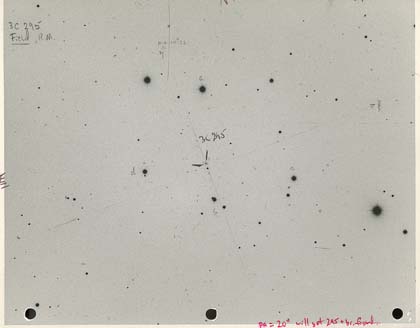
Rudolph Minkowski, after a long and distinguished career in astronomy, had his last night of observing on Palomar's 200-inch Hale Telescope on March 29, 1960. It proved to be a good night as he measured the distance to the central galaxy in a cluster of galaxies known as 3C295.

With a redshift of 0.46, 3C295 held the record as the most distant known galaxy cluster until 1975. How far away is it? About 4.8 billion light years.

Modern electronic detectors are much more sensitive to light than the old photographic plates used by Minkowski and others and as such galaxies of vastly greater distances are now known making Minkowski's find seem almost close.

Friday, March 28, 2008

Lights Out!

Be sure to participate in Earth Hour Saturday, March 29. From 8:00 to 9:00 p.m everyone is being asked to turn out their lights for the hour. Why? Turning off unneeded lights will save energy and make a statement towards fighting global warming. Turning off outdoor lights will also give everyone (including those that work at observatories) the opportunity to have a darker sky from which to enjoy (or study) the stars.


March 29th also kicks off National Dark-Sky Week which runs until April 4. This is a great time to see the nighttime sky and learn what can be done to preserve it. Visit the website of the International Dark-Sky Association, THE source on nighttime lighting, to learn about what can be done each and every week of the year.

Catching Up

Here are a number of Palomar anniversaries that I let slip past me while I was on vacation last week.

March 22, 1955 — Discovery of comet 52P/Harrington-Abell by Robert G. Harrington and George O. Abell on a plate taken during the National Geographic Society-Palomar Observatory Sky Survey.


March 22, 1972 – First light for the Palomar 60-inch telescope located in the Oscar Mayer Building. Thirty six years later the 60-inch is a major workhorse telescope. Its main task now is in rapid-response observations for gamma-ray bursts and other transient phenomena.

March 23, 1993 – Discovery of Comet Shoemaker-Levy 9 at Palomar’s 18-inch Schmidt telescope by Eugene M. Shoemaker, Carolyn S. Shoemaker and David H. Levy. More on this when we "hit" the July anniversary of its impacts with Jupiter.

March 24, 1893 – Walter Baade’s birthday. I'll post some info on Baade later, but in the meantime check out the link or, better yet, read Walter Baade A Life in Astrophysics by Donald E. Osterbrock.

Wednesday, March 26, 2008

Trainspotting


Two years and one day after the first (failed) mirror was cast (see yesterday's post) the second (successful) disc began its trip from Corning, New York to Caltech in Pasadena, California on March 26, 1936.

The 20-ton piece of glass traveled 3,000 miles by rail at the breakneck speed of 25 miles per hour. It seemed like all of America came out to watch the event as thousands of people went down to the train tracks, all across the nation, to watch the train roll past. The route was carefully chosen to ensure that all bridges could handle the load and the the crate would safely pass under all of the overpasses along the way.

The train did not travel at night, making layovers in Buffalo, NY; Cleveland, OH; Bellafontaine, OH; Indianapolis, IN; Matoon, IL; St. Louis, MO; Brookfield, MO; Kansas City, MO; Wellington, KS; Canadian, TX; Clovis, NM; Belen, NM; Winslow, AZ; Needles, CA; San Bernardino, CA. It took 16 days to travel from Corning to Pasadena.

With the delays caused by World War II, the mirror remained at Caltech for 11 1/2 years as it was carefully crafted into the proper shape .

A few years ago I had the honor to meet a retired gentleman who was an elementary school student in Kansas when the mirror made its historic trip. He told me how his entire school was brought down to the railroad tracks to watch the mirror and the train go past. It is always a pleasure to meet people who have had a personal connection to part of the Palomar story.

Tuesday, March 25, 2008

Casting the Giant Mirror - Part I

I have been on vacation and have missed a few important Palomar dates that I would like to commemorate. I'll have to put them off for a while because today's anniversary is a big one.

Seventy four years ago today (March 25, 1934) the dedicated crew at Corning Glass Works made their first attempt at casting the 200-inch mirror.

Creating the 200-inch mirror was a monumental task.

Initially General Electric was hired to fabricate a 200-inch disc made out of quartz. Nearly a million dollars later, that idea was abandoned. George Ellery Hale approached the Corning Glass Works of New York with a proposal to instead cast the 200-inch mirror out of a special blend of glass called Pyrex. Changes in temperature make Pyrex expand and contract much less than ordinary glass, so a Pyrex mirror would be much less prone to the focus and distortion problems that plagued other glass mirrors.

The top side of a mirror has to be perfectly shaped, while the back is used for support. The back side of the 200-inch disc is honeycombed. The triangular pieces are hollow areas to make the mirror weigh less, while the round area are places where the mirror is supported from below to help the topside to maintain its critical shape. Making the honeycomb undersurface provided some challenges.

A mold was built inside of an oven (think bottom of a waffle iron) to give the mirror’s underside its special shape. The hollow spots were created by bricks that were held down by steel bolts.

After
taking nearly a month to melt enough glass, on March 25, 1934 the molten glass was ladled into the mold. Alas, the glass was hot enough to melt the steel bolts and the bricks floated to the surface and ruined the mirror. This first disc is on display at the Corning Museum of Glass in New York. The successful second casting was performed in December 1934.

The Corning Museum of Glass website has a great article on the making of the mirror called The Glass Giant.

I have seen many wonderful photographs of March & December, 1934 castings. Thankfully it was also captured in two paintings by artist Christian Jacob Walter. Shown above is "Pouring Glass". The other painting is called "Ladling Glass." The paintings are on display at the Earth and Mineral Sciences Museum at Penn State University.

Later this year I hope to make the trek to visit Corning and to see the first disc. It is a part of the Palomar heritage that I need to visit.

Monday, March 17, 2008

Five Years and Counting

As of today I have been at Caltech's Palomar Observatory for five years. It continues to be a pleasure and an honor to work at this fine institution with its remarkable, dedicated staff. The observatory has a distinguished history and a promising future of exploration and I am happy to be able to help bring the Palomar story to many people.

Helping me to bring Palomar to the people are a great group of volunteers, the Palomar Observatory Docents (or PODs as I call them). Many of our active docents are shown in this recent group photo.


The PODs are a dedicated and wonderful group of people who have become part of the Palomar family by helping in our public outreach program in a variety of ways, including giving tours of the Hale Telescope.

We are always looking for more people who might be interested in helping out, especially as we are about to enter into our new tour season with docent-led tours of the 200-inch Hale Telescope given twice daily on Saturdays (11:30 am & 1:30 pm) from April through October.

Potential docents don't need to be an astronomer or a Palomar expert to apply. A willingness to learn and an interest in speaking to people is all that is needed. More information can be found here.

Honoring a Planetary Geologist


Eight years ago yesterday NASA's Near-Earth Asteroid Rendezvous (NEAR) spacecraft was re-
named NEAR Shoemaker to honor the late Dr. Eugene M. Shoemaker. Gene Shoemaker was legendary and inspirational planetary geologist who had a remarkable career. He was instrumental in organizing and performing many comet and asteroid surveys in the past century. He was perhaps most famous for finding, along with Carolyn Shoemaker and David Levy, Comet Shoemaker-Levy 9 with the Palomar 18-inch Schmidt in March 1993. The comet had broken up with a previous close encounter with Jupiter and collided with it in spectacular fashion in July 1994.

After a year in orbit about the asteroid Eros NEAR Shoemaker became the first spacecraft to perform a landing on an asteroid. Here is a sequence of images taken during one orbit about Eros:


Sunday, March 16, 2008

Movin' On Up

Today's San Diego Union Tribune newspaper has an article, with some eyewitness reports, on moving the 200-inch mirror back in 1947. It is worth a look.

Saturday, March 15, 2008

Talk is tonight

Just a reminder, Nick Law will be talking about adaptive optics and LuckyCam (See Get Lucky below) 7 pm tonight downstairs at OPT, located at 918 Mission Avenue in Oceanside, CA.

As long as I don't get stuck in the snow on Palomar I hope to see you there!