Friday, January 16, 2009

Friends in High Places

I have always heard that it is good to have friends in high places. I don't suppose this is what is meant by that though.

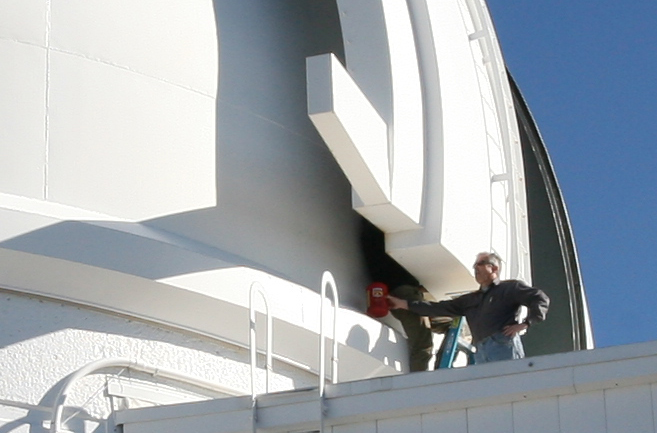
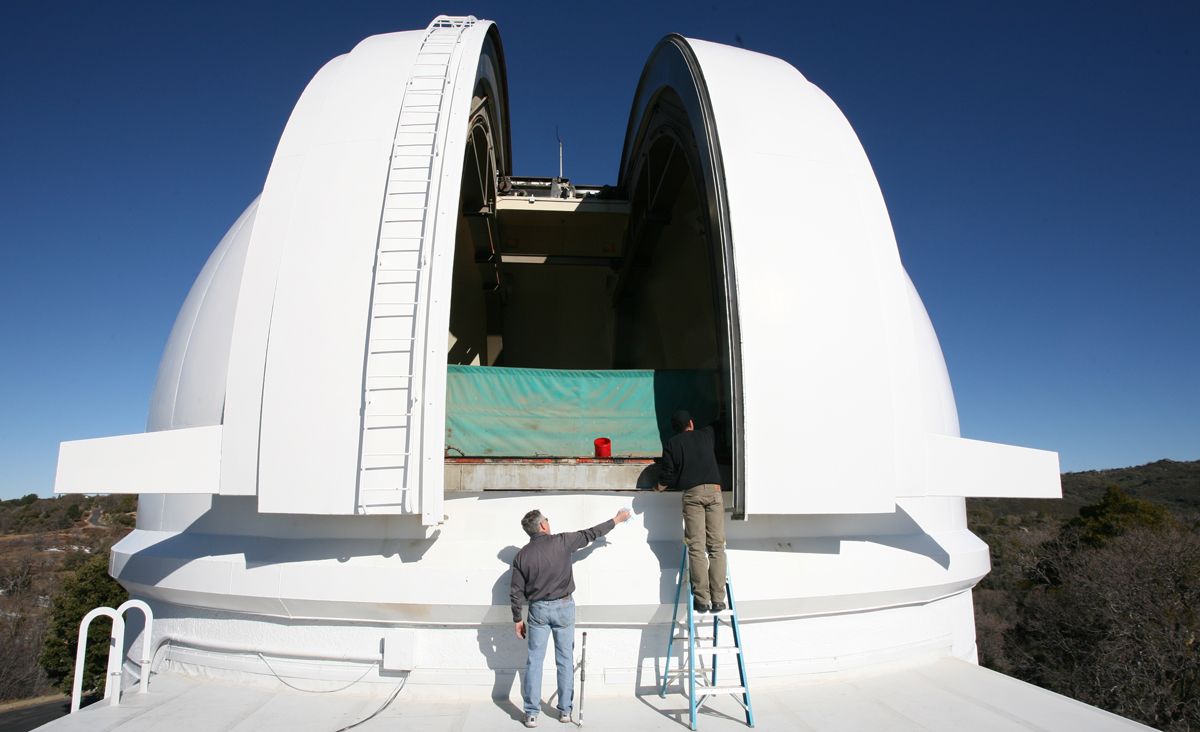
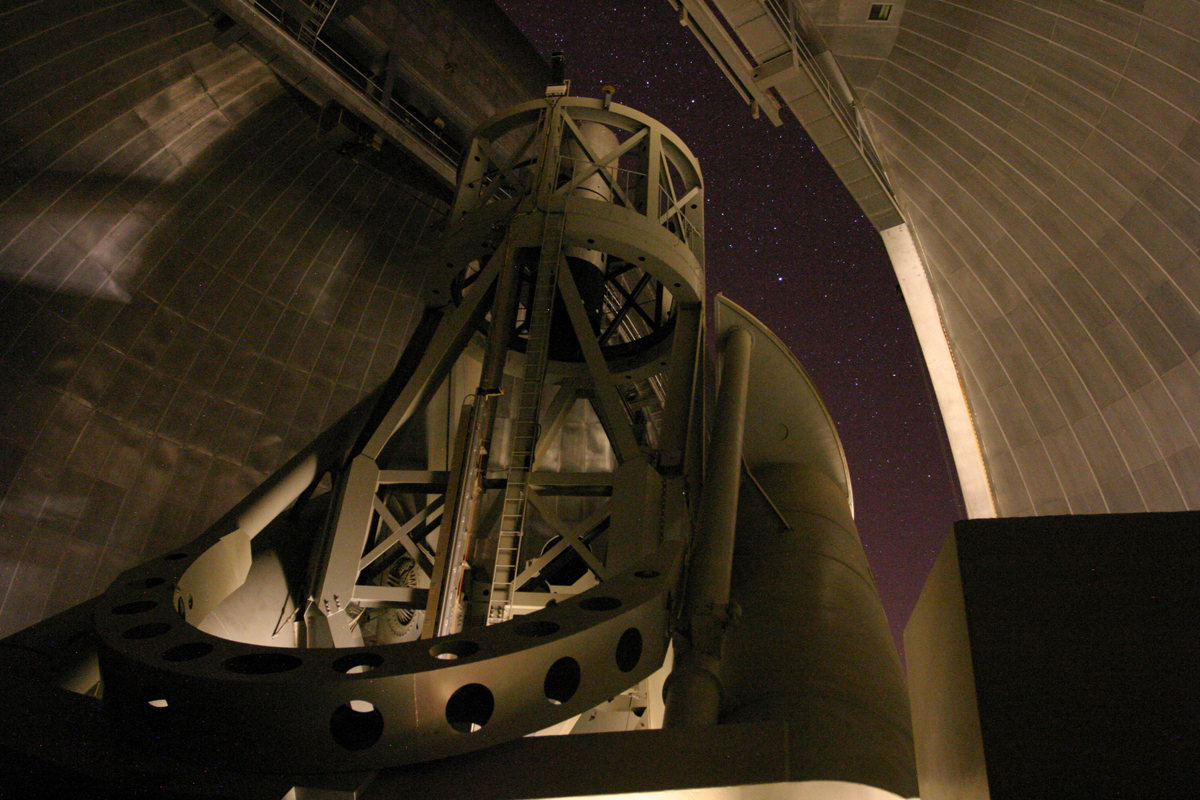
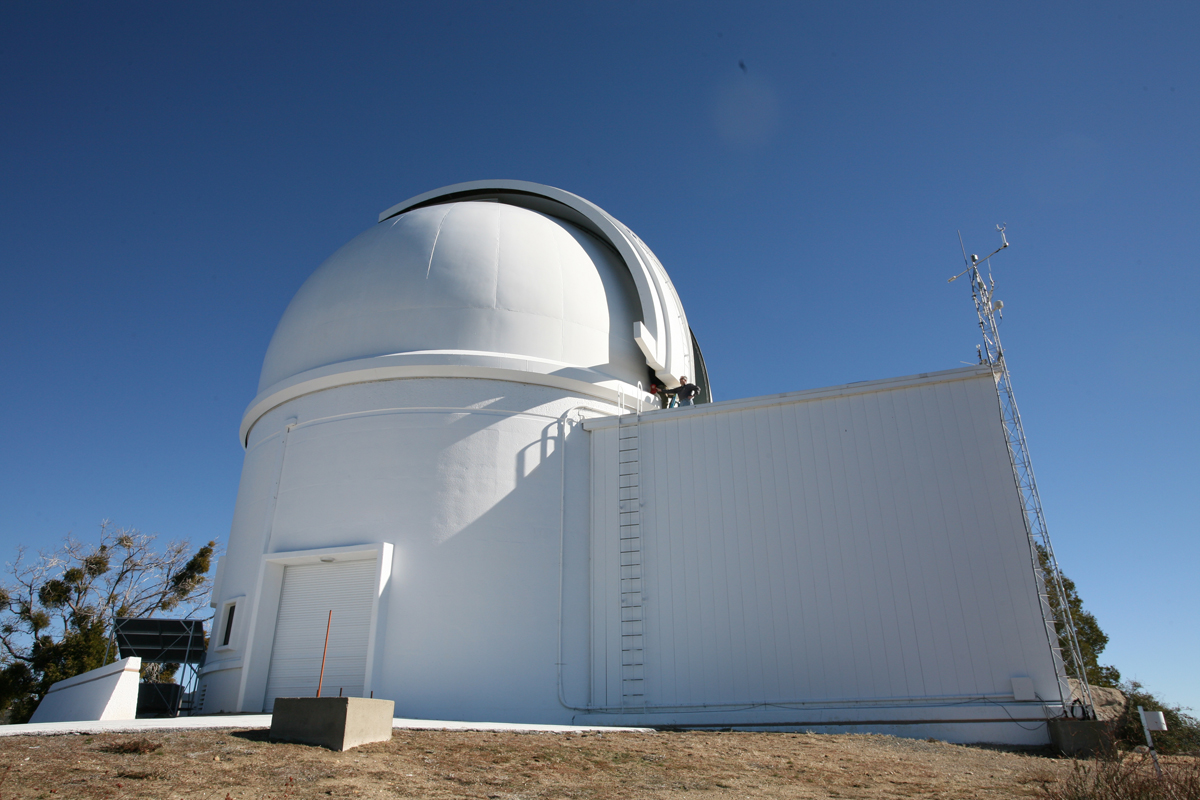
Here's two members of the Palomar Observatory Mountain Operations day crew (Bruce and Drew) working on the dome shutters for the 60-inch telescope. As you look at the photo above you may have a hard time seeing them. Take a look at the cropped version below. Can you see both of them?

It was time to once again inspect, scrape and grease the rails that the dome shutters ride on. Its a dirty job, but somebody's gotta do it.

Thursday, January 15, 2009

5 Minute Travels Visits Palomar Observatory

Anything Goes Productions has a series of cool 5-minute travel features. They recently visited Palomar Observatory. Have a look:

Another night comes to an end

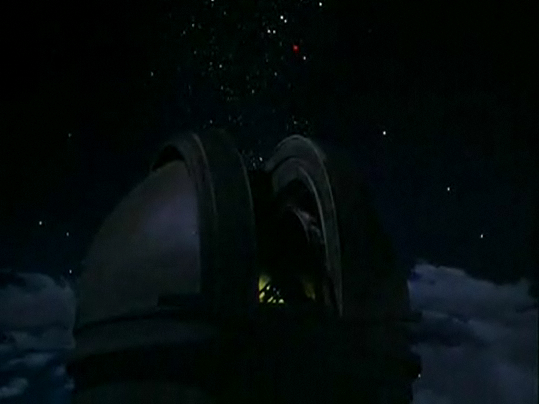
Here's a really short time-lapse of images captured every 3 minutes by the Hale Telescope webcam from the end of last night. Observing continued to just past sunrise.


A higher resolution Quicktime version is here.

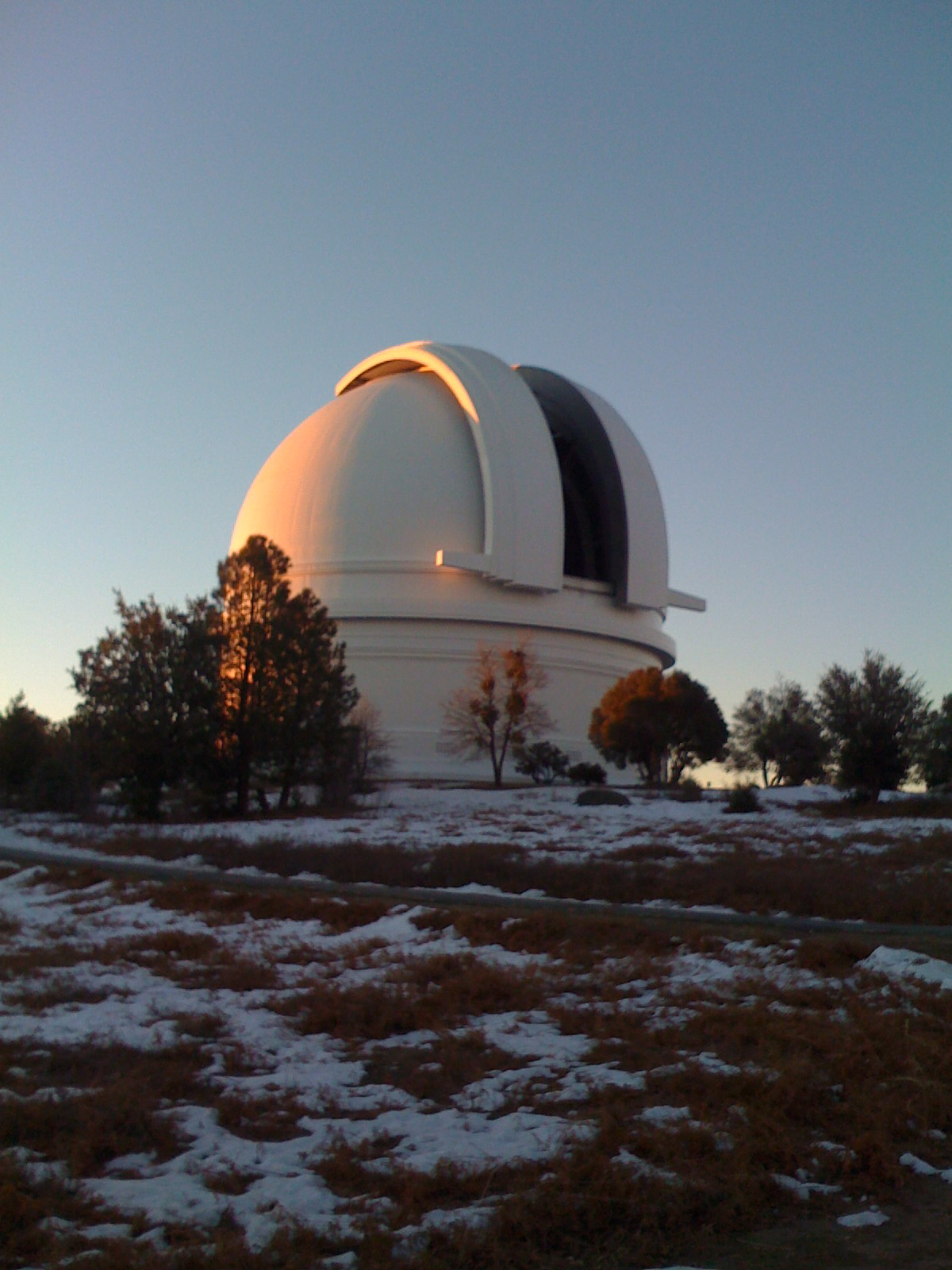
I came in to work before they closed up and was greeted to this view:

A beautiful morning. Too bad I didn't have my "real" camera with me. This shot was captured with my phone.

Monday, January 12, 2009

365 Days of Astronomy Podcasts

Time keeps on slipping into the future and I forgot to mention that Palomar Observatory is a sponsor for the International Year of Astronomy's 365 Days of Astronomy podcasts. Our first sponsored episode was the January 7th episode which happens to feature some folks from the American Association of Variable Star Observers talking about variable stars. We'll be sponsoring more episodes during the year and you'll get the chance to hear me on January 26th and throughout the year as well.

Saturday, January 10, 2009

Palomar in Science Fiction - IV

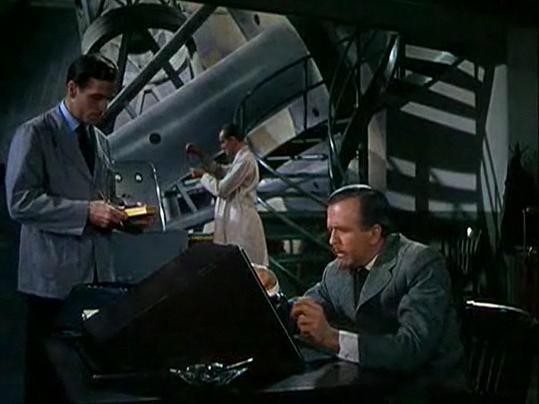
The 1951 sci-fi disaster movie When Worlds Collide offers up the end of the Earth. In it a star with a planet of its own hurls into the solar system bringing our planet to its doom.

In the film the discovery is made at the Mt. Kenna Observatory in South Africa. Have a look at the Mt. Kenna Observatory. Does it look familiar to you?


Clearly both of the matt paintings were based on the 200-inch Hale Telescope at Palomar.

Here's a short clip for you:


The movie is available on DVD. If you watch you'll also see a background painting showing the 100-inch Hooker Telescope on Mt. Wilson.

Friday, January 9, 2009

Palomar Skies on Wordle


Here's the last several postings from Palomar Skies reduced to a graphic from Wordle. I haven't yet decided if this is a useful application or not but it does look cool.

Talks in January

Next Friday at 1:00 p.m. I'll be giving a talk at Mira Costa College as a part of their LIFE program. If you've been reading here you know that this is the International Year of Astronomy and my talk will help to celebrate that. In the talk I'll review some of the discoveries of Galileo and then move on to the reflecting telescope, the development of Palomar Observatory, the research we do at Palomar and the large telescopes of the future that are coming. Finally, I'll point out some of the many ways that people can participate in the International Year of Astronomy.

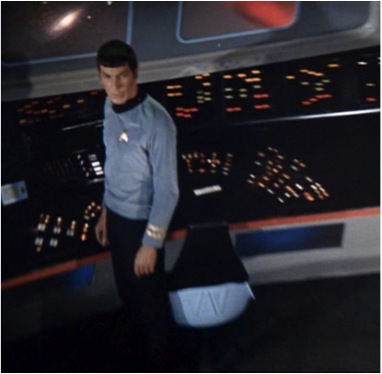
I'll even explain what what all of this has to do with Mr. Spock.

The talk is free and open to the public. More information is available by calling (760) 721-8124. The program has lots of talks on a wide-range of subjects. Click here for their full calendar of events.

On the 24th I'll be giving a talk for the Friends of Palomar Observatory on the history of building the 200-inch Hale Telescope. I will also cover some of the fantastic research Sorry, but this one is for members only.

Wednesday, January 7, 2009

What Are You Lookin' At?

People often ask me “Who gets to use the telescope?” and “What do they look at all night?”

The Hale Telescope is owned and operated by Caltech. Once upon a time 100% of the observing time belonged to Caltech. More recently Caltech has entered into partnerships with other institutions to divide up the observing time. Caltech now splits its observing time on the 200-inch telescope with astronomers from the Jet Propulsion Laboratory, Cornell University, American Museum of Natural History and Oxford University.


The astronomers come to Palomar but they do not look through the telescope at all. Instead complex instruments measure and record the visible or near-infrared light. The astronomers save the data and take it back to their home institutions to analyze. Eventually they publish their results for other astronomers to review and argue about.

A couple of weeks ago the Hale Telescope’s observing schedule for February – July, 2009 was published. Here’s a list that I put together of the kinds of things that our astronomers will be observing in the next six months.

In our solar system: Near-Earth asteroids, objects in the Kuiper Belt, comets, Centaurs

Other solar systems: Exoplanets (several search programs and studies of known exoplanets)

Stars and Almost Stars: brown dwarfs (including L dwarfs and Y dwarfs), M dwarf stars, binary stars, Wolf-Rayet stars, open star clusters, globular star clusters

Stellar birth, death and the some of what gets left behind: Circumstellar disks, star formation, giant molecular clouds, Pre-Planetary Nebulae, cataclysmic variable stars, X-ray binaries, hypervelocity stars, transients, Type Ia supernovae, supernova remnants, neutron stars, ultraluminous supernovae, gamma-ray bursts, possible sources of gravitational waves.

Galaxies and beyond: galaxy formation, galaxy evolution, dwarf galaxies, Luminous Infrared Galaxies, galaxies with active galactic nuclei, Seyfert Galaxies, high-redshift dust obscured galaxies, radio jets, quasars, the intergalactic medium, the re-ionization era, gravitational lensing, dark matter.

It is possible that I may have missed a thing or two, but as you can see we are studying objects in our own back yard (near-Earth asteroids) to the farthest reaches of the observable universe (quasars, the re-ionization era) and a lot of stuff in between.

The astronomers making these observations are coming to Palomar to use the Hale Telescope and its instrumentation, but they will also be using a wide range of other instrumentation and other telescopes including data from the Palomar Transient Factory, W.M. Keck Observatory, the ultraviolet Galaxy Evolution Explorer (Galex), the infrared Spitzer Space Telescope, Hubble Space Telescope, Chandra X-ray Observatory, Westerbork Synthesis Radio Telescope, Two Micron All-Sky Survey (2MASS), Owens Valley Radio Observatory, Catalina Sky Survey, Fermi Gamma-ray Telescope, and others.

We have one new instrument coming to the Hale this semester. In May, we will be commissioning the Cosmic Web Imager. You'll be hearing more about CWI later in the year.
Tuesday, January 6, 2009

IYA Kickoff

The International Year of Astronomy kicks off here in the US tonight at the winter meeting of the American Astronomical Society (AAS) in Long Beach, California. The opening ceremony will take place at the Long Beach Convention Center on Tuesday, January 6, in Exhibit Hall B, starting at 7:45 p.m. PST. The public is encouraged to attend. Can't make it to Long Beach? No problem because the ceremony will be broadcast live on the World Wide Web here.


The ceremony will feature a virtual "ribbon cutting" of the IYA2009 presence in the online community Second Life. This action will be initiated using light from the Pleiades star cluster sent over the Web from the Cincinnati Observatory, via the world's oldest telescope still in nightly use by the general public. Light from this famous star cluster (also known as the "Seven Sisters") takes approximately 400 years to reach Earth.

Therefore, the photons of light to be viewed tonight were emitted around the time Galileo first looked through his telescope. How cool is that? Back then Galileo was the first person to see—among other things—mountains and craters on the Moon, the four biggest moons of Jupiter, the phases of Venus and countless faint stars in the Pleiades invisible to the unaided eye. One of the goals of the IYA is to get as many people as possible to look through a telescope. More on that in a later post.

The ceremony will conclude with the world premiere of a new high-definition PBS television documentary by Interstellar Studios, 400 Years of the Telescope, A Journey of Science, Technology and Thought, which was filmed at dozens of the world's greatest observatories. I haven't seen the film yet, but they did film at Palomar. Twice. According to their website the film will be shown on PBS on Friday April 10th (10 PM PT/ET, 9 PM CT/MT).

There is lots more going on and it will be all year long. Much more information on IYA2009 can be found at www.astronomy2009.us and www.astronomy2009.org.

Friday, January 2, 2009

Fritz Zwicky: The Father of Dark Matter

Longtime readers of Palomar Skies may remember my birthday tribute to Zwicky last February and his daughter's tribute as well.

There can be no doubt that Zwicky was a giant in astronomy and astrophysics. For a look at the career of Fritz Zwicky I highly recommend the article Idea Man by Stephen M. Maurer.
.
R