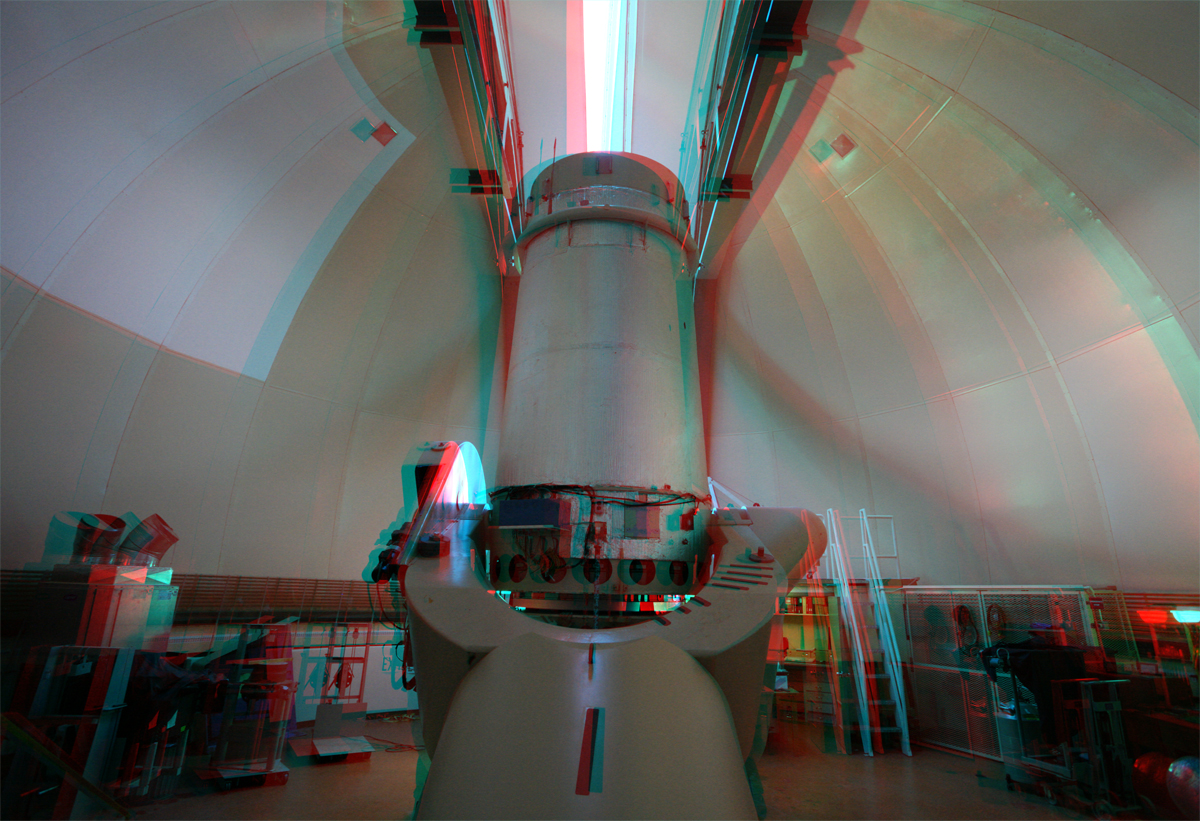
 If you have got a pair of those red-blue 3D glasses lying around you might enjoy this anaglyph image of the Palomar 60-inch telescope.
Wednesday, August 27, 2008
60-inch Telescope in 3D
If you have got a pair of those red-blue 3D glasses lying around you might enjoy this anaglyph image of the Palomar 60-inch telescope.


Tuesday, August 26, 2008
60-inch Aluminizing - the Conclusion
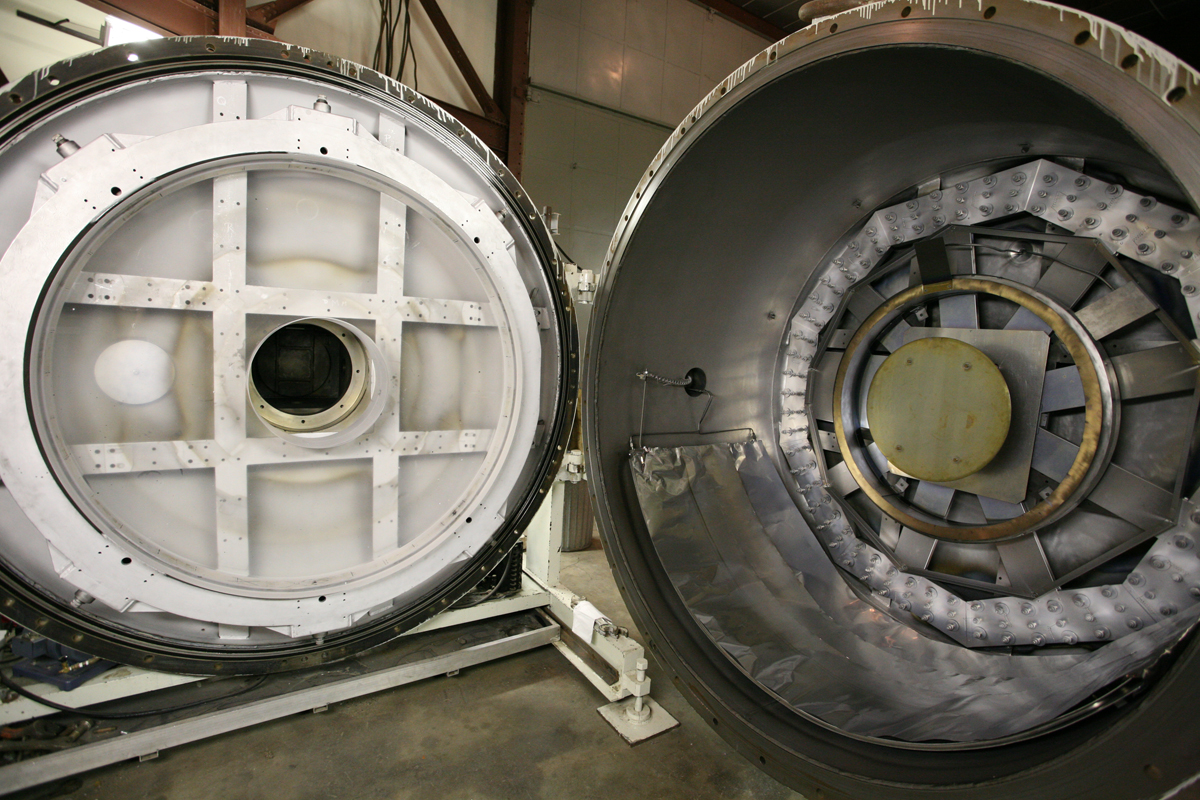 When I left off last week I had described the process of how we took Palomar's 60-inch mirror out of its telescope, transported it from its dome to the 200", cleaned it & stripped off the aluminum coating. Finally, when everything was clean and dry it was loaded into the aluminizing tank as shown above.
The tank is then sealed and vacuum pumps are engaged to pump the air out.
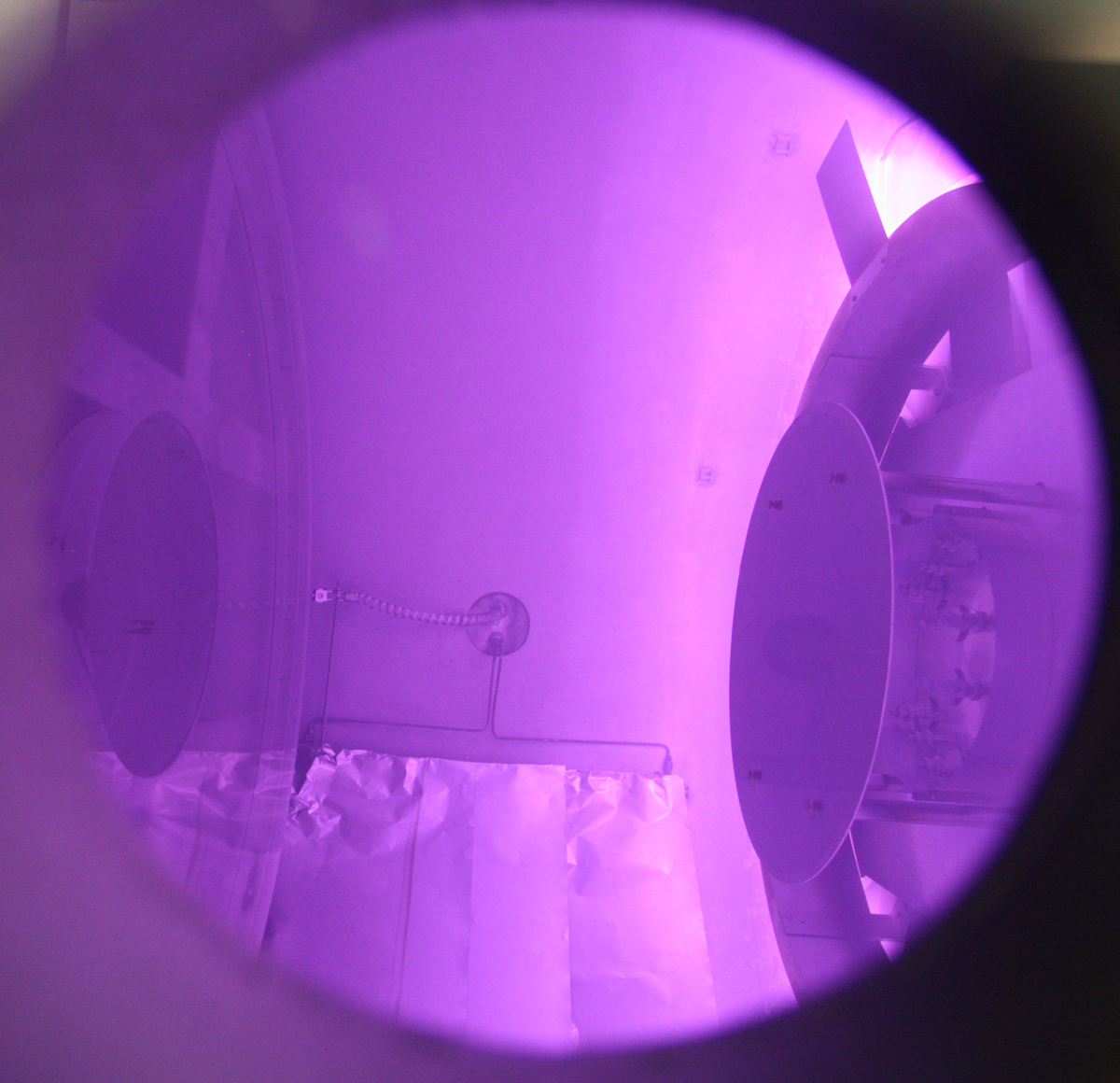
 When the tank approaches a pressure of 10x-6 torr a process known as glow discharge is applied. Essentially a plasma (ionized gas) is created inside the tank.
In Procedures in Applied Optics John Strong (1988), the guy who invented the process of vacuum deposition of aluminum onto telescope mirrors, describes the glow discharge as an "old but still useful method" that essentially further cleans the mirror surface of any organic residues "which may also positively influence the film structure" (i.e. the aluminum coating).
Here is the view looking into the aluminizing tank during one of the three glow discharges. The mirror is on the left, the plasma is produced at the bright spot in the upper right.
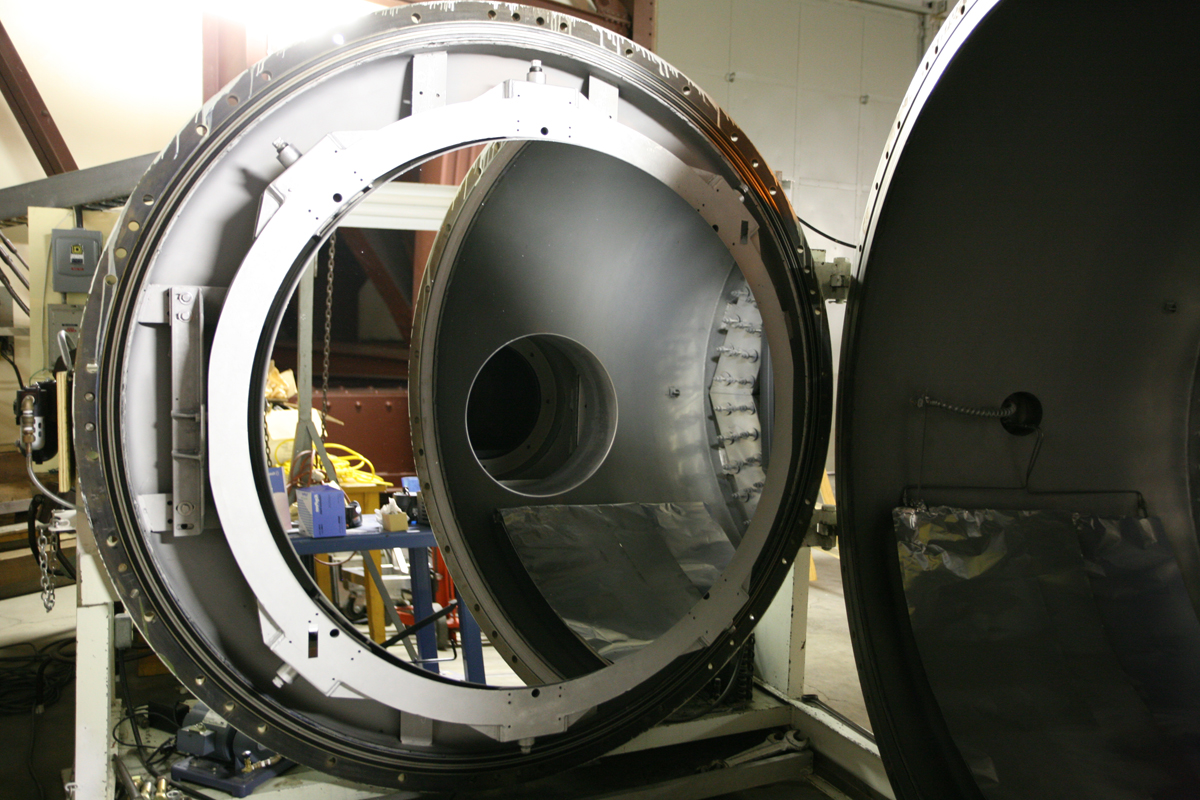
 The tank is pumped further and when finally ready it is time to apply the aluminum coating. The inside of the tank contains tungsten wire coils that have had aluminum melted onto them. I didn't manage to get a shot (I got stuck on the phone) but one of the staff throws the "Frankenstein" switches seen in front the chamber to send electricity into the coils. This then vaporizes the aluminum. This newly formed aluminum gas spreads outwards and applies a thin coating of aluminum to everything inside the chamber, including the 60-inch mirror.
When the process is concluded you (hopefully) end up with a mirror looking like this:
 The next step is to evaluate the coating and, if things are good, to return it to the telescope.
 As you can see the process produces a remarkable improvement on the reflectivity of the mirror.
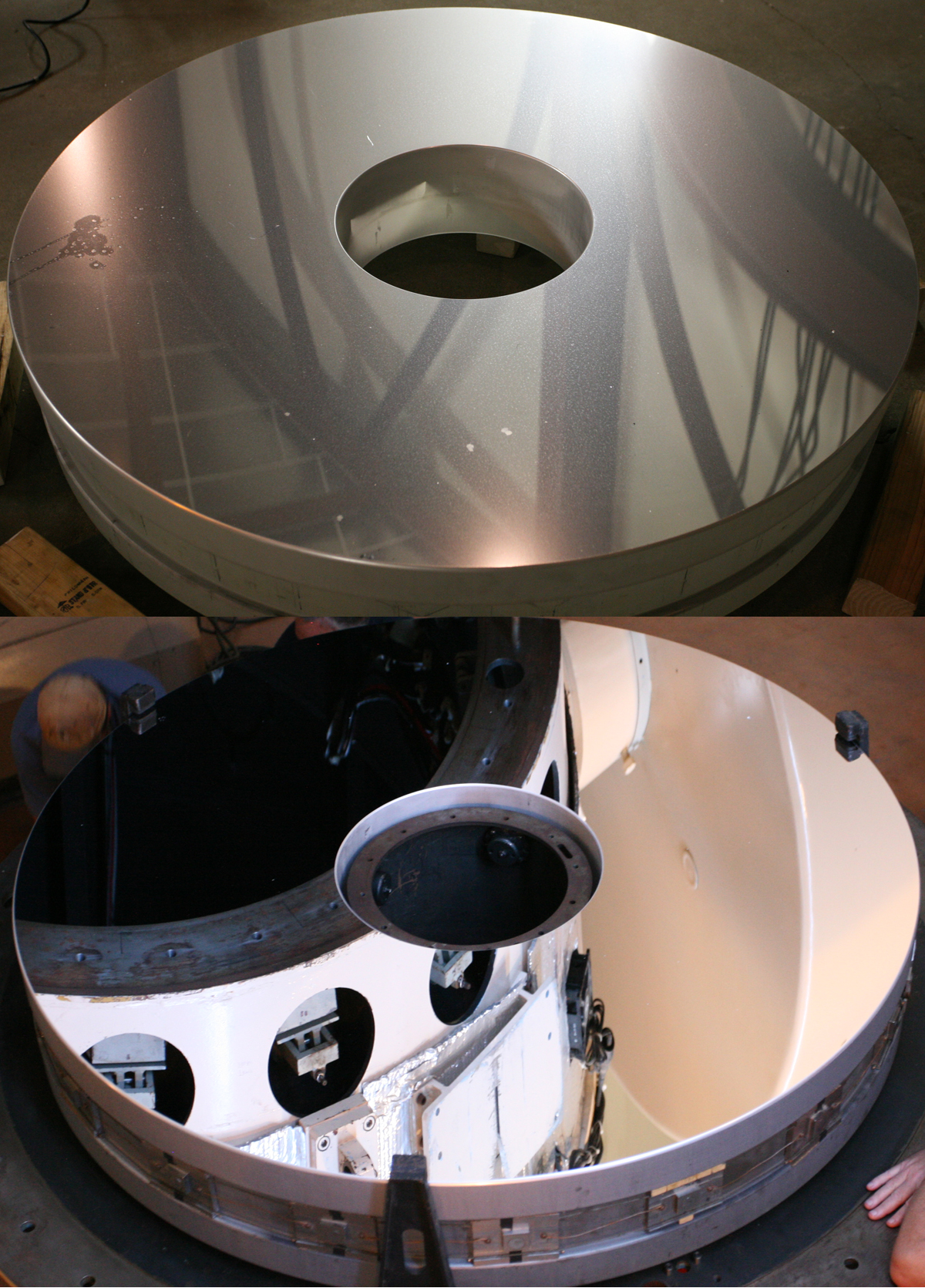 Hats off to the Palomar crew for another fine job!
Saturday, August 23, 2008
Two Up Coming Events on Palomar
On Saturday, August 30th the Palomar Mountain Volunteer Fire Department (PMVFD) will hold it annual fundraising barbecue. Several members of the observatory staff volunteer their time to help protect the Palomar community. The PMVFD and other fire agencies helped protect the observatory from the large fires that hit Palomar last fall (see photo below).
 Click on the image below to learn more about the event. You can help support the PMVFD even if you can't make it to Palomar Mountain to attend the event. This is their one and only fundraising event for the year. You can help keep the PMVFD thriving.
 August 30th is also the 60th anniversary of the first day of issue of the Palomar Observatory U.S. postage stamp.
 To help commemorate the anniversary of the stamp the Palomar Mountain Station Post Office will be using a special postmark that day. I'll there with the current postmaster and a former Palomar postmaster who was here back when the 200-inch mirror arrived. The event will be from noon - 1:00 pm. For more information contact the Palomar Mountain Post Office at 760 742-3044.
 Click on the image below to learn more about the event. You can help support the PMVFD even if you can't make it to Palomar Mountain to attend the event. This is their one and only fundraising event for the year. You can help keep the PMVFD thriving.
 August 30th is also the 60th anniversary of the first day of issue of the Palomar Observatory U.S. postage stamp.
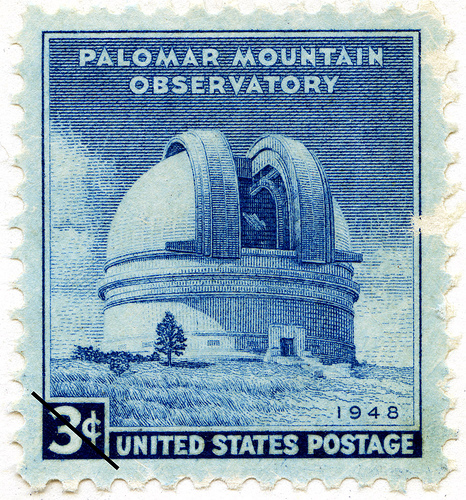 To help commemorate the anniversary of the stamp the Palomar Mountain Station Post Office will be using a special postmark that day. I'll there with the current postmaster and a former Palomar postmaster who was here back when the 200-inch mirror arrived. The event will be from noon - 1:00 pm. For more information contact the Palomar Mountain Post Office at 760 742-3044.
Keep on Truckin'
 Back in early July I posted this photo and promised to explain the story behind it. Sorry for not getting around to it until now.
If you make a visit to the observatory you'll likely notice that our picnic area is named for former employee Gus Weber. I have been told that Gus planted many of the now tall trees on the observatory grounds. Apparently Gus also liked to drive his pickup truck through the big back door and park it inside the dome of the 200-inch telescope. Observatory superintendent Byron Hill had had enough of that and decided one day to teach him a lesson. While Gus was off working Hill had his truck lifted to the top of the dome. According to The Perfect Machine by Ronald Florence:
Weber, suspecting a practical joke, search the mountain before he came into the dome and saw the visitors staring up above the telescope. His barrage of swearing was another treat for the visitors.
Speaking of trucks. Here's another old photo for you.
 Here you can see the inside of the dome of the 200-inch telescope from back in the time of construction. The panels that cover the inside of the dome have not yet been installed. Also six of the dome's 32 dome trucks are visible. They support the 1,000-ton dome and ride around on the rails as the dome rotates. You may not be able to tell from the photo, but each of the trucks has four wheels. Each wheel supports at weight of 15,625 pounds.
I'll be presenting some of the observatory's history and new research to the Riverside Astronomical Society in two weeks.
By the way, I haven't forgotten about finishing up the story of the re-aluminumizing of our 60-inch mirror. I just need to catch up on my photography.
Friday, August 22, 2008
60-inch Aluminizing, part III
Continuing from part II . . . .
The mirror is rinsed and then soaped. For washing the mirror we use sea sponges that have been treated to remove any particles that may be embedded in the sponges. Sponges are dipped into buckets of soapy water and then squeezed out over the mirror as shown in the photo below.
 The mirror is then rinsed again . . .
 and then re-washed. This time the soapy sponges are lightly brought into contact with the surface of the mirror.
After additional rinsing and an evaluation of the surface reflectivity (improved almost 10% at this point), it is time to remove the old layer of aluminum from the mirror. It is treated with a solution (a mix of Copper Sulfate & Hydrochloric Acid) we call "Green River" that dissolves the aluminum from the disc, taking it from this . . . .
 to this . . . .
 The mirror is then given a dusting of Calcium Carbonate . . .
 and washed with Potassium Hydroxide and then distilled water.
The mirror is then dried with an industrial paper towel that leaves no particles behind.
To give the mirror its new coating of aluminum it must be carefully lifted . . . .
 and placed into the aluminizing chamber.
 In case you can't tell, the mirror is hanging on the left side of the image, with the important parts of the aluminizing chamber in the section on the right. I'll describe the process of aluminizing in the next post, part IV.
The mirror is rinsed and then soaped. For washing the mirror we use sea sponges that have been treated to remove any particles that may be embedded in the sponges. Sponges are dipped into buckets of soapy water and then squeezed out over the mirror as shown in the photo below.
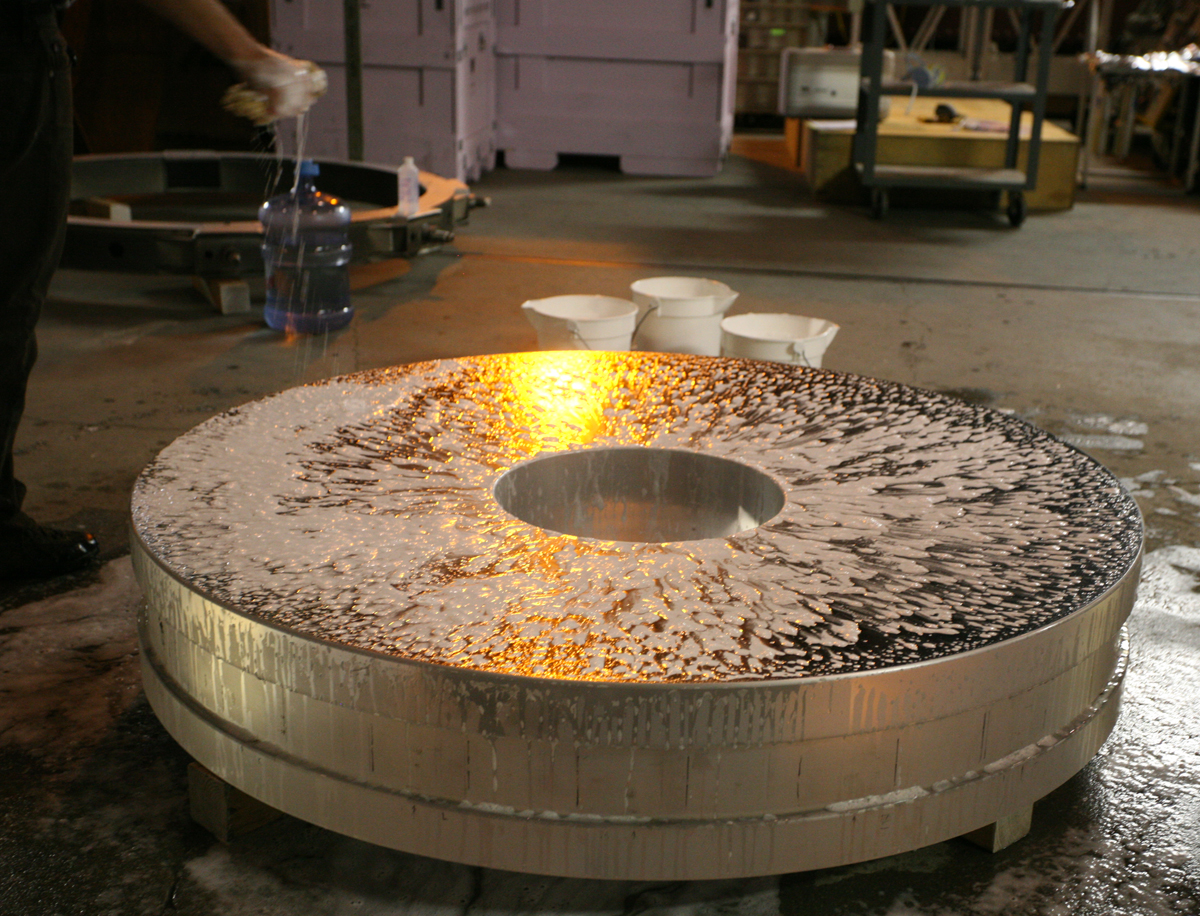 The mirror is then rinsed again . . .
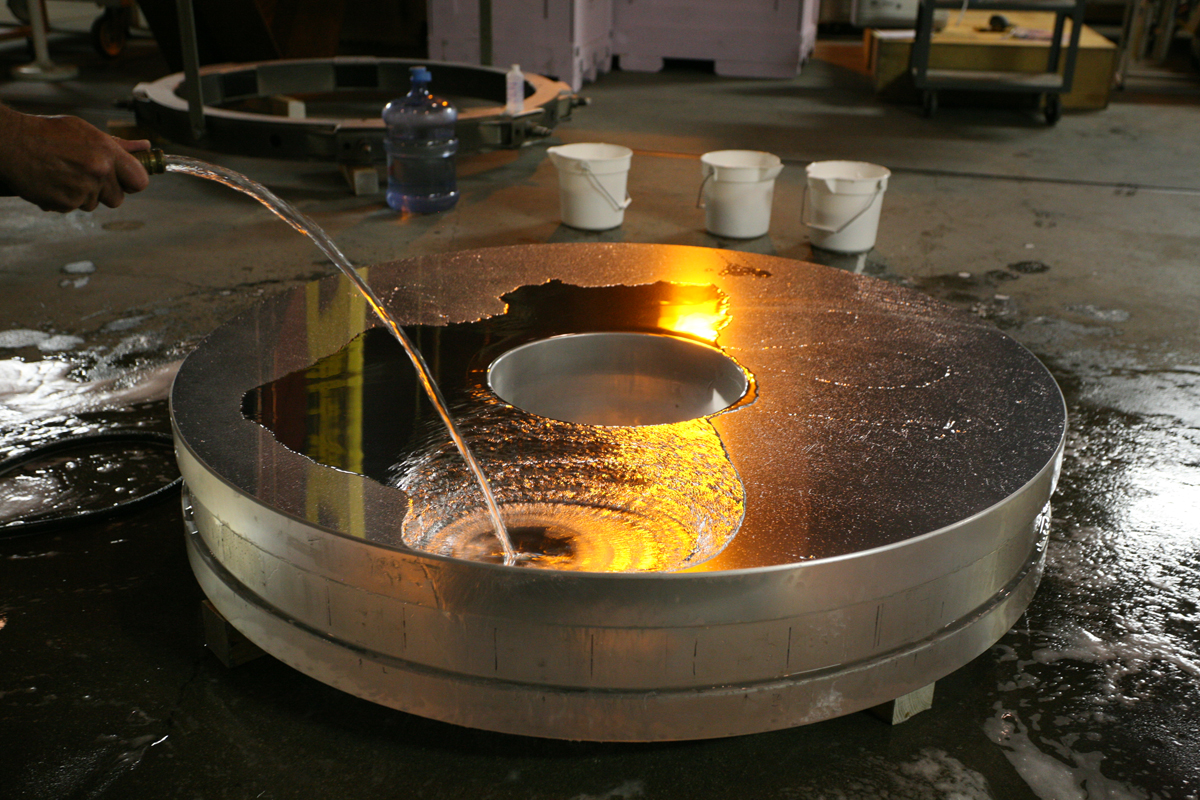 and then re-washed. This time the soapy sponges are lightly brought into contact with the surface of the mirror.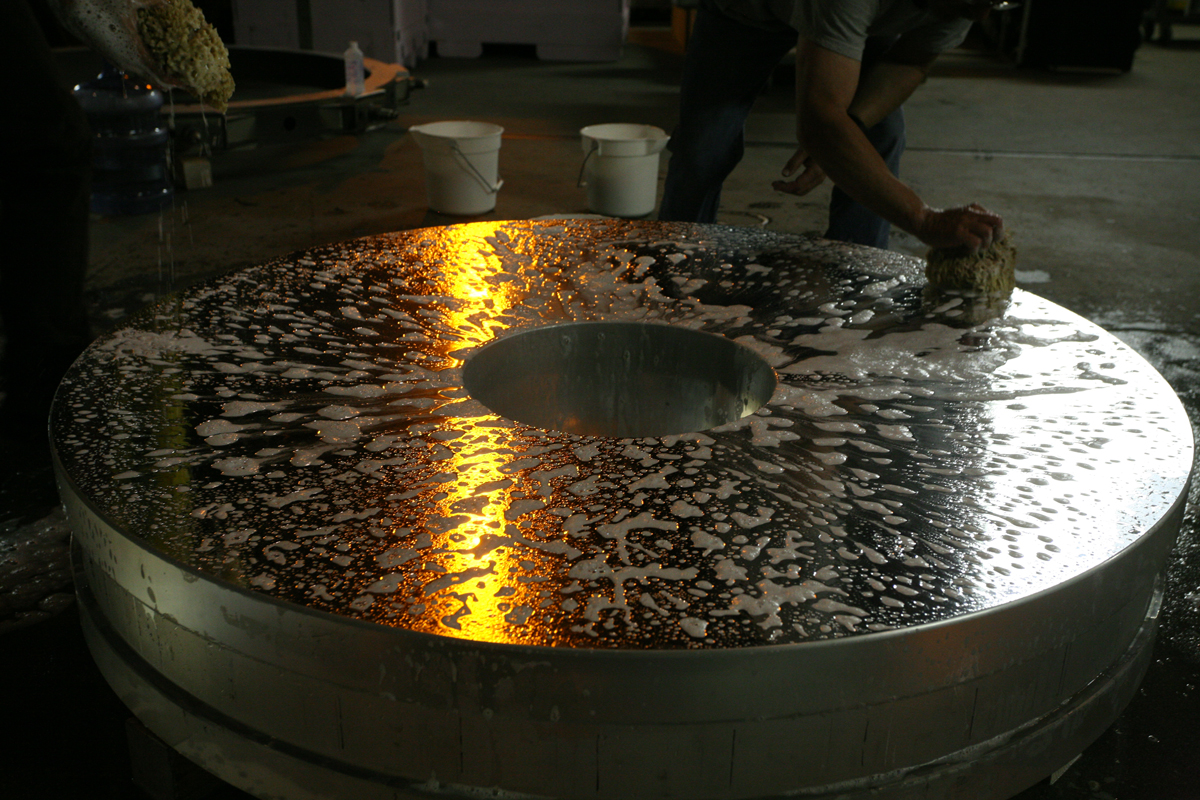
After additional rinsing and an evaluation of the surface reflectivity (improved almost 10% at this point), it is time to remove the old layer of aluminum from the mirror. It is treated with a solution (a mix of Copper Sulfate & Hydrochloric Acid) we call "Green River" that dissolves the aluminum from the disc, taking it from this . . . .
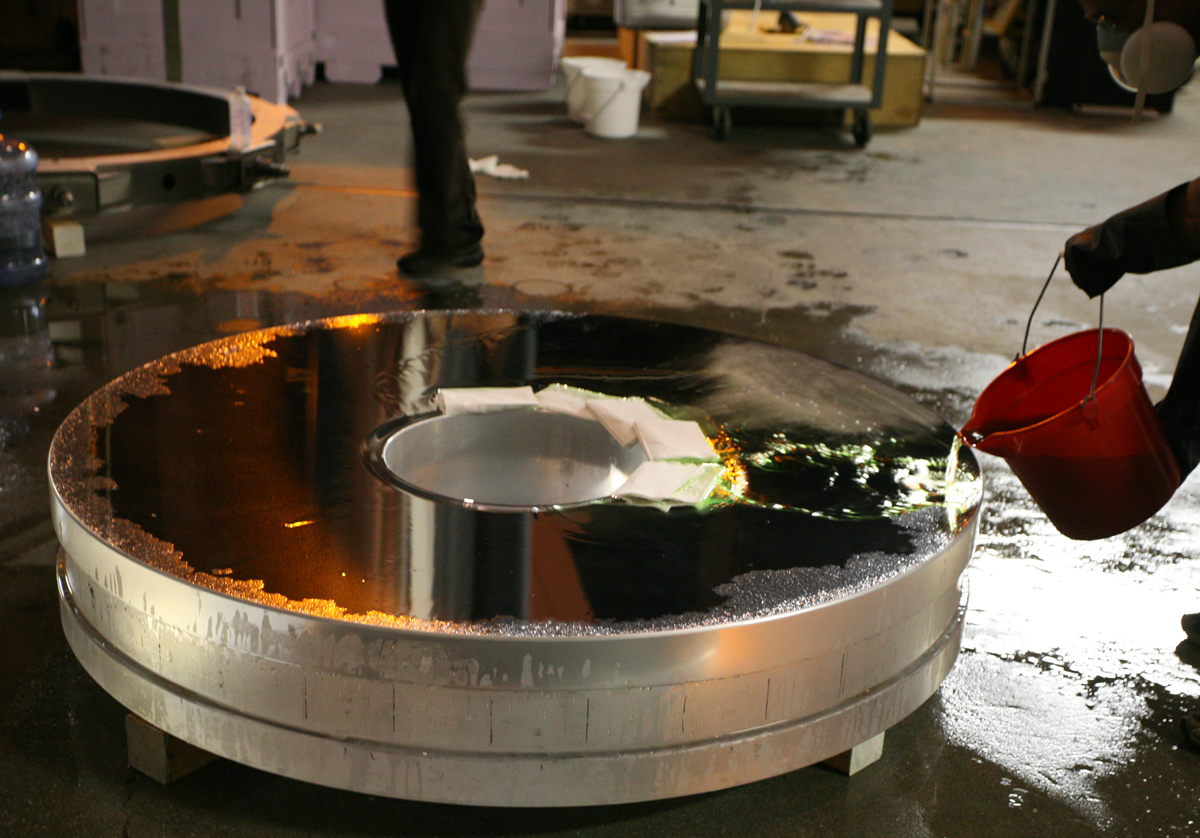 to this . . . .
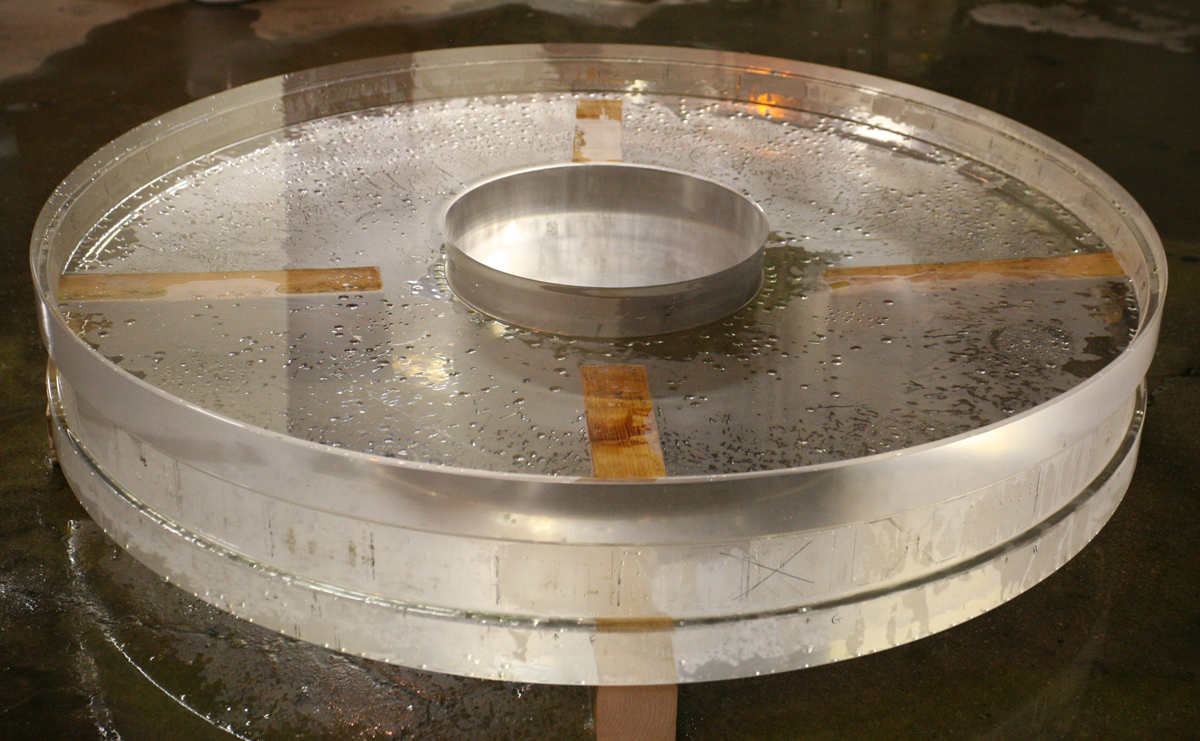 The mirror is then given a dusting of Calcium Carbonate . . .
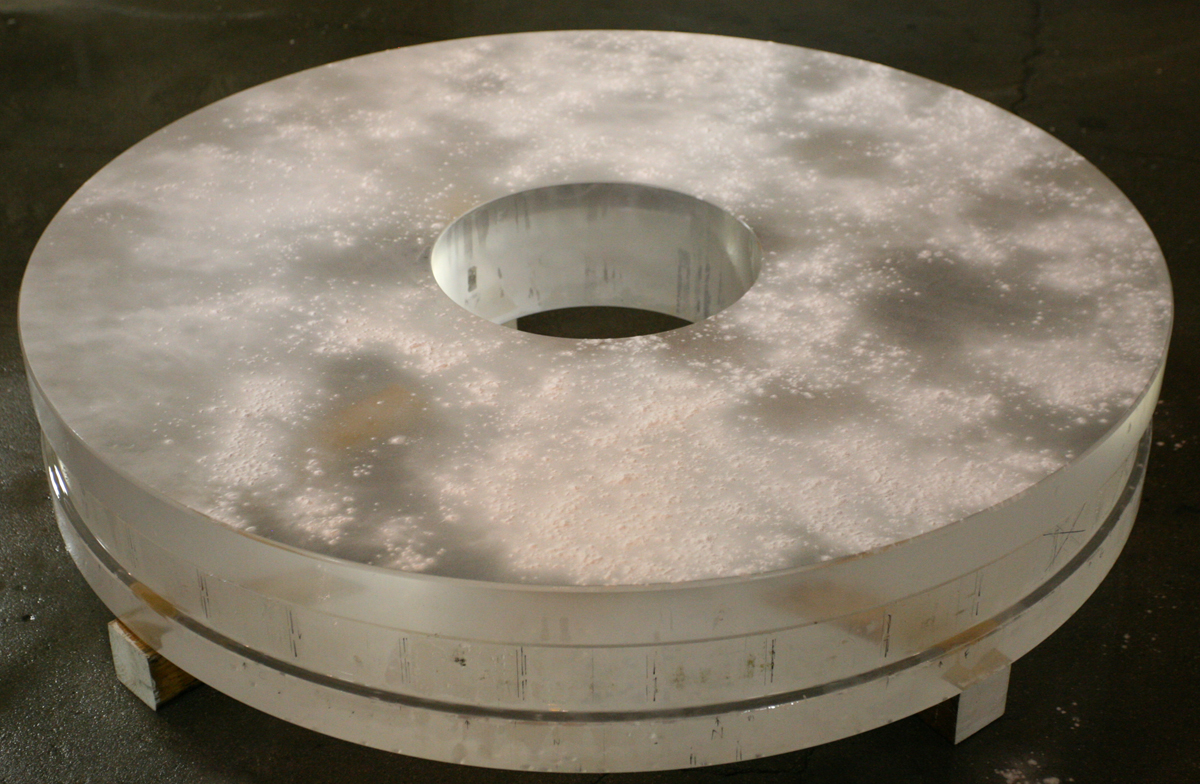 and washed with Potassium Hydroxide and then distilled water.
The mirror is then dried with an industrial paper towel that leaves no particles behind.
To give the mirror its new coating of aluminum it must be carefully lifted . . . .
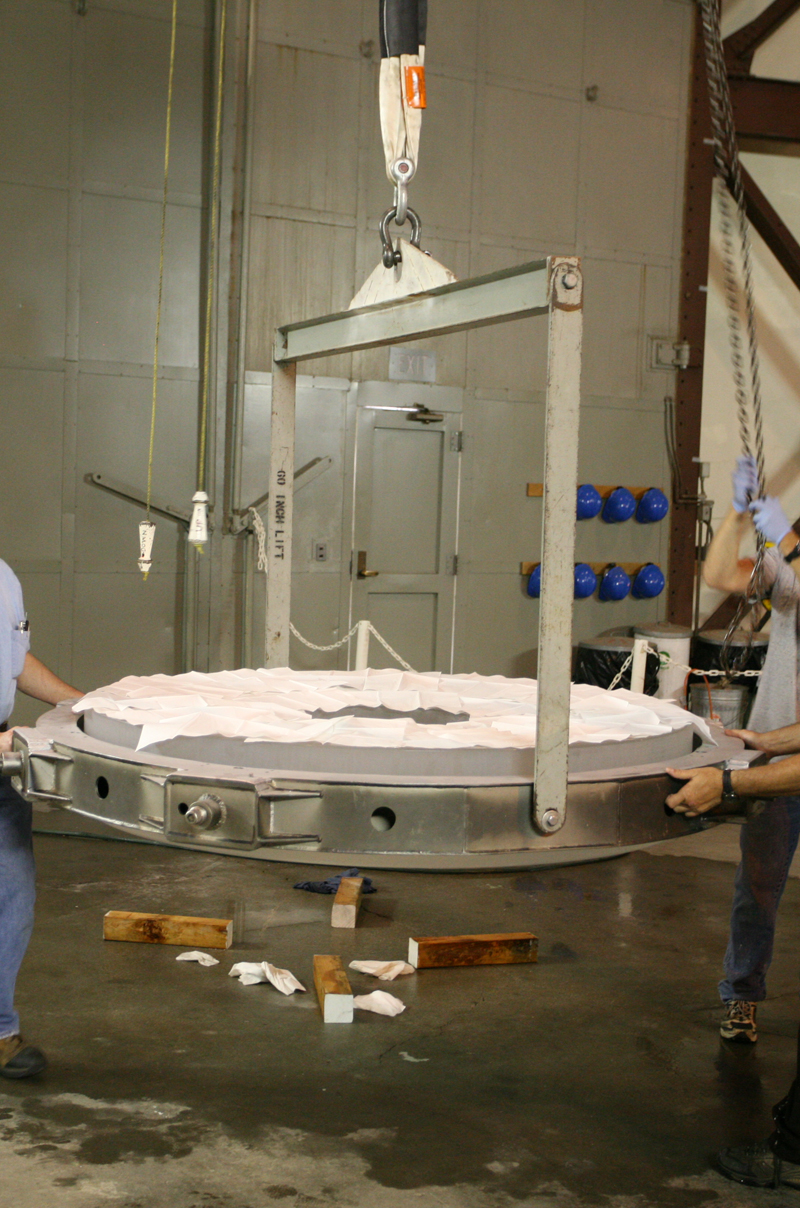 and placed into the aluminizing chamber.In case you can't tell, the mirror is hanging on the left side of the image, with the important parts of the aluminizing chamber in the section on the right. I'll describe the process of aluminizing in the next post, part IV.
Wednesday, August 20, 2008
60-inch Aluminizing, part II
 The second day of the project began as the mirror was carefully lifted onto a truck, covered and then driven slowly (5 mph) to the dome of the 200-inch telescope.
 Once the mirror is safely inside the real work begins.
First the reflectivity of the mirror's old coating is tested.
 Then it is time to break out the tools of the trade. Soap, water, buckets, and sea sponge.
 More on the technique later - I've got to go and take photos of today's action. Day 2 will get finished in a later post.
Tuesday, August 19, 2008
60-inch Aluminizing
This week we are re-aluminizing the mirror for our 60-inch telescope. As you'll see below telescope mirrors can get dirty over time. Even with a weekly spraying of CO2 to remove dust, it is eventually time to give them a good washing, strip off the old coating of aluminum and apply a new one.
The process began early yesterday morning with the removal of the science instrument and other components of the telescope. The telescope has a light baffle directly over the primary mirror which needs to be removed before the mirror can be taken out. Members of the staff have to carefully work inside the telescope tube to remove the baffle.

Here's a view from inside the telescope (taken from between the primary and secondary mirrors) looking down at the primary mirror.
 The telescope is then brought into the vertical position and locked into place. A cart, made just for this purpose, is moved into position and raised to the back end of the telescope.
 The mirror is then unbolted from the telescope and the cart, with its precious cargo, is then carefully lowered.
 Here is the mirror, safely removed from the telescope and the mirror cell. As you can see it is time to clean it up.

The rest of the process takes place in the dome of 200-inch telescope. In the next post I'll cover transportation, washing, stripping and re-coating the mirror.
The process began early yesterday morning with the removal of the science instrument and other components of the telescope. The telescope has a light baffle directly over the primary mirror which needs to be removed before the mirror can be taken out. Members of the staff have to carefully work inside the telescope tube to remove the baffle.
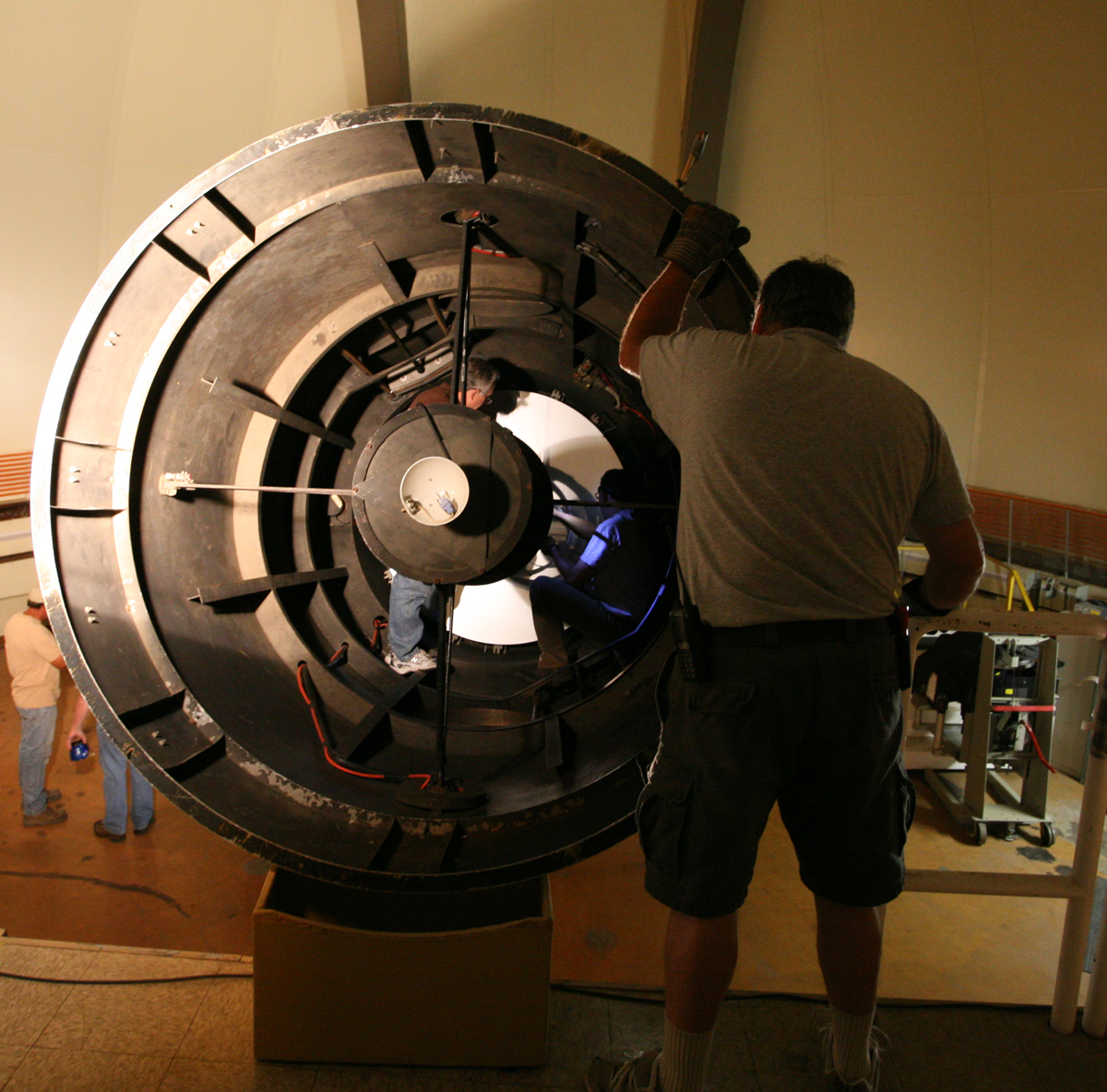
Here's a view from inside the telescope (taken from between the primary and secondary mirrors) looking down at the primary mirror.
 The telescope is then brought into the vertical position and locked into place. A cart, made just for this purpose, is moved into position and raised to the back end of the telescope.
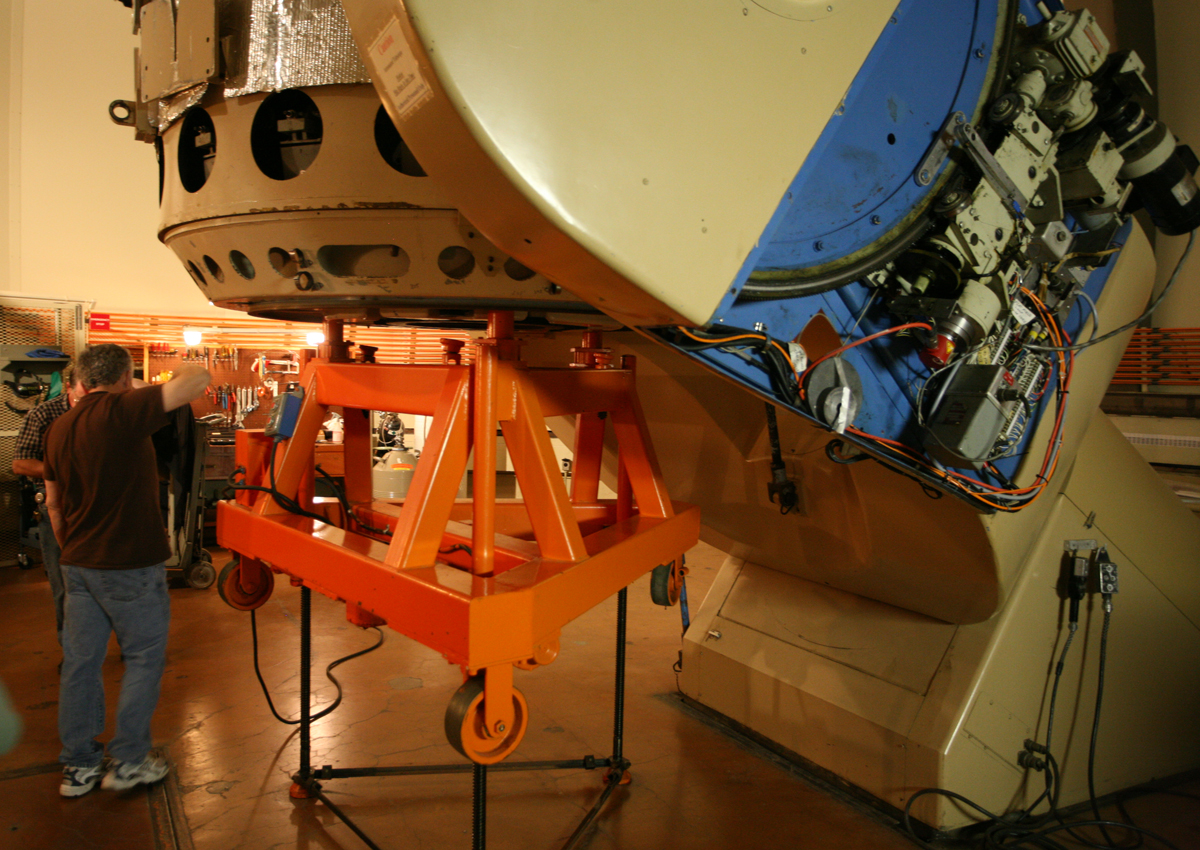 The mirror is then unbolted from the telescope and the cart, with its precious cargo, is then carefully lowered.
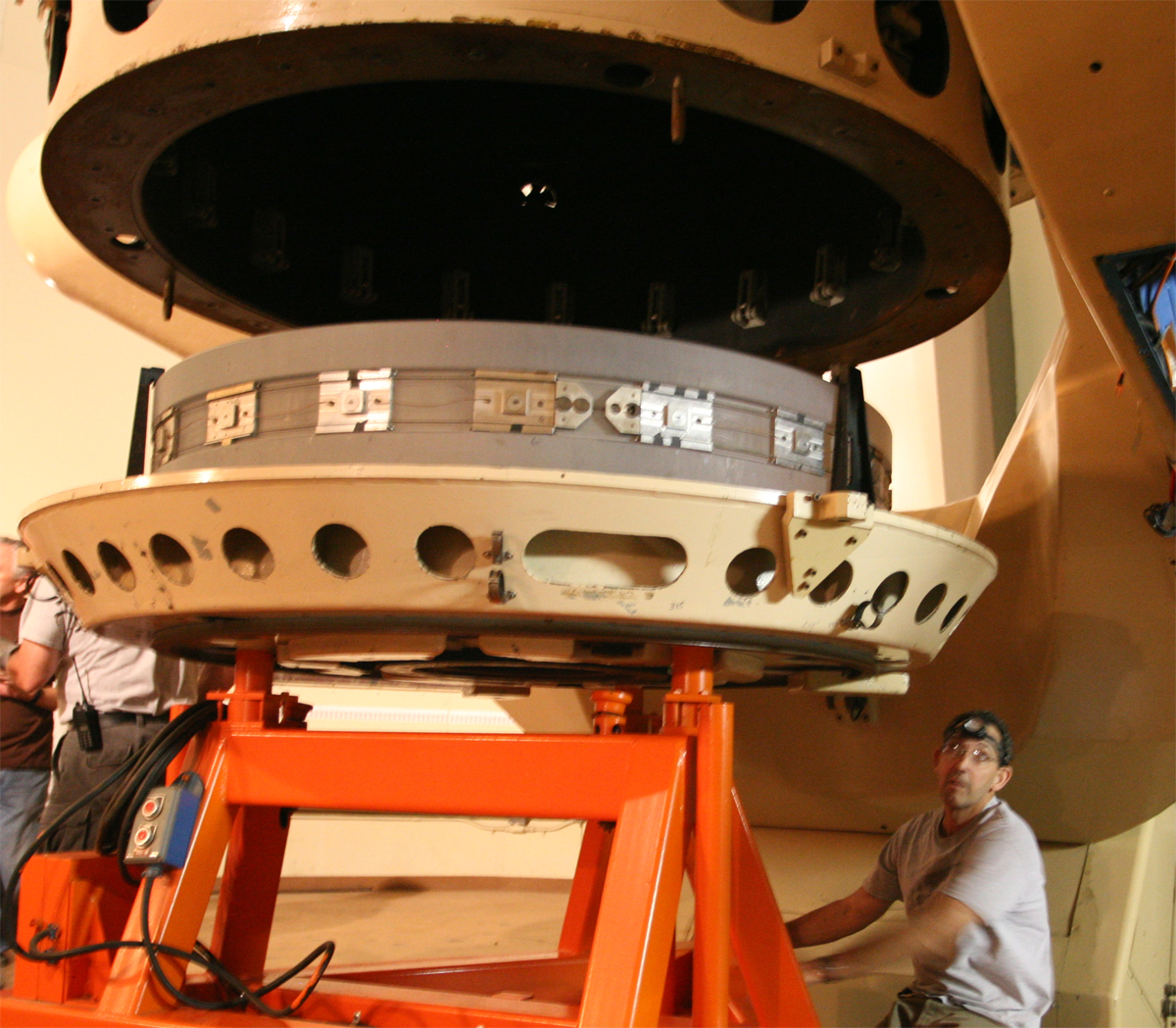 Here is the mirror, safely removed from the telescope and the mirror cell. As you can see it is time to clean it up.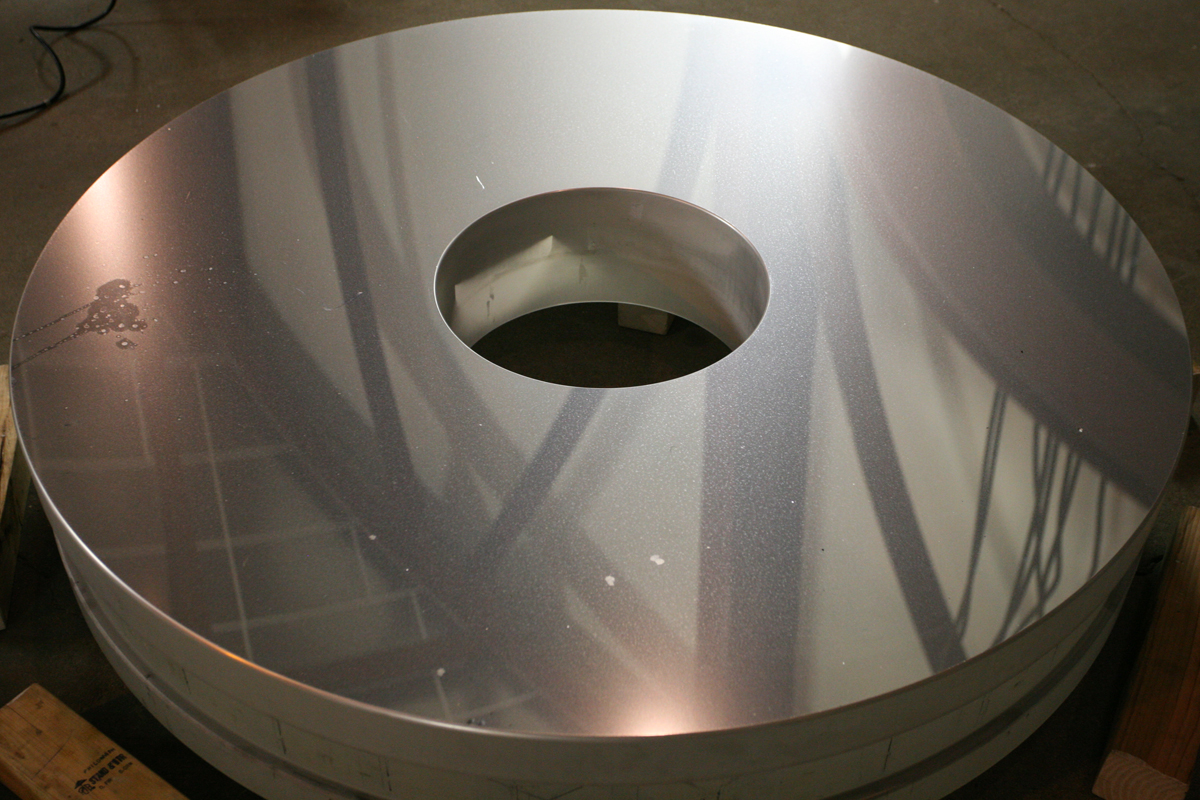
The rest of the process takes place in the dome of 200-inch telescope. In the next post I'll cover transportation, washing, stripping and re-coating the mirror.
The Difference Engine
The good folks over at the High Performance Wireless Research and Education Network do some cool stuff with the images that come out of the Hale Telescope's webcam. They grab and archive an image every three minutes and produce time-lapse animations from them. An interesting twist on the Hale Telescope webcam is the differential image that is produced by subtracting the newest image from the previous one. Sometimes the results are pretty cool looking.
 Here's a webcam shot taken in morning twilight from Monday. The differenced image is below. From that you can tell the the telescope is slowly tracking across the sky & that the mirror cover closed.

 Here's a webcam shot taken in morning twilight from Monday. The differenced image is below. From that you can tell the the telescope is slowly tracking across the sky & that the mirror cover closed.
Saturday, August 16, 2008
The Journey to Palomar
The trailer for The Journey to Palomar, to be broadcast on PBS on November 10, is available below. Check out the trailer and mark the date on your calendar. You'll be glad you did.
Return to Palomar
A few months ago I had the pleasure of meeting Robert Gandolfi and his wife Bobbi. Back in 1968-69 Robert was here on Palomar, working for Western Gear Corporation, working on the construction of the dome and Oscar Mayer Building that houses our 60-inch telescope.
 That's Robert on the right in this photo with the uncompleted dome behind him. Robert had some great stories and photos to share about his experiences from that time. What I didn't realize until his visit was that his work had finished before the telescope was installed and he had never actually seen it. I was happy to show him the telescope as it is today and explain the research that it is being used for. Here is Robert in his return to Palomar, nearly 40 years after his last visit.
 I am glad that he was able to finally see the telescope and the fruits of his labors all those years ago.
By the way, in the coming week the 60-inch telescope will have its mirror pulled to be re-aluminized. I'll be posting photos of pieces and parts while explaining the process.
 That's Robert on the right in this photo with the uncompleted dome behind him. Robert had some great stories and photos to share about his experiences from that time. What I didn't realize until his visit was that his work had finished before the telescope was installed and he had never actually seen it. I was happy to show him the telescope as it is today and explain the research that it is being used for. Here is Robert in his return to Palomar, nearly 40 years after his last visit.
 I am glad that he was able to finally see the telescope and the fruits of his labors all those years ago.
By the way, in the coming week the 60-inch telescope will have its mirror pulled to be re-aluminized. I'll be posting photos of pieces and parts while explaining the process.
Subscribe to:
Posts (Atom)

 Posts
Posts

