Tuesday, March 17, 2009

Don't Panic!

If you are anywhere near Palomar Mountain today you probably noticed the smoke plume. For me the view is giving strong memories of 2007's Poomacha Fire.

The good news is that this is not a wild fire. The National Forest Service is performing a 20-acre "prescribed burn" in the Fry Creek area.

Unfortunately, it is still rather close to the observatory and the smoke is likely to have a major impact on observing tonight.

Here's the view from the 60-inch telescope around noon today:


Even from well off of Palomar the smoke plume is rather impressive as you can see in this photo from around 4 p.m.

Alas, these are low quality shots captured from my phone. :(

Pluto!

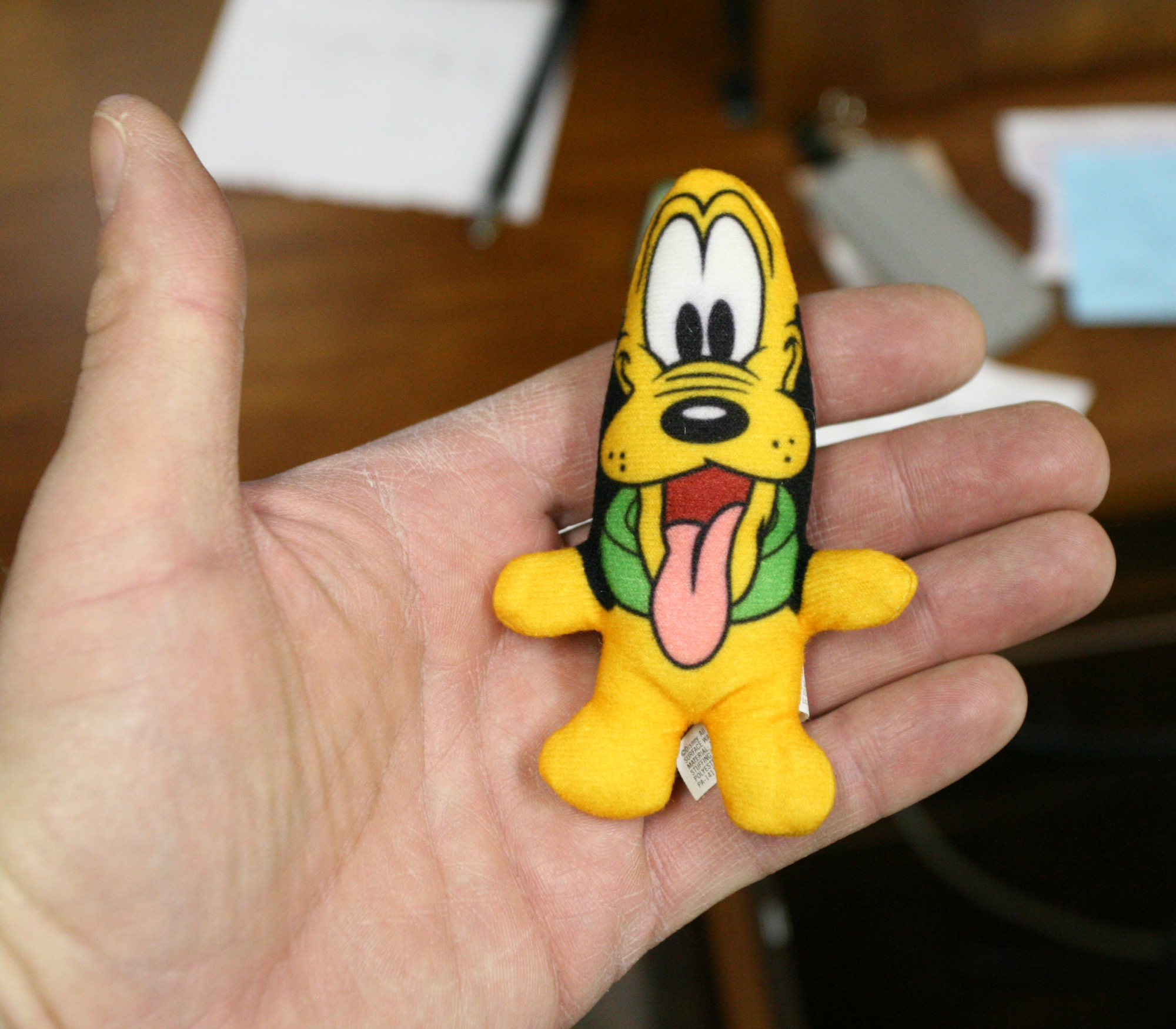
Look at what my daughter pulled out of a cereal box the other day:


Yes, Pluto. Thankfully she gave it to me. It is a great addition to my office.

Pluto has been getting a bad rap since the IAU demoted it from planet to a dwarf planet. It still is a pretty interesting place. If you are interested you should read 10 Things You Don't Know About Pluto from the Bad Astronomy Blog.

If you want to learn more about the world that helped to demote Pluto, you should visit Mike Brown's website on Eris.

Just a couple of weeks after the IAU made their big vote in 2006, Tom Jarrett was observing on the 200-inch Hale Telescope when he photographed Pluto (arrowed) next to a trio of stars that strongly resembles a certain mouse that Pluto the cartoon character is associated with. Coincidence?
For anyone who is looking to learn more about the mythical "Planet X", I strongly recommend this resource.

By the way, today is my 6th anniversary of working here at Palomar Observatory. It has been a good ride so far. I am honored to be here and look forward to continuing to expand our public outreach programs.

Model A's Visit Palomar

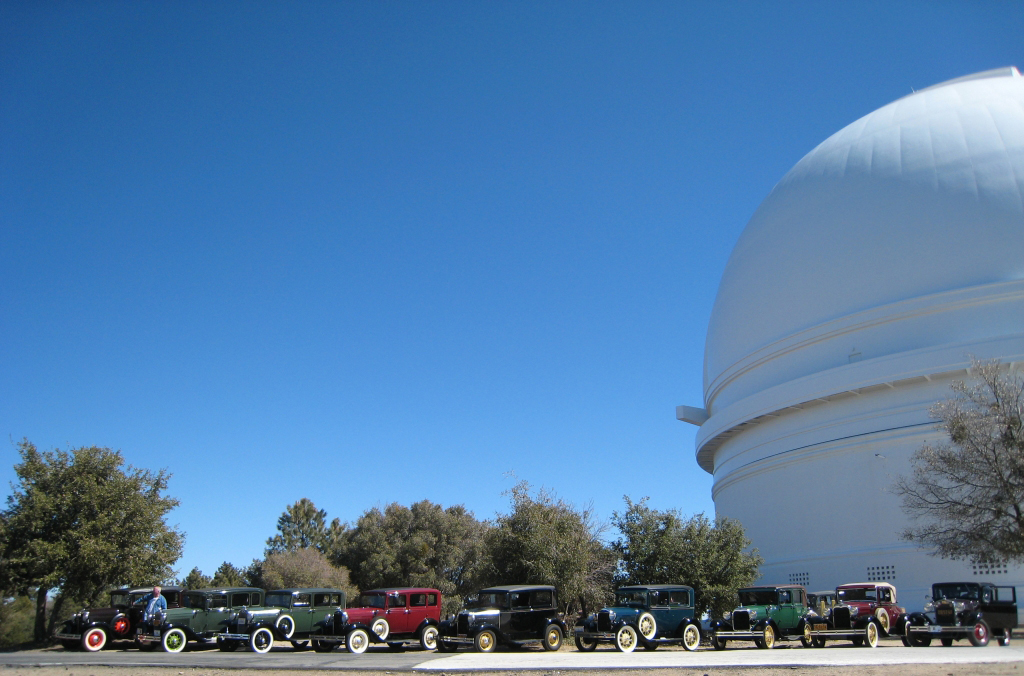
A couple of Saturdays ago we had the Santa Anita A's car club here for a tour. Afterward we let them pose their 1930s-vintage cars by the dome.

Photo by Mike Vergara

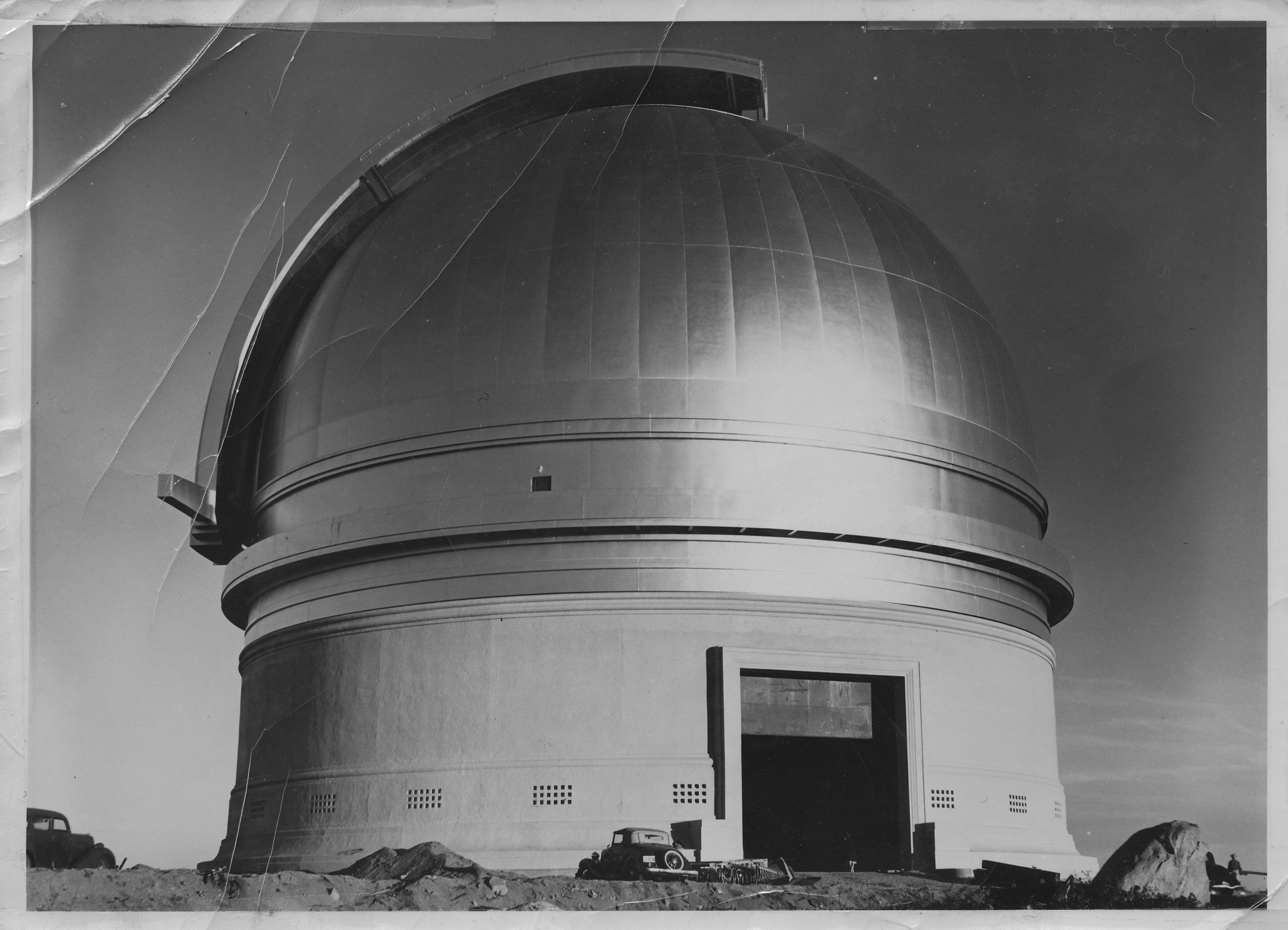
Their visit reminds me a bit of this photo from the late 1930s:


Here is the car in full resolution:


If you know what type or year the car is feel free to drop me an email or post a comment.

Friday, March 13, 2009

Death of a Star on Nat Geo

I was remiss in pointing out that Palomar's Hale Telescope was shown briefly (& mostly for eye candy) last night on Naked Science: Death of a Star on the National Geographic Channel.

The episode chronicles the discovery of the long tail of the star Mira that was found by Chris Martin of Caltech and Mark Siebert of the Carnegie Institution using the UV Galex satellite.

It looks like the show will be repeated on Sunday March 15 @ 2 p.m. As always, check your local listings.

Here's a clip:

Thursday, March 12, 2009

Science Fiction with Accurate Astronomy

Another installment of Palomar in Science Fiction will be coming before too long. In the meantime you might want to take advantage of some free SF that features a wide "range of astronomical facts and mind-blowing concepts." Just visit Diamonds in the Sky. There you can read the short stories while you are online or download them to your hand-held device and read 'em while you are on the go.

The effort was supported by the National Science Foundation. Your tax dollars at work.

Wednesday, March 11, 2009

Dutch Treat

A few weeks ago I had the pleasure of meeting Robert Langenhuysen of the Dwingeloo Radio Observatory located in the Netherlands. They have an old 25-meter radio telescope that began operations in 1956, but recently fell into disuse.

The good news is that the "C.A. Muller Radio Astronomy Station" foundation ("CAMRAS" for short) has brought the telescope back into working order! You can even see a live data stream from the dish, which is currently acting as a transit scope. It is wonderful to see old instruments come alive again.

Robert was kind enough to send me a copy of the CAMRAS newsletter that details some of his visit to Palomar. Be warned the newsletter is written in Dutch.

Here's Robert & I from the newsletter:

According to Babelfish the caption reads:

"Scott left me also vestiges see from the time of the construction of this telescope. Just like at us in Dwingeloo lie in the field still pieces concrete from that time. In the case of Mt Palomar it goes mirror that made for a disk reinforced concrete for the size of Pyrex the glass as a dummy weight served."
Computer translations aren't all that great, are they?

Robert tells me that the CAMRAS website will soon be available in English as well as Dutch and that the facility will be available for people wishing to use a 35-meter radio telescope for their own research projects. How cool is that?

In case you were wondering, our concrete dummy weight is located right next to the dome of the Hale Telescope and can be seen here. It is the same size as the 200-inch mirror and it weighs the same as the mirror and the mirror cell.

Exoplanet Hunter to be Honored

Last week the National Science Foundation announced that former Caltech astronomer David Charbonneau will be awarded the Alan T. Waterman Award in May.

Dave has been a leader in the field of exoplanets and here at Palomar he established the now retired 4-inch Sleuth telescope which found a few exoplanets of its own.

Be sure to check his photo from National Geographic Magazine.

Galileoscopes!

Last June I posted a little bit about the Galileoscope that was unveiled at the Astronomical Society of the Pacific meeting. I am happy to announce that the Galileoscopes are finally ready to order.


It is no exaggeration to say that the telescope changed everything: Galileo's discoveries literally revolutionized our perception of the universe and Earth's place in it.

The Galileoscope is a perfect way for many, many people to participate in recreating one of the major events in the history of science - Galileo's observations through his small telescope. After all, anyone with a telescope can see what Galileo saw.

But not everyone has a telescope, especially in less developed parts of the world. To enable more people in more places to personally experience the wonders of the universe, we've developed a remarkably inexpensive, very-high-quality, easy-to-use refractor. With this new instrument, called the Galileoscope, children and adults can learn how telescopes work and repeat for themselves the spectacular observations made by Galileo beginning in 1609. (Here's a detailed description of the telescope.)

The Galileoscope comes as a kit with simple instructions for no-tools assembly in 5 minutes or less. Its achromatic optics include a 50-mm-diameter objective lens of focal length 500 mm, an eyepiece of focal length 20 mm (magnification 25x), and a 2x Barlow lens (yielding 50x when used with the supplied eyepiece). The Galileoscope accepts almost any optical accessory that has a standard 1¼-inch (31¾-mm) barrel, and it attaches to virtually every tripod made or distributed anywhere in the world. (A tripod is not included with the kit; you'll have to supply your own.) You get all this for just U.S. $15 each plus shipping, or U.S. $12.50 each plus shipping for orders of 100 or more.

That's right, $15 (plus shipping) will get you or your favorite kid a telescope that is actually better than the one Galileo used to change our perception of the universe. Not bad.

We'll soon be ordering a bunch of these at Palomar for some educational programs that we'll be running.

Friday, March 6, 2009

San Diego Science Festival


In case you haven't heard the San Diego Science Festival is now in progress. There will be events all month culminating in Expo Day on Saturday, April 4th.

The SD Science Festival's Expo Day will take place in San Diego's Balboa Park on April 4, 2009 from 10:30 AM - 6:00 PM. According to their website:

There will be 200 different organizations creating over 300 different hands-on activities. Check out music performances, solve puzzles, build structures, look at the teeny tiny! Best of all, learn about the science all around you as you explore.

I will be there showing off some cool stuff about Palomar Observatory and giving everyone a chance to safely view the Sun. Be sure to attend. It should be a blast.

Earth Hour Commercial

I don't know much about insurance, nor would I recommend any particular company, but Esurance is supporting Earth Hour, a world-wide energy conservation program that takes place on March 28th. In the program people are asked to dim and turn off unnecessary lights for just one hour.

The net result is less energy used, less greenhouse gasses produced and darker skies. In many places people are even encouraged to go outside to see the stars during the event - a cool thing to do, especially during the International Year of Astronomy.

Check out the Esurance commercial about Earth Hour: