Showing posts with label Hale Telescope. Show all posts
Showing posts with label Hale Telescope. Show all posts
Wednesday, July 13, 2011
Ride the Dome
We don't often get to turn the Hale Telescope's 1000-ton dome for people while giving a tour, but when we do the video cameras are usually out and running. The turning of the dome is so smooth that it looks and feels like the telescope is rotating. Here is a short video that nicely shows off the effect.


Friday, July 1, 2011
Celebrate Your Independence with a Tour of the Hale Telescope
To celebrate Independence Day our regular program of weekend tours of the 200-inch Hale Telescope will be extended to include tours on Monday, July 4th.
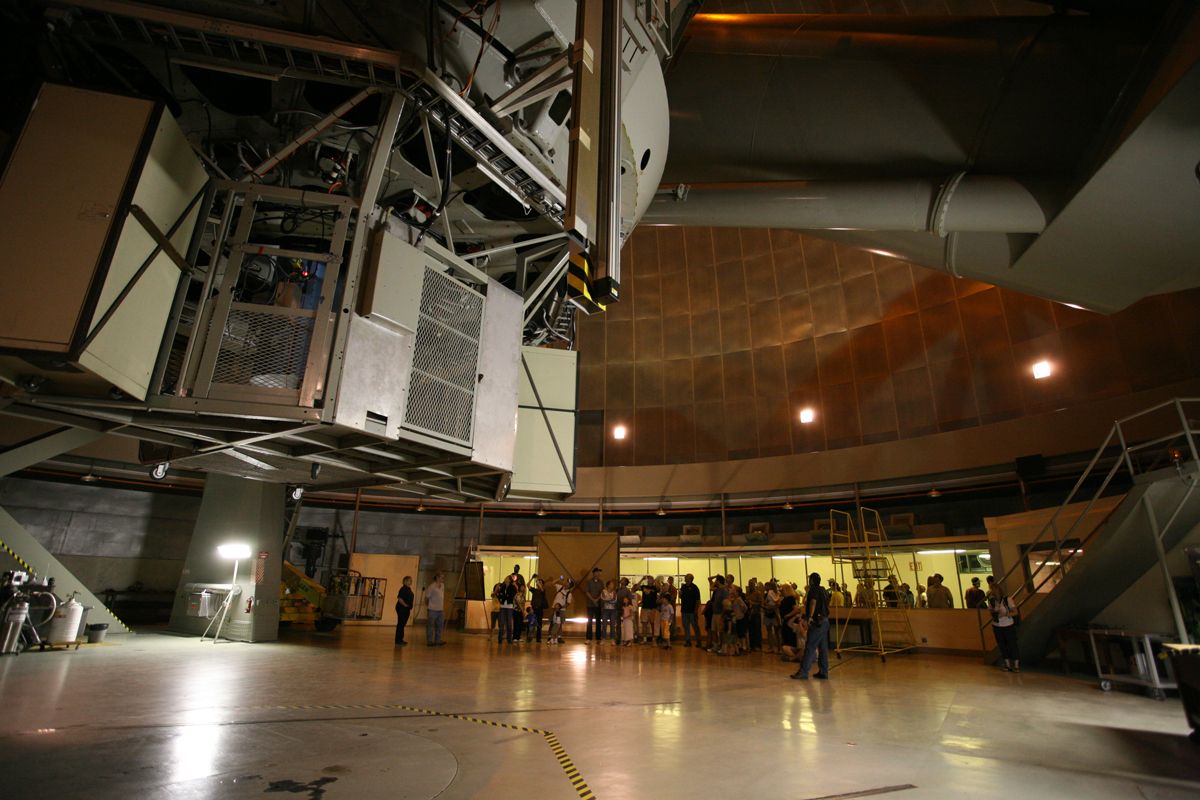
The Hale Telescope is an icon of American science, so why not come up and see it for the 4th.
The Hale Telescope is an icon of American science, so why not come up and see it for the 4th.
Wednesday, June 22, 2011
Reminder: The Journey to Palomar on PBS
Consider yourself reminded that The Journey to Palomar airs on many PBS stations tonight (June 22nd). Be sure to check your local listings and check out the trailer below:
The trailer was made for the first airing of the documentary, which is why it says "November 10th" at the end. Feel free to ignore that.
The trailer was made for the first airing of the documentary, which is why it says "November 10th" at the end. Feel free to ignore that.
Tuesday, June 21, 2011
Palomar in a Vintage Escondido Travel Brochure
PALM-3000, the world's best adaptive optics instrument, is currently on the Hale Telescope, but instead of talking about that, I am going to share a bit of Palomar history.
Below are scans from a 1951 brochure put out by the Escondido Chamber of Commerce.

You are going to want to click on the image below to view the inside of the brochure which was written by David O. Woodbury. Some of you may recall that Woodbury was the author The Glass Giant of Palomar, one of the first books to tell the story of the 200-inch telescope. The details described inside are pretty much spot on, but the one odd thing is the diagram that shows off the path of light through the telescope. There are several places where light can be focused and the illustration shows the just one of the three -- coudé focus.

The back cover of the brochure shows the location of Escondido and how to get to the observatory via The Highway to the Stars.
 Alas, The Highway to the Stars signs that once marked the roadway are now long gone. The observatory now sells a reproduction of the sign on one of our t-shirts, but here is how they looked:

Below are scans from a 1951 brochure put out by the Escondido Chamber of Commerce.
You are going to want to click on the image below to view the inside of the brochure which was written by David O. Woodbury. Some of you may recall that Woodbury was the author The Glass Giant of Palomar, one of the first books to tell the story of the 200-inch telescope. The details described inside are pretty much spot on, but the one odd thing is the diagram that shows off the path of light through the telescope. There are several places where light can be focused and the illustration shows the just one of the three -- coudé focus.
The back cover of the brochure shows the location of Escondido and how to get to the observatory via The Highway to the Stars.
Alas, The Highway to the Stars signs that once marked the roadway are now long gone. The observatory now sells a reproduction of the sign on one of our t-shirts, but here is how they looked:
Saturday, June 18, 2011
The Journey to Palomar Returns to PBS this Week
I am happy to report that The Journey to Palomar, a documentary about George Ellery Hale and the building of the 200-inch telescope, will again be shown on PBS. It is a moving and inspirational story that is not to be missed.
Follow this link to check your local listings.
A short clip is posted below.
Follow this link to check your local listings.
A short clip is posted below.
Saturday, June 11, 2011
Looking Ahead
Earlier this month the 2011B observing schedule for the 200-inch Hale Telescope was announced. The astronomers who applied for time in early April finally found out if and when they will be coming to Palomar from August through January.
I thought that the readers of Palomar Skies might like summary of the projects coming our way this fall, so here goes.
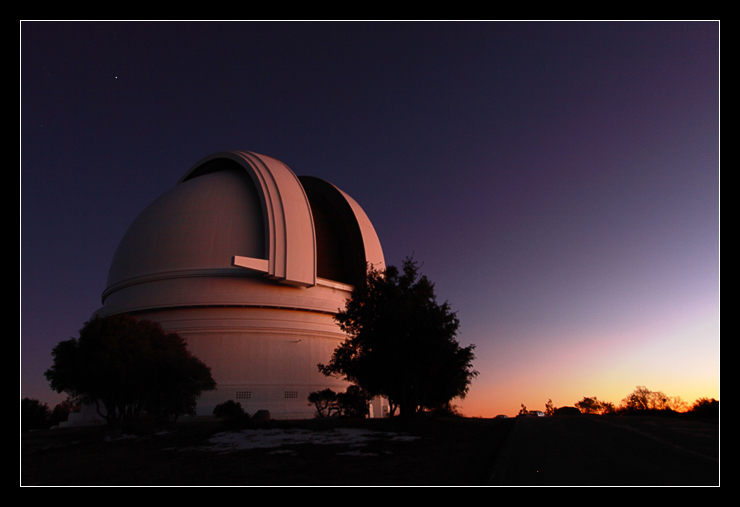
Transients are all the rage and 13 nights, spread out across the months, will be devoted to following up on objects discovered with the Palomar Transient Factory survey. An additional four nights will be devoted to doing similar work, but for transients discovered via the Catalina Real-Time Transient Survey. Both of these programs will primarily use our visible light spectrograph to identify the type of transients discovered. One other night will specifically devoted to a particular type of supernova known as a Type Ia.
The other big item on the agenda for 2011B is the study of exoplanets. Some of this is follow-up work from the Kepler mission. 14 nights are devoted to various studies on Kepler exoplanets or their host stars. Much of this is visible or near infrared spectroscopy, but some of it also makes use of our newly souped-up adaptive optics system known as PALM-3000. This high-resolution imaging system will be used 12 nights to study and hunt for exoplanets and planet-forming disks of debris located around young stars. Using instruments other than the AO system, two nights will be used to study some of these disks discovered by the WISE mission and another two to study some “hot Jupiters” as they are seen to transit their host stars. All together that comes to 30 nights of exoplanets in 2011B or 1/6th of the telescope time.
Speaking of planets and things that orbit a star, worlds of our own solar system are a subject of study too. This includes studies of asteroids (8 nights), the Galilean moons of Jupiter (1), the irregular satellites of the outer planets (2), the atmosphere of Uranus (1), and the frozen world located beyond Neptune in the Kuiper Belt (2).
Looking a little further out, 12 nights will be devoted to studying brown dwarfs, so called “failed stars” – objects that are more massive than a planet but not massive enough to sustain nuclear fusion the way that stars do. Many of the objects to be observed were first discovered by the WISE mission.
Lots of stellar astrophysics will be going on as our astronomers study star formation (3), young stars and protostars (4), young variable stars, novae (4), white dwarfs (2), x-ray binary systems (1). The presence of dark matter in our own galaxy will be mapped via studies of the motions of RR Lyrae type variable stars that are part of the Pisces tidal stream (3).
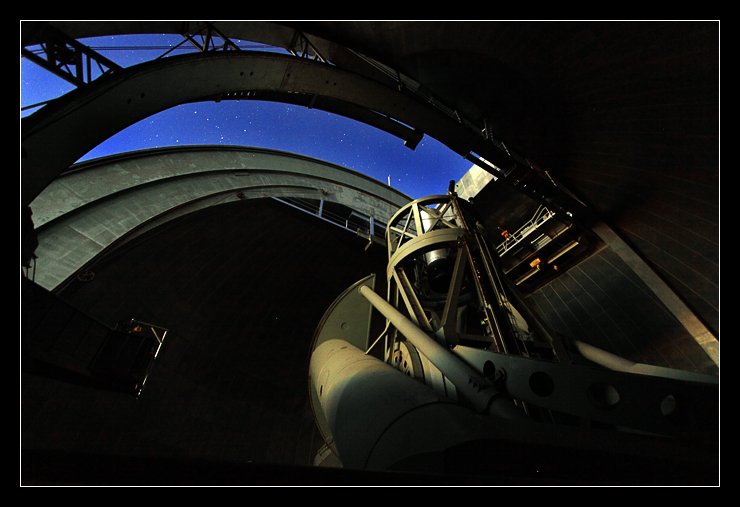
Looking beyond our galaxy is still a big part of science at Palomar. In fact, aside from engineering time, it comprises the rest of the time on the schedule. Massive stars and the chemistry of the stars in M31 (aka the Andromeda Galaxy), our nearest big galaxy, will be the subject of study for 8 nights. Included on the list are blue compact dwarf galaxies (2), massive elliptical galaxies (5), hyperluminous galaxies (1), low-luminosity star-forming galaxies (5), galaxies known as Lyman-alpha emitters (7), luminous infrared galaxies (7), and galaxy clusters (6). Five nights will be directed toward the evolution of galaxies and six nights will be devoted toward using the Cosmic Web Imager instrument to map out the presence of gas located between galaxies.
Supermassive black holes, which lie at the core of quasars and various galaxies with active galactic nuclei are to be studied for six nights, while quasars themselves are studied another seven nights. The environment in and around another type of active galaxy – radio galaxies— is to be studied for five nights.
It takes time to keep the telescope & its instrumentation in tip-top shape. Seven nights will be lost because we will be re-aluminizing the 200-inch mirror in October. An additional twelve nights will be spent on engineering various scientific cameras, mostly related to our new PALM-3000 adaptive optics system. Two of those nights will be a demonstration of a new instrument known as ARCONS – the ARray Camera for Optical to Near-IR Spectrophotometry. It is likely that there will be science observations on a good fraction of these “engineering” nights.
Finally, we will be closed to astronomy and engineering December 24 & 25 for our only two holidays of the year.
There is the summary of what we will be looking at from August through January. Hopefully I didn't miss anything.
I thought that the readers of Palomar Skies might like summary of the projects coming our way this fall, so here goes.
Photo by Iair Arcavi.
Transients are all the rage and 13 nights, spread out across the months, will be devoted to following up on objects discovered with the Palomar Transient Factory survey. An additional four nights will be devoted to doing similar work, but for transients discovered via the Catalina Real-Time Transient Survey. Both of these programs will primarily use our visible light spectrograph to identify the type of transients discovered. One other night will specifically devoted to a particular type of supernova known as a Type Ia.
The other big item on the agenda for 2011B is the study of exoplanets. Some of this is follow-up work from the Kepler mission. 14 nights are devoted to various studies on Kepler exoplanets or their host stars. Much of this is visible or near infrared spectroscopy, but some of it also makes use of our newly souped-up adaptive optics system known as PALM-3000. This high-resolution imaging system will be used 12 nights to study and hunt for exoplanets and planet-forming disks of debris located around young stars. Using instruments other than the AO system, two nights will be used to study some of these disks discovered by the WISE mission and another two to study some “hot Jupiters” as they are seen to transit their host stars. All together that comes to 30 nights of exoplanets in 2011B or 1/6th of the telescope time.
Speaking of planets and things that orbit a star, worlds of our own solar system are a subject of study too. This includes studies of asteroids (8 nights), the Galilean moons of Jupiter (1), the irregular satellites of the outer planets (2), the atmosphere of Uranus (1), and the frozen world located beyond Neptune in the Kuiper Belt (2).
Looking a little further out, 12 nights will be devoted to studying brown dwarfs, so called “failed stars” – objects that are more massive than a planet but not massive enough to sustain nuclear fusion the way that stars do. Many of the objects to be observed were first discovered by the WISE mission.
Lots of stellar astrophysics will be going on as our astronomers study star formation (3), young stars and protostars (4), young variable stars, novae (4), white dwarfs (2), x-ray binary systems (1). The presence of dark matter in our own galaxy will be mapped via studies of the motions of RR Lyrae type variable stars that are part of the Pisces tidal stream (3).
Photo by Iair Arcavi.
Looking beyond our galaxy is still a big part of science at Palomar. In fact, aside from engineering time, it comprises the rest of the time on the schedule. Massive stars and the chemistry of the stars in M31 (aka the Andromeda Galaxy), our nearest big galaxy, will be the subject of study for 8 nights. Included on the list are blue compact dwarf galaxies (2), massive elliptical galaxies (5), hyperluminous galaxies (1), low-luminosity star-forming galaxies (5), galaxies known as Lyman-alpha emitters (7), luminous infrared galaxies (7), and galaxy clusters (6). Five nights will be directed toward the evolution of galaxies and six nights will be devoted toward using the Cosmic Web Imager instrument to map out the presence of gas located between galaxies.
Supermassive black holes, which lie at the core of quasars and various galaxies with active galactic nuclei are to be studied for six nights, while quasars themselves are studied another seven nights. The environment in and around another type of active galaxy – radio galaxies— is to be studied for five nights.
It takes time to keep the telescope & its instrumentation in tip-top shape. Seven nights will be lost because we will be re-aluminizing the 200-inch mirror in October. An additional twelve nights will be spent on engineering various scientific cameras, mostly related to our new PALM-3000 adaptive optics system. Two of those nights will be a demonstration of a new instrument known as ARCONS – the ARray Camera for Optical to Near-IR Spectrophotometry. It is likely that there will be science observations on a good fraction of these “engineering” nights.
Finally, we will be closed to astronomy and engineering December 24 & 25 for our only two holidays of the year.
There is the summary of what we will be looking at from August through January. Hopefully I didn't miss anything.
Thursday, June 9, 2011
Hale Telescope Webcam is Back!
It has been a tough spring for the webcam in the dome of the 200-inch Hale Telescope, but as summer approaches I am happy to announce that it is back on line.
I made a slight adjustment on the camera's focus this morning and captured this shot of me with the Big Eye. I will try not to block the view from now on.

I made a slight adjustment on the camera's focus this morning and captured this shot of me with the Big Eye. I will try not to block the view from now on.
Wednesday, June 8, 2011
Press Release: Caltech-led Astronomers Find a New Class of Stellar Explosions
Below is a press release that was issued today about some of the science behind the Palomar Transient Factory survey.
PASADENA, Calif.—They're bright and blue—and a bit strange. They're a new type of stellar explosion that was recently discovered by a team of astronomers led by the California Institute of Technology (Caltech). Among the most luminous in the cosmos, these new kinds of supernovae could help researchers better understand star formation, distant galaxies, and what the early universe might have been like.
"We're learning about a whole new class of supernovae that wasn't known before," says Robert Quimby, a Caltech postdoctoral scholar and the lead author on a paper to be published in the June 9 issue of the journal Nature. In addition to finding four explosions of this type, the team also discovered that two previously known supernovae, whose identities had baffled astronomers, also belonged to this new class.
Quimby first made headlines in 2007 when—as a graduate student at the University of Texas, Austin—he discovered what was then the brightest supernova ever found: 100 billion times brighter than the sun and 10 times brighter than most other supernovae. Dubbed 2005ap, it was also a little odd. For one thing, its spectrum—the chemical fingerprint that tells astronomers what the supernova is made of, how far away it is, and what happened when it blew up—was unlike any seen before. It also showed no signs of hydrogen, which is commonly found in most supernovae.
At around the same time, astronomers using the Hubble Space Telescope discovered a mysterious supernova called SCP 06F6. This supernova also had an odd spectrum, though there was nothing that indicated this cosmic blast was similar to 2005ap.
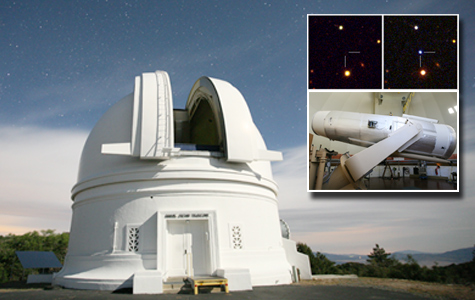 The 1.2-meter Samuel Oschin Telescope at Palomar Observatory that was used to discover four supernovae of a new class. Inset: one of the newly discovered supernovae, PTF09cnd.
Shri Kulkarni, Caltech's John D. and Catherine T. MacArthur Professor of Astronomy and Planetary Science and a coauthor on the paper, recruited Quimby to become a founding member of the Palomar Transient Factory (PTF). The PTF is a project that scans the skies for flashes of light that weren't there before—flashes that signal objects called transients, many of which are supernovae. As part of the PTF, Quimby and his colleagues used the 1.2-meter Samuel Oschin Telescope at Palomar Observatory to discover four new supernovae. After taking spectra with the 10-meter Keck telescopes in Hawaii, the 5.1-meter telescope at Palomar, and the 4.2-meter William Herschel Telescope in the Canary Islands, the astronomers discovered that all four objects had an unusual spectral signature.
Quimby then realized that if you slightly shifted the spectrum of 2005ap—the supernova he had found a couple of years earlier—it looked a lot like these four new objects. The team then plotted all the spectra together. "Boom—it was a perfect match," he recalls.
The astronomers soon determined that shifting the spectrum of SCP 06F6 similarly aligned it with the others. In the end, it turned out that all six supernovae are siblings, and that they all have spectra that are very blue—with the brightest wavelengths shining in the ultraviolet.
According to Quimby, the two mysterious supernovae—2005ap and SCP 06F6—had looked different from one another because 2005ap was 3 billion light-years away while SCP 06F6 was 8 billion light-years away. More distant supernovae have a stronger cosmological redshift, a phenomenon in which the expanding universe stretches the wavelength of the emitted light, shifting supernovae spectra toward the red end.
The four new discoveries, which had features similar to 2005ap and SCP 06F6, were at an intermediate distance, providing the missing link that connected the two previously unexplained supernovae. "That's what was most striking about this—that this was all one unified class," says Mansi Kasliwal, a Caltech graduate student and coauthor on the Nature paper.
Even though astronomers now know these supernovae are related, no one knows much else. "We have a whole new class of objects that can't be explained by any of the models we've seen before," Quimby says. What we do know about them is that they are bright and hot—10,000 to 20,000 degrees Kelvin; that they are expanding rapidly at 10,000 kilometers per second; that they lack hydrogen; and that they take about 50 days to fade away—much longer than most supernovae, whose luminosity is often powered by radioactive decay. So there must be some other mechanism that's making them so bright.
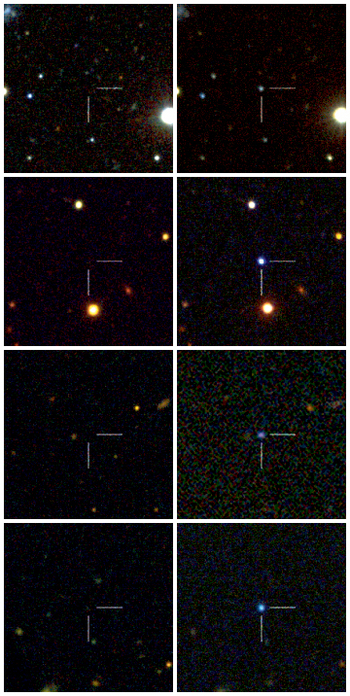 The four supernovae discovered by the Palomar Transient Factory. Left: before explosion. Right: after explosion. From top to bottom, the supernovae are PTF09atu, PTF09cnd, PTF09cwl, and PTF10cwr.
One possible model that would create an explosion with these properties involves a pulsating star about 90 to 130 times the mass of the sun. The pulsations blow off hydrogen-free shells, and when the star exhausts its fuel and explodes as a supernova, the blast heats up those shells to the observed temperatures and luminosities.
A second model requires a star that explodes as a supernova but leaves behind what's called a magnetar, a rapidly spinning dense object with a strong magnetic field. The rotating magnetic field slows the magnetar down as it interacts with the sea of charged particles that fills space, releasing energy. The energy heats the material that was previously blown off during the supernova explosion and can naturally explain the brightness of these events.
The newly discovered supernovae live in dim, small collections of a few billion stars called dwarf galaxies. (Our own Milky Way has 200–400 billion stars.) The supernovae, which are almost a hundred times brighter than their host galaxies, illuminate their environments like distant street lamps lighting up dark roads. They work as a kind of backlight, enabling astronomers to measure the spectrum of the interstellar gas that fills the dwarf galaxies in which the supernovae reside, and revealing each galaxy's composition. Once an observed supernova fades a couple of months later, astronomers can directly study the dwarf galaxy—which would have remained undetected if it weren't for the supernova.
These supernovae could also reveal what ancient stars might have been like, since they most likely originate from stars around a hundred times more massive than the sun—stars that would have been very similar to the first stars in the universe.
“It is really amazing how rich the night sky continues to be," Kulkarni says. "In addition to supernovae, the Palomar Transient Factory is making great advances in stellar astronomy as well.”
In addition to Quimby, Kasliwal, and Kulkarni, 24 other authors—11 of whom are from Caltech—contributed to the work described in the Nature paper, "A new class of hydrogen-poor super-luminous stellar explosions." This research was supported by the National Science Foundation, the United States-Israel Binational Science Foundations, the Israeli Science Foundation, the Department of Energy, the Gordon & Betty Moore foundation, Gary and Cynthia Bengier, the Richard and Rhoda Goldman Fund, and the Royal Society. The Palomar Transient Factory is a collaboration between Caltech, Columbia University, Las Cumbres Observatory Global Telescope, Lawrence Berkeley Laboratory, UC Berkeley, University of Oxford, and the Weizmann Institute of Science (Israel).
# # #
Written by Marcus Woo
PASADENA, Calif.—They're bright and blue—and a bit strange. They're a new type of stellar explosion that was recently discovered by a team of astronomers led by the California Institute of Technology (Caltech). Among the most luminous in the cosmos, these new kinds of supernovae could help researchers better understand star formation, distant galaxies, and what the early universe might have been like.
"We're learning about a whole new class of supernovae that wasn't known before," says Robert Quimby, a Caltech postdoctoral scholar and the lead author on a paper to be published in the June 9 issue of the journal Nature. In addition to finding four explosions of this type, the team also discovered that two previously known supernovae, whose identities had baffled astronomers, also belonged to this new class.
Quimby first made headlines in 2007 when—as a graduate student at the University of Texas, Austin—he discovered what was then the brightest supernova ever found: 100 billion times brighter than the sun and 10 times brighter than most other supernovae. Dubbed 2005ap, it was also a little odd. For one thing, its spectrum—the chemical fingerprint that tells astronomers what the supernova is made of, how far away it is, and what happened when it blew up—was unlike any seen before. It also showed no signs of hydrogen, which is commonly found in most supernovae.
At around the same time, astronomers using the Hubble Space Telescope discovered a mysterious supernova called SCP 06F6. This supernova also had an odd spectrum, though there was nothing that indicated this cosmic blast was similar to 2005ap.
The 1.2-meter Samuel Oschin Telescope at Palomar Observatory that was used to discover four supernovae of a new class. Inset: one of the newly discovered supernovae, PTF09cnd. [Credit: Caltech/Scott Kardel/Robert Quimby/modified from Nature]
Shri Kulkarni, Caltech's John D. and Catherine T. MacArthur Professor of Astronomy and Planetary Science and a coauthor on the paper, recruited Quimby to become a founding member of the Palomar Transient Factory (PTF). The PTF is a project that scans the skies for flashes of light that weren't there before—flashes that signal objects called transients, many of which are supernovae. As part of the PTF, Quimby and his colleagues used the 1.2-meter Samuel Oschin Telescope at Palomar Observatory to discover four new supernovae. After taking spectra with the 10-meter Keck telescopes in Hawaii, the 5.1-meter telescope at Palomar, and the 4.2-meter William Herschel Telescope in the Canary Islands, the astronomers discovered that all four objects had an unusual spectral signature.
Quimby then realized that if you slightly shifted the spectrum of 2005ap—the supernova he had found a couple of years earlier—it looked a lot like these four new objects. The team then plotted all the spectra together. "Boom—it was a perfect match," he recalls.
The astronomers soon determined that shifting the spectrum of SCP 06F6 similarly aligned it with the others. In the end, it turned out that all six supernovae are siblings, and that they all have spectra that are very blue—with the brightest wavelengths shining in the ultraviolet.
According to Quimby, the two mysterious supernovae—2005ap and SCP 06F6—had looked different from one another because 2005ap was 3 billion light-years away while SCP 06F6 was 8 billion light-years away. More distant supernovae have a stronger cosmological redshift, a phenomenon in which the expanding universe stretches the wavelength of the emitted light, shifting supernovae spectra toward the red end.
The four new discoveries, which had features similar to 2005ap and SCP 06F6, were at an intermediate distance, providing the missing link that connected the two previously unexplained supernovae. "That's what was most striking about this—that this was all one unified class," says Mansi Kasliwal, a Caltech graduate student and coauthor on the Nature paper.
Even though astronomers now know these supernovae are related, no one knows much else. "We have a whole new class of objects that can't be explained by any of the models we've seen before," Quimby says. What we do know about them is that they are bright and hot—10,000 to 20,000 degrees Kelvin; that they are expanding rapidly at 10,000 kilometers per second; that they lack hydrogen; and that they take about 50 days to fade away—much longer than most supernovae, whose luminosity is often powered by radioactive decay. So there must be some other mechanism that's making them so bright.
The four supernovae discovered by the Palomar Transient Factory. Left: before explosion. Right: after explosion. From top to bottom, the supernovae are PTF09atu, PTF09cnd, PTF09cwl, and PTF10cwr.[Credit: Caltech/Robert Quimby/Nature]
One possible model that would create an explosion with these properties involves a pulsating star about 90 to 130 times the mass of the sun. The pulsations blow off hydrogen-free shells, and when the star exhausts its fuel and explodes as a supernova, the blast heats up those shells to the observed temperatures and luminosities.
A second model requires a star that explodes as a supernova but leaves behind what's called a magnetar, a rapidly spinning dense object with a strong magnetic field. The rotating magnetic field slows the magnetar down as it interacts with the sea of charged particles that fills space, releasing energy. The energy heats the material that was previously blown off during the supernova explosion and can naturally explain the brightness of these events.
The newly discovered supernovae live in dim, small collections of a few billion stars called dwarf galaxies. (Our own Milky Way has 200–400 billion stars.) The supernovae, which are almost a hundred times brighter than their host galaxies, illuminate their environments like distant street lamps lighting up dark roads. They work as a kind of backlight, enabling astronomers to measure the spectrum of the interstellar gas that fills the dwarf galaxies in which the supernovae reside, and revealing each galaxy's composition. Once an observed supernova fades a couple of months later, astronomers can directly study the dwarf galaxy—which would have remained undetected if it weren't for the supernova.
These supernovae could also reveal what ancient stars might have been like, since they most likely originate from stars around a hundred times more massive than the sun—stars that would have been very similar to the first stars in the universe.
“It is really amazing how rich the night sky continues to be," Kulkarni says. "In addition to supernovae, the Palomar Transient Factory is making great advances in stellar astronomy as well.”
In addition to Quimby, Kasliwal, and Kulkarni, 24 other authors—11 of whom are from Caltech—contributed to the work described in the Nature paper, "A new class of hydrogen-poor super-luminous stellar explosions." This research was supported by the National Science Foundation, the United States-Israel Binational Science Foundations, the Israeli Science Foundation, the Department of Energy, the Gordon & Betty Moore foundation, Gary and Cynthia Bengier, the Richard and Rhoda Goldman Fund, and the Royal Society. The Palomar Transient Factory is a collaboration between Caltech, Columbia University, Las Cumbres Observatory Global Telescope, Lawrence Berkeley Laboratory, UC Berkeley, University of Oxford, and the Weizmann Institute of Science (Israel).
# # #
Written by Marcus Woo
Sunday, May 29, 2011
Memorial Day Tours on Palomar
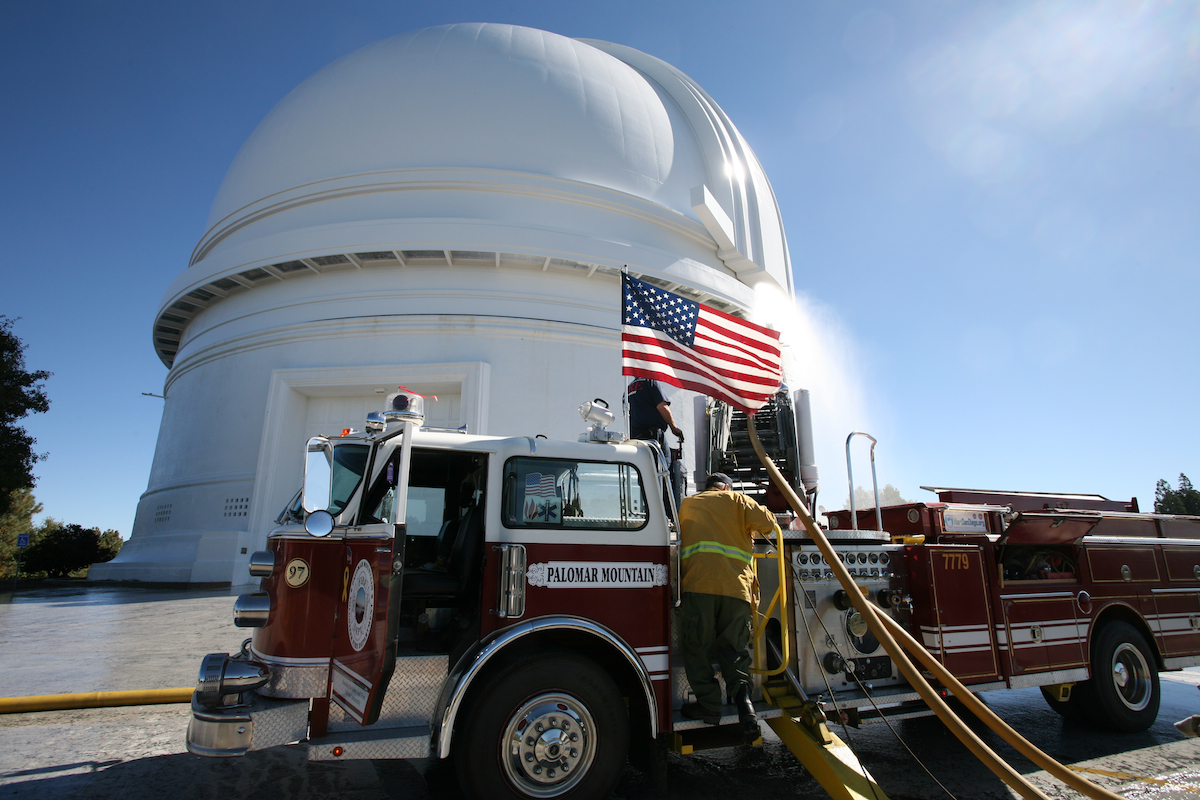
I don't know that you will be able to see flags and firetrucks, but it is Memorial Day weekend and we are celebrating by extending our public tours past the usual ones heldon Saturdays & Sundays to include Monday, May 30 as well. Tours will be at 11:00 a.m., 1:00 p.m. and 2:30 p.m. Tours are $8 per person. More information on the tours can be found here.
Friday, May 20, 2011
Zooming in on PALM-3000
Here are three photos that show off the PALM-3000 adaptive-optics system.
The first is a wide shot of the 200-inch Hale Telescope:
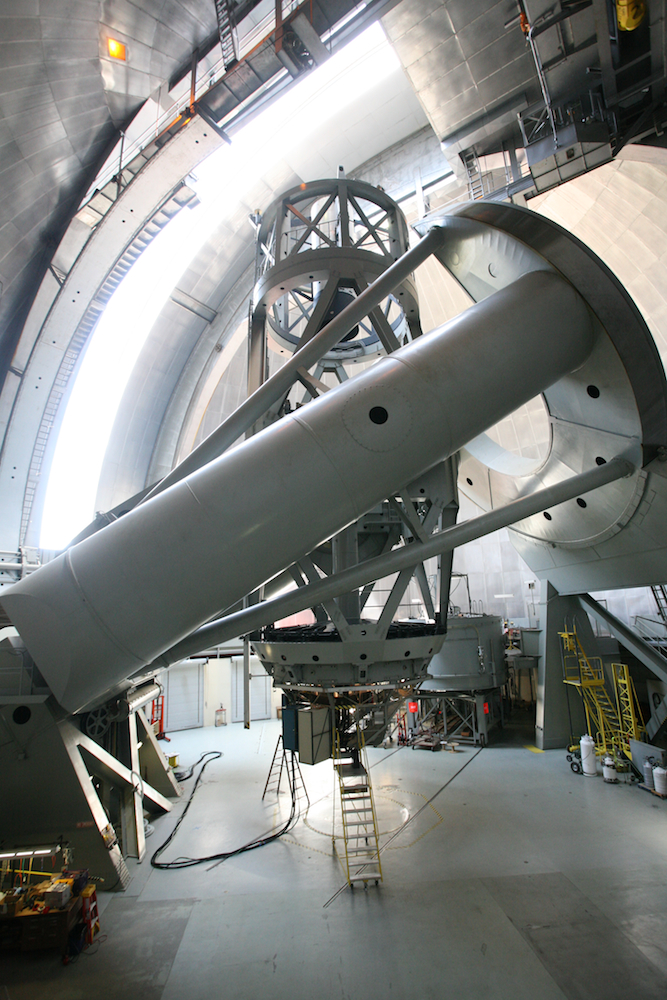 In this view the only easily noticeable changes to the telescope are the hoses and cables hanging from the telescope's south side. The instrument itself is housed in the telescope's Cassegrain cage and can be seen in this wide-angle photo:
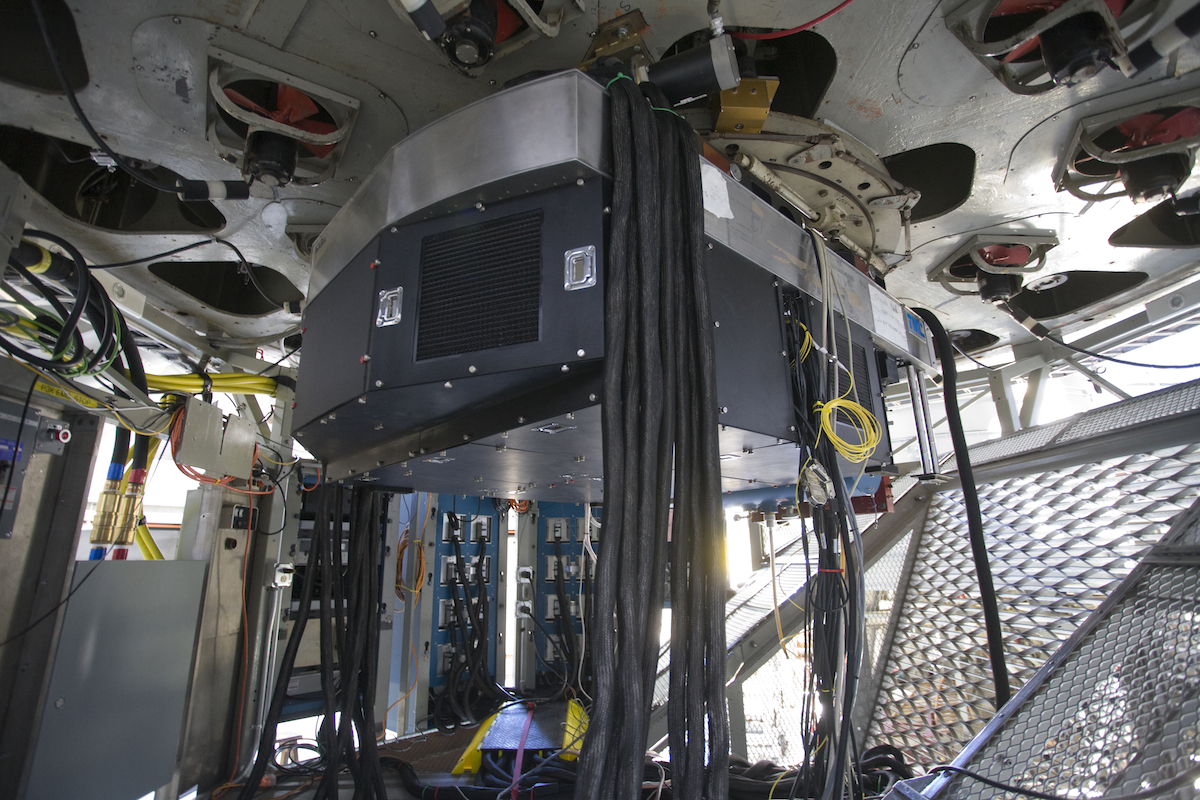 The photo gives a feel for some of the complexity of the system through the number of cables visible, but there is much more that the image does not capture. At the heart of the system is the new 3388 actuator higher order deformable mirror. Here you can see the back end of it here:
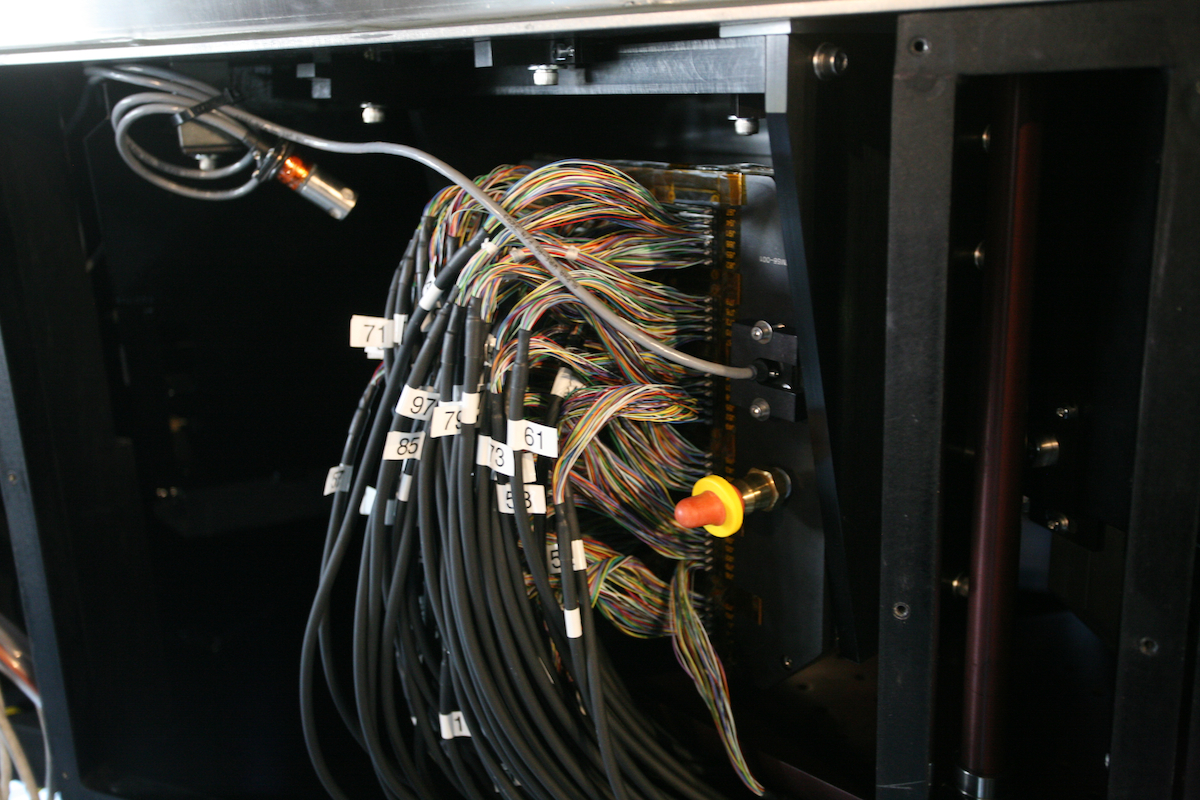 The weather has not been favorable for the first two nights of commissioning the instrument. The forecast for tonight looks good. Let's hope that the weather cooperates as tonight is the third and final night for this observing run. On Saturday the instrument comes off the telescope until their next observing run in June.
The first is a wide shot of the 200-inch Hale Telescope:
In this view the only easily noticeable changes to the telescope are the hoses and cables hanging from the telescope's south side. The instrument itself is housed in the telescope's Cassegrain cage and can be seen in this wide-angle photo:The photo gives a feel for some of the complexity of the system through the number of cables visible, but there is much more that the image does not capture. At the heart of the system is the new 3388 actuator higher order deformable mirror. Here you can see the back end of it here:The weather has not been favorable for the first two nights of commissioning the instrument. The forecast for tonight looks good. Let's hope that the weather cooperates as tonight is the third and final night for this observing run. On Saturday the instrument comes off the telescope until their next observing run in June.
North County News Visits Palomar Observatory
On Saturdays & Sundays guided tours of the Hale Telescope take place 3 times daily. North County News was up recently to see the action. Here is their video:
The public tours do not go into the control room, but they do get rave reviews. If you are going to be in the area, why come on over for a visit?
The public tours do not go into the control room, but they do get rave reviews. If you are going to be in the area, why come on over for a visit?
Thursday, May 19, 2011
Another Look at Installing PALM-3000
Here is another time-lapse movie of yesterday's installation of the PALM-3000 adaptive optics system onto the 200-inch Hale Telescope. This is shorter, covers less time, but is closer to the action as was shot with a digital SLR from on the observing floor.
Installing PALM-3000
Yesterday, the new upgrade to our adaptive-optics system, the PALM-3000, was first installed on the Hale Telescope. The webcam in the dome of the 200-inch telescope is currently offline to the outside world (sorry about that), but we were able to use it to capture images of the work taking place.
Here is almost 12 hours of work, compressed into just under 4 minutes
How did the first night go? Fog and drizzle kept the dome from opening. Thankfully, the weather is improving as the team has two more nights on this observing run, before the the instrument is used again in June.
More pictures and another video will follow as soon as things get put together.
Here is almost 12 hours of work, compressed into just under 4 minutes
How did the first night go? Fog and drizzle kept the dome from opening. Thankfully, the weather is improving as the team has two more nights on this observing run, before the the instrument is used again in June.
More pictures and another video will follow as soon as things get put together.
Tuesday, May 17, 2011
Palomar Observatory - A Timescape
Last weekend astronomer Roger Griffith was using the 200-inch Hale Telescope to hunt for cold brown dwarfs. His observations were made to follow-up on data collected with the Wide-Field Infrared Survey Explorer mission. In addition to his time on the telescope, Roger managed to dash out to continue work on a video of time-lapse photography that he had begun shooting at Palomar during one of his observing runs last year.
Here is the result:
Here is the result:
Palomar Observatory - A Timescape from Roger Griffith on Vimeo.
Glider Over Palomar
On a warm day it is not unusual to see a glider spiraling over Palomar Mountain. Occasionally they come close enough to the observatory that you can actually hear them.
We had gliders out last Saturday when Brad Eells of the Forest Fire Lookout Association took this photo:
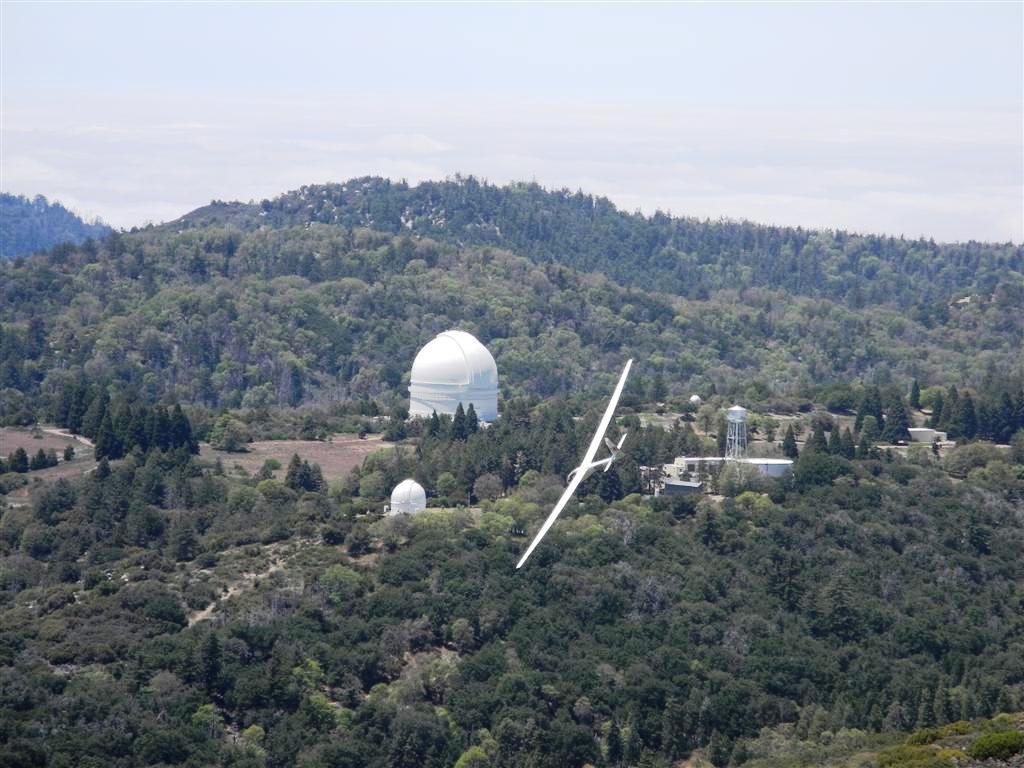 Brad took this unique photo from the old fire lookout tower at High Point, which looks down on the observatory. To the left of the glider are the domes of the 48-inch Samuel Oschin Telescope and the much larger 200-inch Hale Telescope. To the right of the glider is the dome of the 24-inch telescope and the observatory's water tower.
For another shot of a glider over the observatory, check out this post from 2009.
I know that blog posts here have been rare lately, that is starting to change as I have plenty of material to share. Be sure to check back for more this week.
We had gliders out last Saturday when Brad Eells of the Forest Fire Lookout Association took this photo:
Brad took this unique photo from the old fire lookout tower at High Point, which looks down on the observatory. To the left of the glider are the domes of the 48-inch Samuel Oschin Telescope and the much larger 200-inch Hale Telescope. To the right of the glider is the dome of the 24-inch telescope and the observatory's water tower.For another shot of a glider over the observatory, check out this post from 2009.
I know that blog posts here have been rare lately, that is starting to change as I have plenty of material to share. Be sure to check back for more this week.
Tuesday, May 3, 2011
Coming Soon: PALM-3000
Much of the behind-the-scenes work at Palomar Observatory lately has been directed toward supporting the upgrades for our new adaptive optics-system, known as PALM-3000. When fully functional, the system is expected to be the first of its kind and allow ground-based astronomers to get their clearest view yet in the visible portion of the spectrum (all other systems currently operate in the near infrared portion of the spectrum).
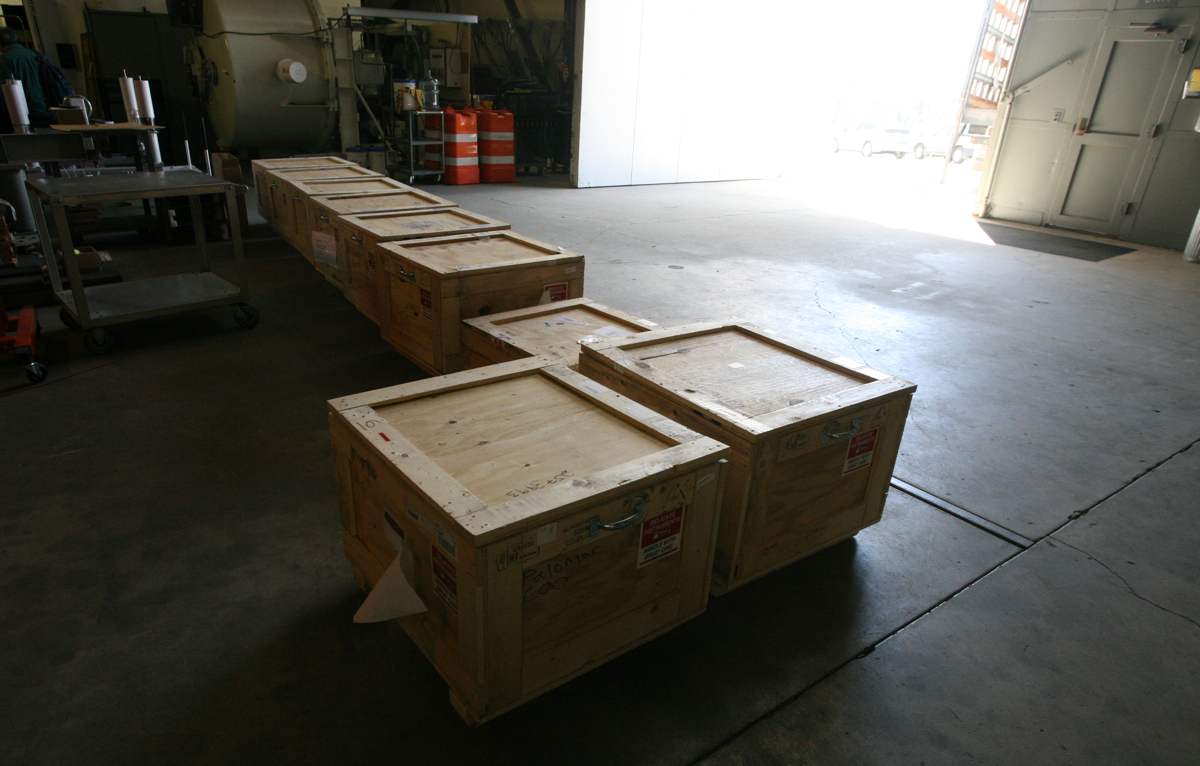
We had the final components for the system delivered to the dome of the Hale Telescope today.
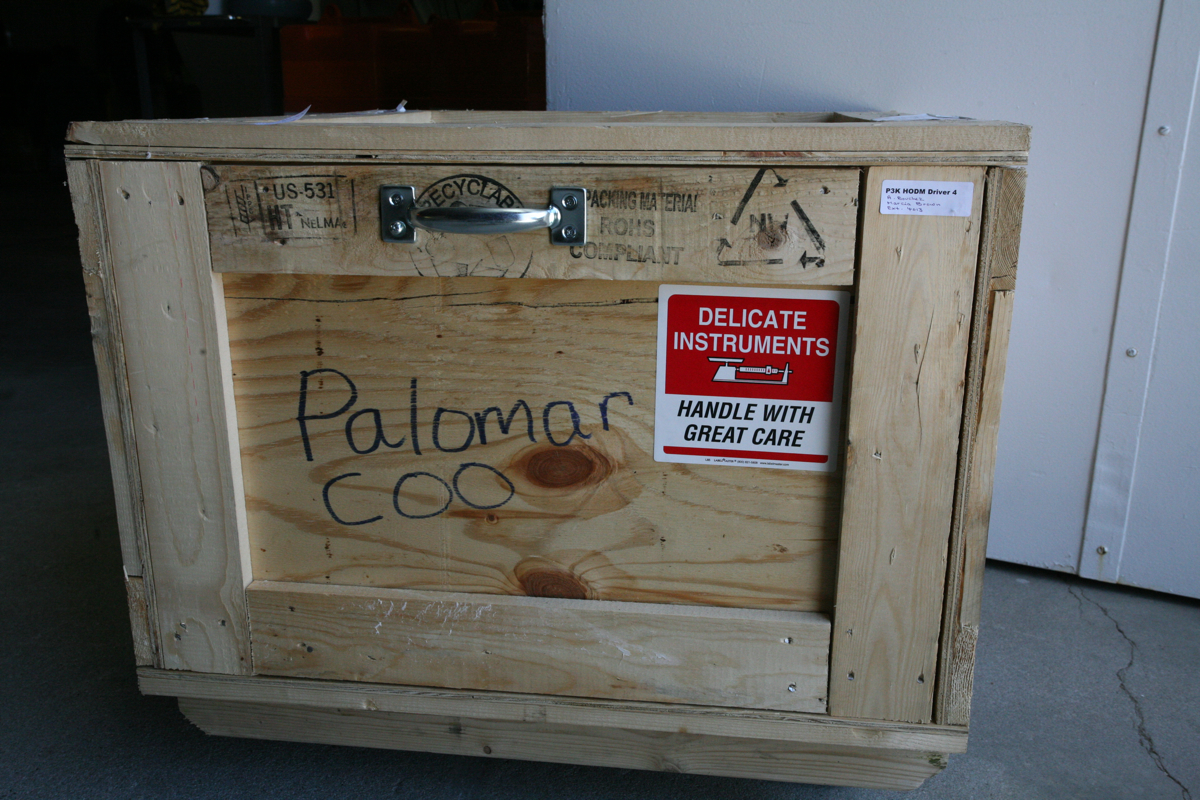 These may look like just a bunch of crates, but inside are the final components that will be installed to bring this system alive.
 More on this amazing system, which is expected to achieve "first light" later this month, will be posted here over the next few weeks, but in the meantime feel free to read this article on the systems new deformable mirror.
We had the final components for the system delivered to the dome of the Hale Telescope today.
These may look like just a bunch of crates, but inside are the final components that will be installed to bring this system alive.More on this amazing system, which is expected to achieve "first light" later this month, will be posted here over the next few weeks, but in the meantime feel free to read this article on the systems new deformable mirror.
Monday, May 2, 2011
Catwalk Panorama
Hopefully this panorama will show up on all Web browsers. It is an interactive Photosnyth panorama shot a few minutes ago from the catwalk of the 200-inch Hale Telescope. In it you can see the observatory's water tower, the dome of the 48-inch Samuel Oschin Telescope and the dome of the 18-inch Schmidt telescope.
Here is a direct link to the panorama. I hope to shoot more of these in the near future to give people a sense of what it is like to be at Palomar Observatory.
Here is a direct link to the panorama. I hope to shoot more of these in the near future to give people a sense of what it is like to be at Palomar Observatory.
Thursday, April 28, 2011
My Favorite 20-ton Piece of Glass
The folks over at the Corning Museum of Glass are asking people to vote for their favorite piece of glass in their collection. Can you guess which one happens to be my favorite?*
Here is a video that they produced that explains it:
Here is a direct link to the video on YouTube.
Last March Robert Cassetti, who is seen in the video, happened to give me a wonderful tour of the fabulous glass collection at the museum. If you are at all interested in unique and amazing glass artistry I encourage you to explore all 60 pieces that are highlighted for the museum's 6oth anniversary.
*By the way, the 200-inch mirror that is actually in service at Palomar is my favorite piece of glass. However, it is not on display, nor does it weigh 20 tons.
Here is a video that they produced that explains it:
Here is a direct link to the video on YouTube.
Last March Robert Cassetti, who is seen in the video, happened to give me a wonderful tour of the fabulous glass collection at the museum. If you are at all interested in unique and amazing glass artistry I encourage you to explore all 60 pieces that are highlighted for the museum's 6oth anniversary.
*By the way, the 200-inch mirror that is actually in service at Palomar is my favorite piece of glass. However, it is not on display, nor does it weigh 20 tons.
Friday, April 22, 2011
Dome Shadow

Here is the shadow of the dome of the Hale Telescope as it looked late yesterday afternoon. The dome of the 48-inch Samuel Oschin Telescope can be seen to the left of the shadow.
Thursday, April 14, 2011
The Edge of Night
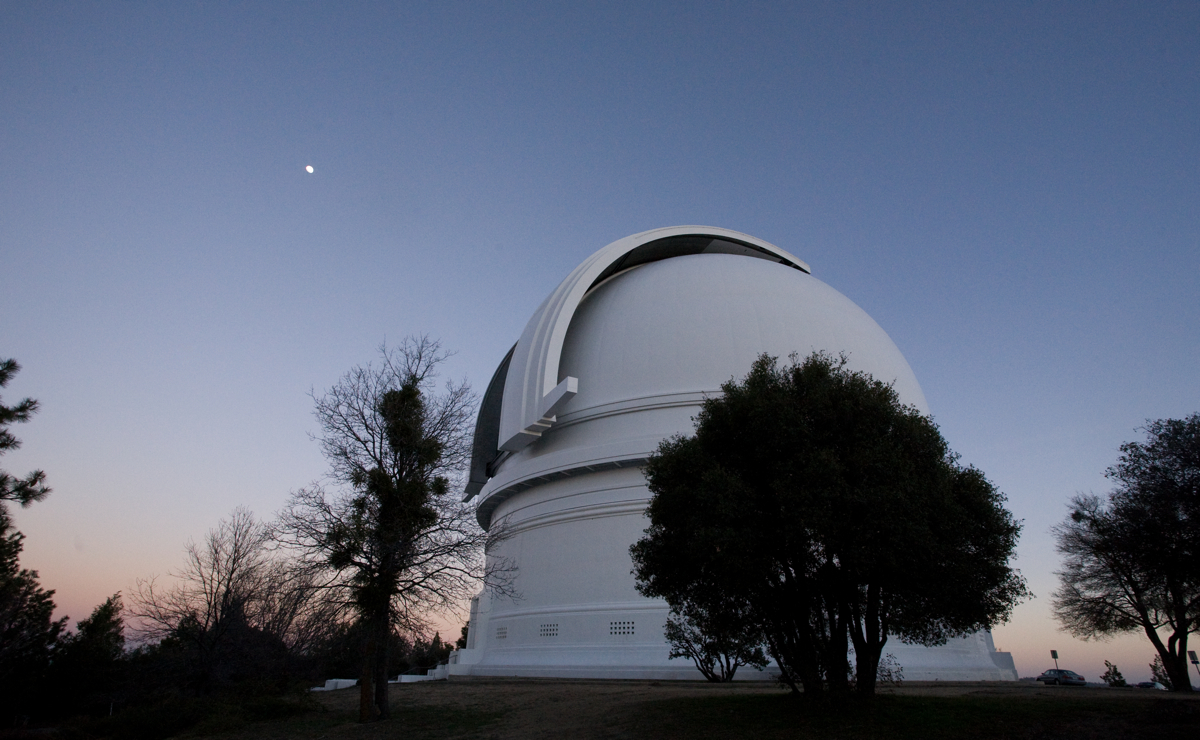 Here is how the dome and the Moon looked just after sunset.
It looks like we will have a good night tonight as the Hale Telescope is used to study quasars.
Subscribe to:
Posts (Atom)

 Posts
Posts

