The National Weather Service is predicting that the winter storm that is just starting to hit the Palomar area will drop some 12 - 20 inches of snow.
Currently there is dense fog, slick roads and snow actively falling.
If Nature delivers as expected it is a good bet that the observatory will be closed for at least the next several days. I will update the observatory's status as soon as there is something new to report.
Tuesday, February 9, 2010


Stupendous Man Visits Palomar Observatory
Look! Up in the Sky! It's a bird. It's a plane. It's Stupendous Man!
Back in the day, the comic strip Calvin and Hobbes ruled the funny pages. The imagination of six-year old Calvin was unlimited.
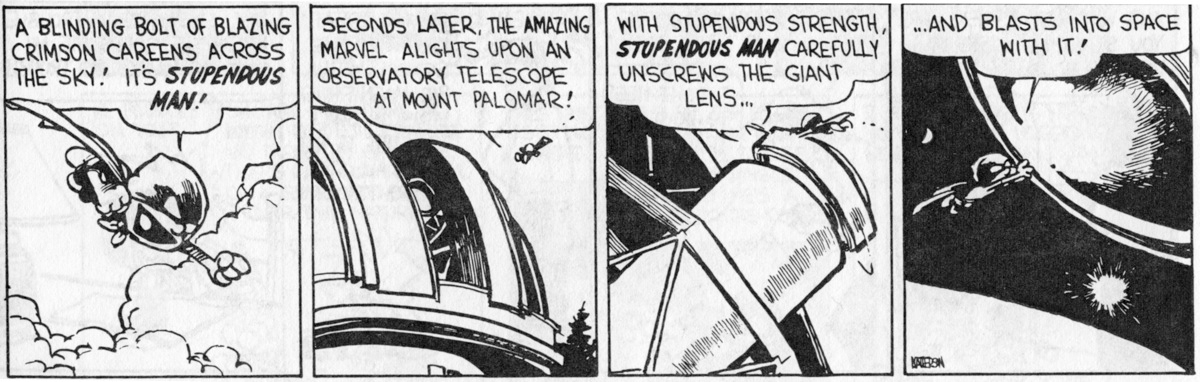
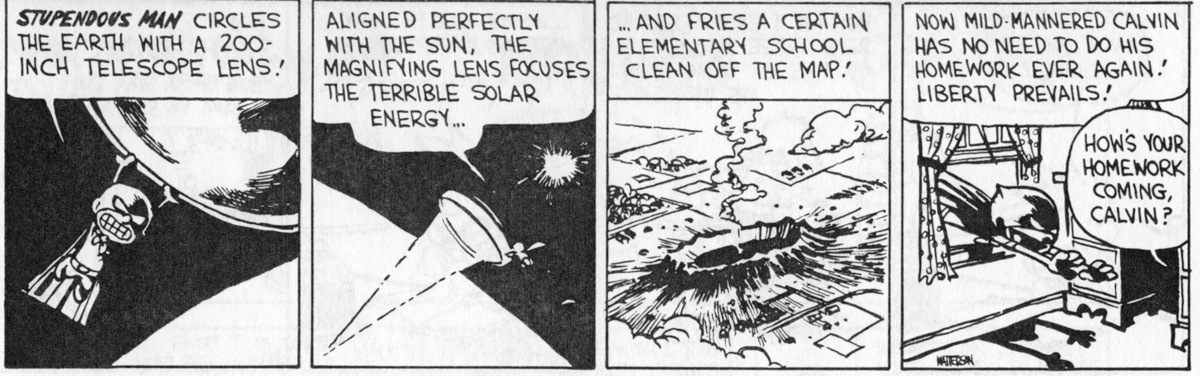
Here are two days of comics, pulled from the collection Scientific Progress Goes "Boink" where Calvin, disguised at Stupendous Man, visits Palomar Observatory:
 Be sure to click on each strip to enlarge.
Alas, the 200-inch telescope on Palomar Mountain (not Mount Palomar) does not have a giant lens. Like all modern research telescopes it uses a mirror to collect light. Of course Calvin can be forgiven. After all he is only six years old. Alas, a great many of our visitors ask about the lens even after we explain that it is all done with mirrors.
This just, perhaps, barely qualifies as another episode of Palomar in Science Fiction. Fear not, more episodes are on the way.
Back in the day, the comic strip Calvin and Hobbes ruled the funny pages. The imagination of six-year old Calvin was unlimited.
Here are two days of comics, pulled from the collection Scientific Progress Goes "Boink" where Calvin, disguised at Stupendous Man, visits Palomar Observatory:
Be sure to click on each strip to enlarge.Alas, the 200-inch telescope on Palomar Mountain (not Mount Palomar) does not have a giant lens. Like all modern research telescopes it uses a mirror to collect light. Of course Calvin can be forgiven. After all he is only six years old. Alas, a great many of our visitors ask about the lens even after we explain that it is all done with mirrors.
This just, perhaps, barely qualifies as another episode of Palomar in Science Fiction. Fear not, more episodes are on the way.
Monday, February 8, 2010
Palomar History Photo of the Week: February 8, 2010
I recently scanned this photo from an old lantern slide:

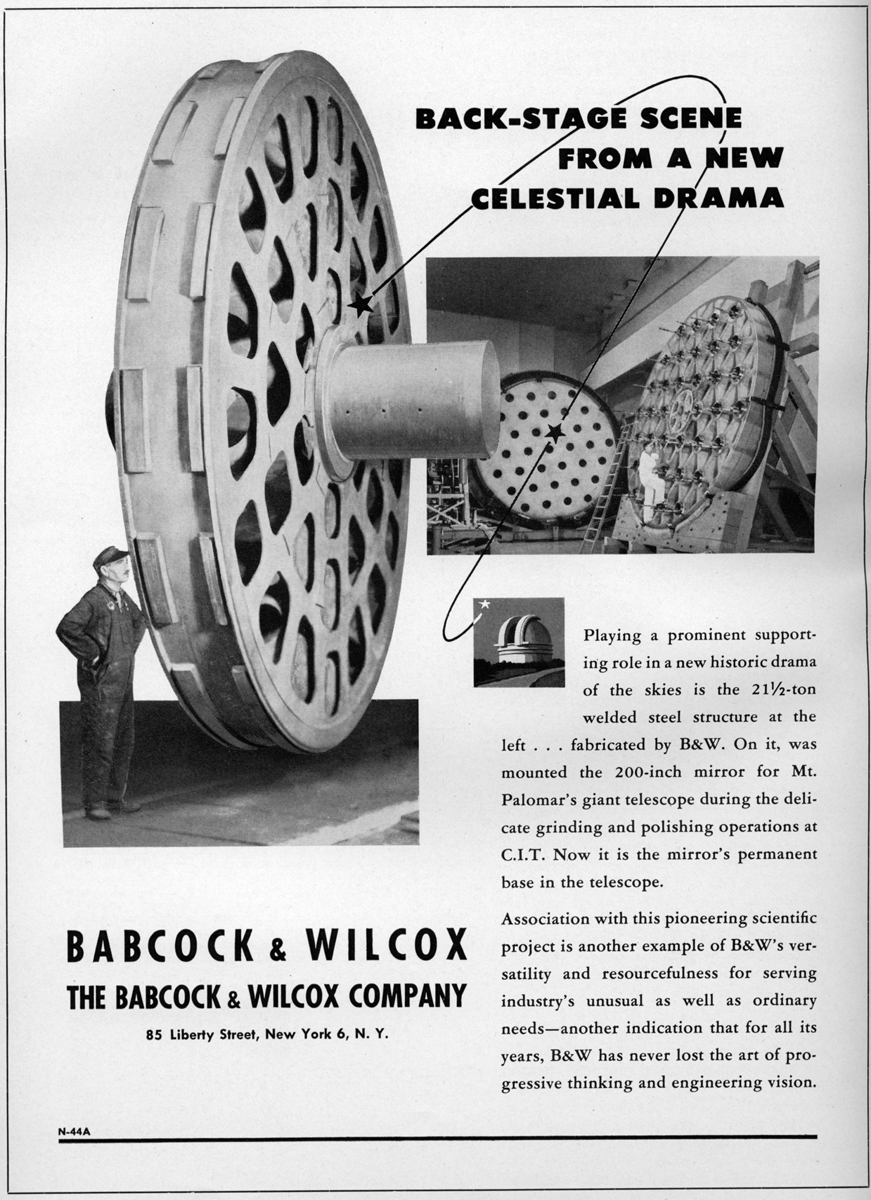
It shows a man standing with the mirror cell for the 200-inch telescope at Palomar. Unfortunately I do not know who is in the photo. Fortunately there is a date given on the photo: 10-25-35. October 25, 1935.
The photo was later featured in an ad for Babcock & Wilcox, the company that built the mirror cell.
 As always, you can click on it to see a bigger version.
The ad ran in the 1948 Caltech yearbook, The Big T.
It seemed like a good time to run this as all the openings in the mirror cell contain the mirror supports which are currently being serviced. In the ad the photo on the right shows optician Marcus Brown climbing the backside of the mirror. A portion of the mirror supports can be seen sticking out of that side of the mirror.
It shows a man standing with the mirror cell for the 200-inch telescope at Palomar. Unfortunately I do not know who is in the photo. Fortunately there is a date given on the photo: 10-25-35. October 25, 1935.
The photo was later featured in an ad for Babcock & Wilcox, the company that built the mirror cell.
As always, you can click on it to see a bigger version.The ad ran in the 1948 Caltech yearbook, The Big T.
It seemed like a good time to run this as all the openings in the mirror cell contain the mirror supports which are currently being serviced. In the ad the photo on the right shows optician Marcus Brown climbing the backside of the mirror. A portion of the mirror supports can be seen sticking out of that side of the mirror.
Friday, February 5, 2010
The Story of the Hale Telescope's Mirror Supports
Warning: This is a long blog post!
There can be no doubt that the Hale Telescope is a complex machine that was built to do a simple purpose: collect star light and focus it to a camera.
Of course the telescope has to be complex given the fact that it must point to various locations across the sky and then smoothly move to counteract Earth’s rotation. The physical structure was built knowing that its massive steel parts would sag under the weight of gravity. This was done in such a way as to keep the optical elements precisely aligned.
The glass mirror is also subject to the stresses and strains of gravity. Its surface is very precisely shaped into the form of elliptic parabaloid (the three dimensional form of a parabola). As the telescope points to various directions in the sky the mirror needs to be supported from its underside to counteract any distortion caused by gravity. These distortions can cause the mirror to deform, losing its perfect shape. Without a properly working system of support mechanisms it can become impossible to uniformly focus the telescope.
The designers of the telescope knew this. That is why the mirror was cast with a waffle-like underside.

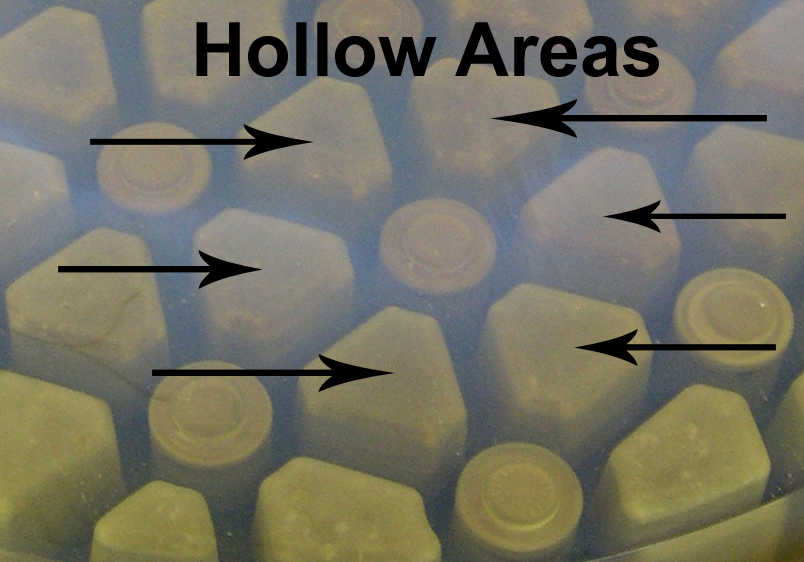
There are 78 hollow areas on the mirror’s underside. Together they make the mirror weigh 42% less than it would if it had been cast with a solid backside. Having a waffle-like backside also helps with the issue of changes in temperature. They give the mirror more surface area, which means that the whole thing can adjust to temperature swings more rapidly.
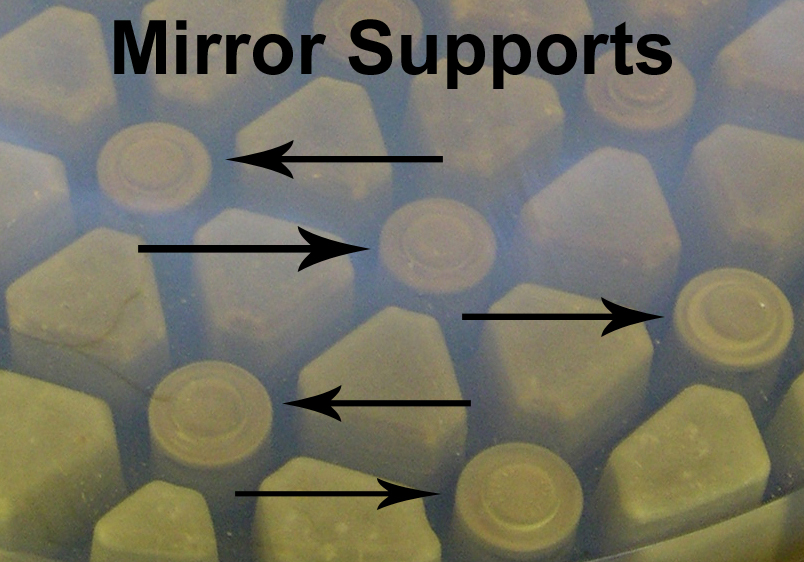 The 36 mirror supports are located in the round areas of the mirror’s underside. The locations of the ones visible in the photo are marked in the image above.
Fitting into each of these round holes is a very complex mechanism that ideally keeps the mirror in a perfect shape.
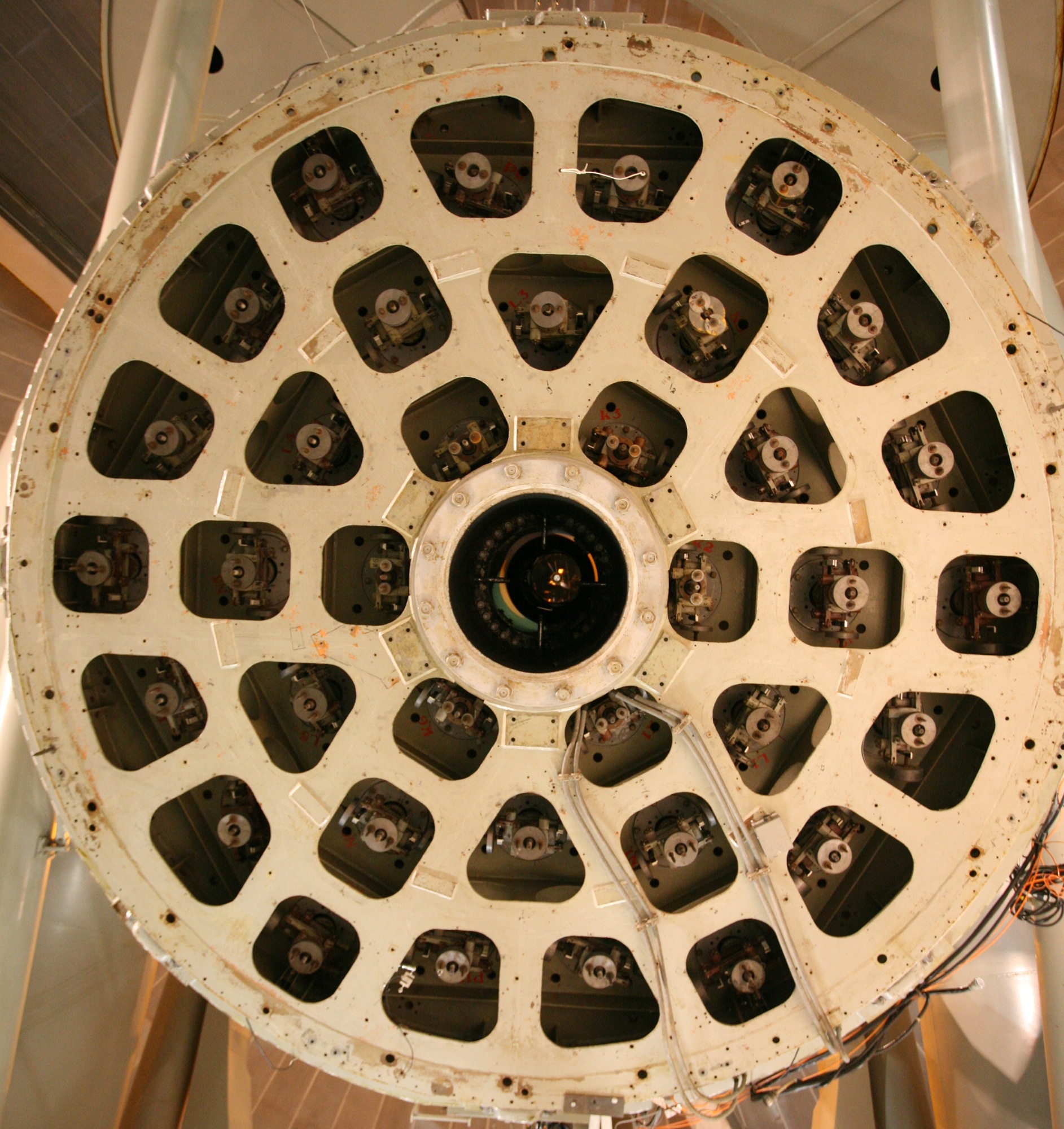
Let’s change the view now and look at the mirror’s underside. This image was taken last week as our current engineering run was just getting started. Notice the hole in the middle. Yes, the mirror has a big hole in it. This allows us to focus light to the underside of the telescope. In the photo of the mirror near the top of this post the hole was plugged.
In concentric circles centered around the central hole you can see the Hale Telescope’s 36 mirror supports. Click to enlarge and you’ll likely notice that the supports do not all look the same. Yes, each of the 36 supports is unique.
For those who might care, here is a map of the supports. It is in the same orientation as the photo above.
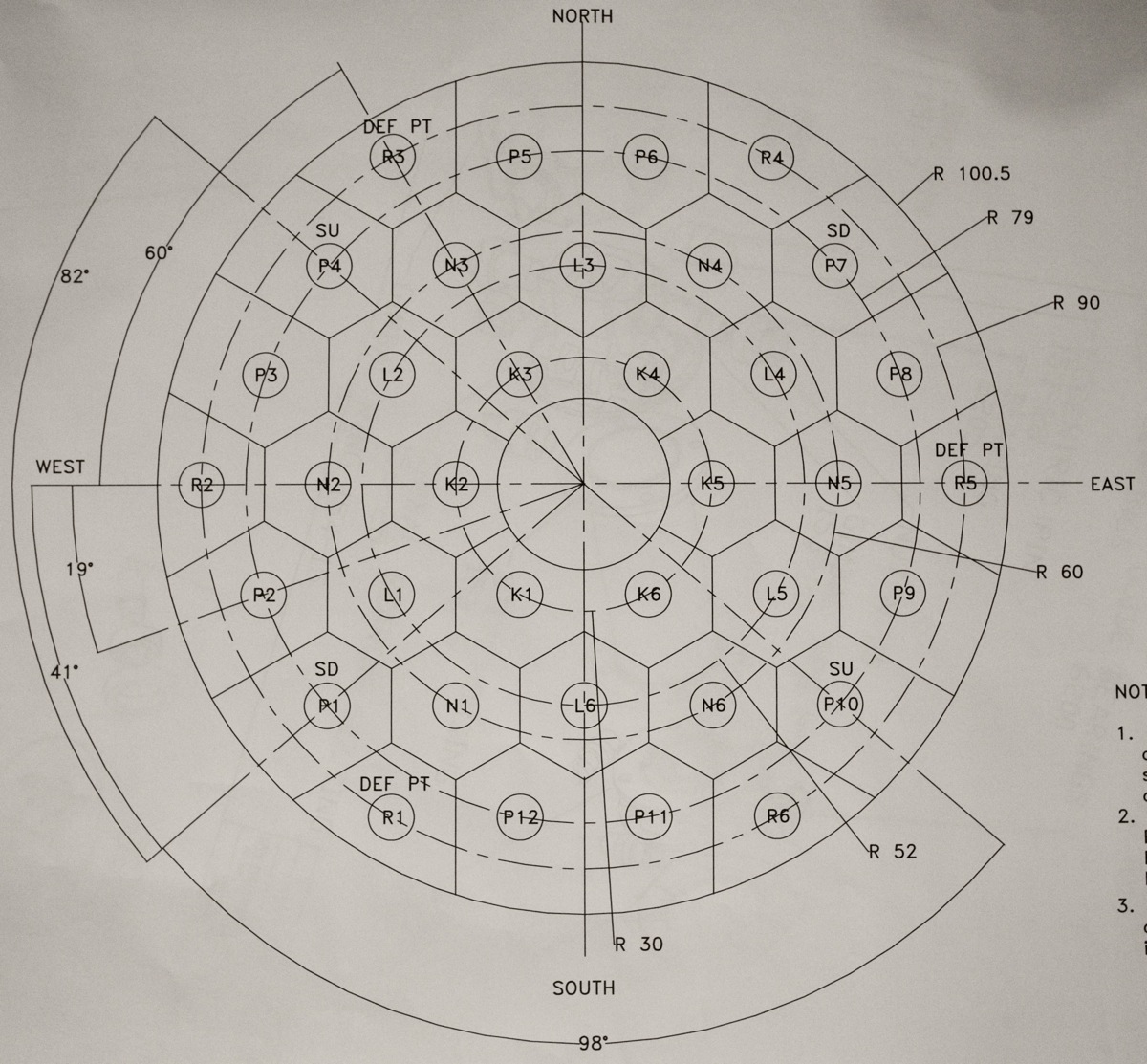
So what exactly do the supports do? They push back on the glass to counteract gravity. The supports near the center hole each exert an average force of about 700 pounds. Out along the outside of the mirror the mirror is thicker and the supports are farther apart, each of the supports needs to push with a force up to about 1,100 pounds.
The forces that the supports need to exert on the mirror must change as the telescope is pointed to different locations on the sky. Take for example the start of the night. The telescope starts off pointing at the zenith and after a quick check of the focus it is time to point at the first object of study. As the telescope moves each of the supports pivots in several ways changing their push on the glass. None of this is actually controlled. Once the supports are in the proper adjustment, gravity does all the work. Newer telescopes have computer-controlled systems that actually push and pull on the base of their mirrors to keep them finely tuned. This is called active optics (not to be confused with adaptive optics which is a different thing).
In 1949 when all the adjustments were done on the 200-inch mirror’s supports Ira Bowen and Bruce Rule found that things were just a little bit off. They added four spring scales to finish their work. Their locations are marked on the map above in positions labeled SU or SD. SU is where a spring pulls up and SD is a spring that pulls down. At mirror support P10 (lower right) the spring scale pulls up with a force of 5 ounces. At P1 (lower left) it pulls down with a force of 21 ounces. At P4 (upper left) it pulls up with a force of 16 ounces and at P7 (upper right) it pulls down with a force of 30 ounces. Remove just one spring scale and the telescope is out of adjustment.

The adjustments finished in 1949 worked for decades, but the mirror supports have to endure some extreme conditions. Every time the mirror is pulled to be washed and realuminized the mirror, the mirror cell and the back supports are potentially exposed to water from the washing. Further, the back supports are exposed to a partial vacuum, which can cause problems with the grease in the bearings.
The supports and the bearings have been worked on before and for the current engineering run 35 of the supports are being worked on (one was done last November).
So what are they doing in this engineering run? I will discuss that in a future post.
There can be no doubt that the Hale Telescope is a complex machine that was built to do a simple purpose: collect star light and focus it to a camera.
Of course the telescope has to be complex given the fact that it must point to various locations across the sky and then smoothly move to counteract Earth’s rotation. The physical structure was built knowing that its massive steel parts would sag under the weight of gravity. This was done in such a way as to keep the optical elements precisely aligned.
The glass mirror is also subject to the stresses and strains of gravity. Its surface is very precisely shaped into the form of elliptic parabaloid (the three dimensional form of a parabola). As the telescope points to various directions in the sky the mirror needs to be supported from its underside to counteract any distortion caused by gravity. These distortions can cause the mirror to deform, losing its perfect shape. Without a properly working system of support mechanisms it can become impossible to uniformly focus the telescope.
The designers of the telescope knew this. That is why the mirror was cast with a waffle-like underside.
This is what the mirror looks like when it is stripped of its reflective aluminum coating. The underside clearly comes into view. There are two main features you can see in the glass from this view.
There are 78 hollow areas on the mirror’s underside. Together they make the mirror weigh 42% less than it would if it had been cast with a solid backside. Having a waffle-like backside also helps with the issue of changes in temperature. They give the mirror more surface area, which means that the whole thing can adjust to temperature swings more rapidly.
The 36 mirror supports are located in the round areas of the mirror’s underside. The locations of the ones visible in the photo are marked in the image above.Fitting into each of these round holes is a very complex mechanism that ideally keeps the mirror in a perfect shape.
Let’s change the view now and look at the mirror’s underside. This image was taken last week as our current engineering run was just getting started. Notice the hole in the middle. Yes, the mirror has a big hole in it. This allows us to focus light to the underside of the telescope. In the photo of the mirror near the top of this post the hole was plugged.
In concentric circles centered around the central hole you can see the Hale Telescope’s 36 mirror supports. Click to enlarge and you’ll likely notice that the supports do not all look the same. Yes, each of the 36 supports is unique.
For those who might care, here is a map of the supports. It is in the same orientation as the photo above.
So what exactly do the supports do? They push back on the glass to counteract gravity. The supports near the center hole each exert an average force of about 700 pounds. Out along the outside of the mirror the mirror is thicker and the supports are farther apart, each of the supports needs to push with a force up to about 1,100 pounds.
The forces that the supports need to exert on the mirror must change as the telescope is pointed to different locations on the sky. Take for example the start of the night. The telescope starts off pointing at the zenith and after a quick check of the focus it is time to point at the first object of study. As the telescope moves each of the supports pivots in several ways changing their push on the glass. None of this is actually controlled. Once the supports are in the proper adjustment, gravity does all the work. Newer telescopes have computer-controlled systems that actually push and pull on the base of their mirrors to keep them finely tuned. This is called active optics (not to be confused with adaptive optics which is a different thing).
In 1949 when all the adjustments were done on the 200-inch mirror’s supports Ira Bowen and Bruce Rule found that things were just a little bit off. They added four spring scales to finish their work. Their locations are marked on the map above in positions labeled SU or SD. SU is where a spring pulls up and SD is a spring that pulls down. At mirror support P10 (lower right) the spring scale pulls up with a force of 5 ounces. At P1 (lower left) it pulls down with a force of 21 ounces. At P4 (upper left) it pulls up with a force of 16 ounces and at P7 (upper right) it pulls down with a force of 30 ounces. Remove just one spring scale and the telescope is out of adjustment.
The adjustments finished in 1949 worked for decades, but the mirror supports have to endure some extreme conditions. Every time the mirror is pulled to be washed and realuminized the mirror, the mirror cell and the back supports are potentially exposed to water from the washing. Further, the back supports are exposed to a partial vacuum, which can cause problems with the grease in the bearings.
The supports and the bearings have been worked on before and for the current engineering run 35 of the supports are being worked on (one was done last November).
So what are they doing in this engineering run? I will discuss that in a future post.
Thursday, February 4, 2010
Observatory Still Closed
Yes, the observatory is still closed to the public and I am told that will likely be the case for the rest of this week, including the coming weekend. Sorry about that.
Sunrise and Facebook
Here is this morning's sunrise.
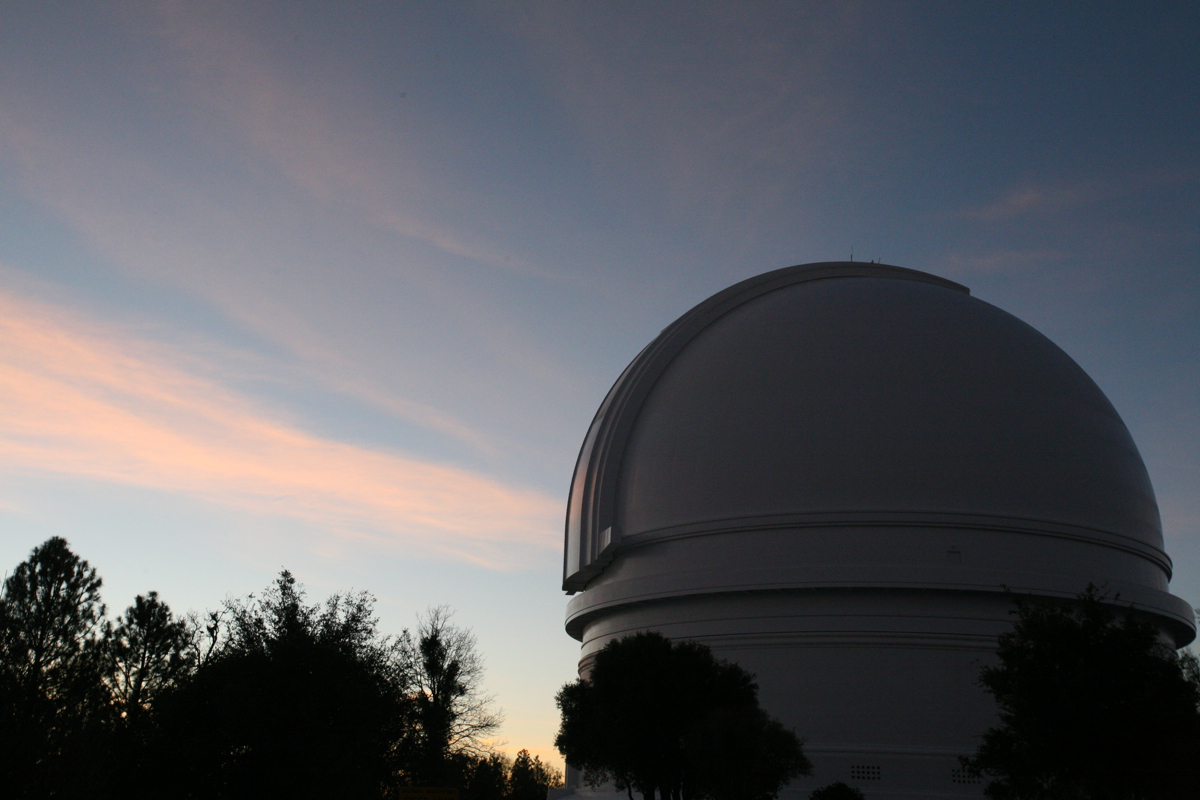 How does it compare to last Friday's sunrise?
Palomar Observatory is finally on Facebook. Click on the image below to head on over if you are part of the Facebook scene.

As a reminder Palomar Skies is on Twitter too.
How does it compare to last Friday's sunrise?Palomar Observatory is finally on Facebook. Click on the image below to head on over if you are part of the Facebook scene.
As a reminder Palomar Skies is on Twitter too.
Wednesday, February 3, 2010
The Asteroid that Became a Comet and the Comet that Became an Asteroid
Once in a while an asteroid comes along that changes things.
On January 6, 2010 the Lincoln Near Earth Asteroid Research team discovered a main-belt asteroid that was experiencing an outburst making it look like a comet. Comets aren't normally found in the asteroid belt and early indications suggested that this was an asteroid that had suffered a collision, which produced it's comet-like outburst and tail. A photo released yesterday (below) taken by the Hubble Space Telescope reveals that the object's tail does not resemble that of a normal comet and that the bright star-like nucleus is strangely offset from the tail itself. All of this tends to support the idea that this display is the result of the collision of two asteroids - an event never before witnessed.

Seeing an asteroid have a comet-like outburst reminds me of the case of a comet that apparently converted into an asteroid. Back in November 1949 Albert Wilson and Robert G. Harrington were using the 48-inch Schmidt (now called the Samuel Oschin Telescope) taking photos for first Palomar Sky Survey when they discovered a comet. Comet 107P/Wilson-Harrington was photographed by the duo over three nights but there was great uncertainty in the orbit and it was eventually lost.
Thirty years later, in November 1979, Eleanor Helin was observing at Palomar when she discovered a new asteroid temporarily dubbed 1979 VA. You can see it as the streak in the center of the image below.

In the early 1990s it was determined that Comet Wilson-Harrington and asteroid 1979 VA were the same object. The asteroid is now known as 4015 Wilson-Harrington and is thought to be a comet that lost all of its icy volatiles, or in essence a "burned out" comet. For more on the discovery of Wilson-Harrington have a look at this page over at Cometography.
Why do astronomers think that Wilson-Harrington is a dead comet and not an asteroid that had a collision back in 1949? It's orbit.

Notice that Wilson-Harrington's orbit is elliptical like a typical comet. At its farthest point from the Sun it is out in the asteroid belt, but at its closest point it comes in a little closer to the Sun than Earth is. Just like a typical comet, this one had its 1949 outburst when it was close to the Sun and its heating.
By the way, as of a few days ago the count of the total number of asteroids discovered at Palomar Observatory stood at 23,366.
On January 6, 2010 the Lincoln Near Earth Asteroid Research team discovered a main-belt asteroid that was experiencing an outburst making it look like a comet. Comets aren't normally found in the asteroid belt and early indications suggested that this was an asteroid that had suffered a collision, which produced it's comet-like outburst and tail. A photo released yesterday (below) taken by the Hubble Space Telescope reveals that the object's tail does not resemble that of a normal comet and that the bright star-like nucleus is strangely offset from the tail itself. All of this tends to support the idea that this display is the result of the collision of two asteroids - an event never before witnessed.
Seeing an asteroid have a comet-like outburst reminds me of the case of a comet that apparently converted into an asteroid. Back in November 1949 Albert Wilson and Robert G. Harrington were using the 48-inch Schmidt (now called the Samuel Oschin Telescope) taking photos for first Palomar Sky Survey when they discovered a comet. Comet 107P/Wilson-Harrington was photographed by the duo over three nights but there was great uncertainty in the orbit and it was eventually lost.
Thirty years later, in November 1979, Eleanor Helin was observing at Palomar when she discovered a new asteroid temporarily dubbed 1979 VA. You can see it as the streak in the center of the image below.
In the early 1990s it was determined that Comet Wilson-Harrington and asteroid 1979 VA were the same object. The asteroid is now known as 4015 Wilson-Harrington and is thought to be a comet that lost all of its icy volatiles, or in essence a "burned out" comet. For more on the discovery of Wilson-Harrington have a look at this page over at Cometography.
Why do astronomers think that Wilson-Harrington is a dead comet and not an asteroid that had a collision back in 1949? It's orbit.
Notice that Wilson-Harrington's orbit is elliptical like a typical comet. At its farthest point from the Sun it is out in the asteroid belt, but at its closest point it comes in a little closer to the Sun than Earth is. Just like a typical comet, this one had its 1949 outburst when it was close to the Sun and its heating.
By the way, as of a few days ago the count of the total number of asteroids discovered at Palomar Observatory stood at 23,366.
Tuesday, February 2, 2010
Engineering Time-Lapse
Here is a time-lapse video that takes the entire first day of engineering on the mirror supports and compresses it into about a minute and a half.
Most of the work during the first day was directed toward preparing the telescope with earthquake tie-downs, removing the Cassegrain cage and preparing for the removal and refurbishment of the mirror supports.
Video on Blogger is somewhat compressed, so if you want to see a larger, 99 mb version, click here. I should have some more of this kind of time-lapse to show off later on. Thanks to Mike V for his help on this!
Stellar Docents
Last Saturday night Palomar Observatory honored our docents who have given exceptional levels of service.
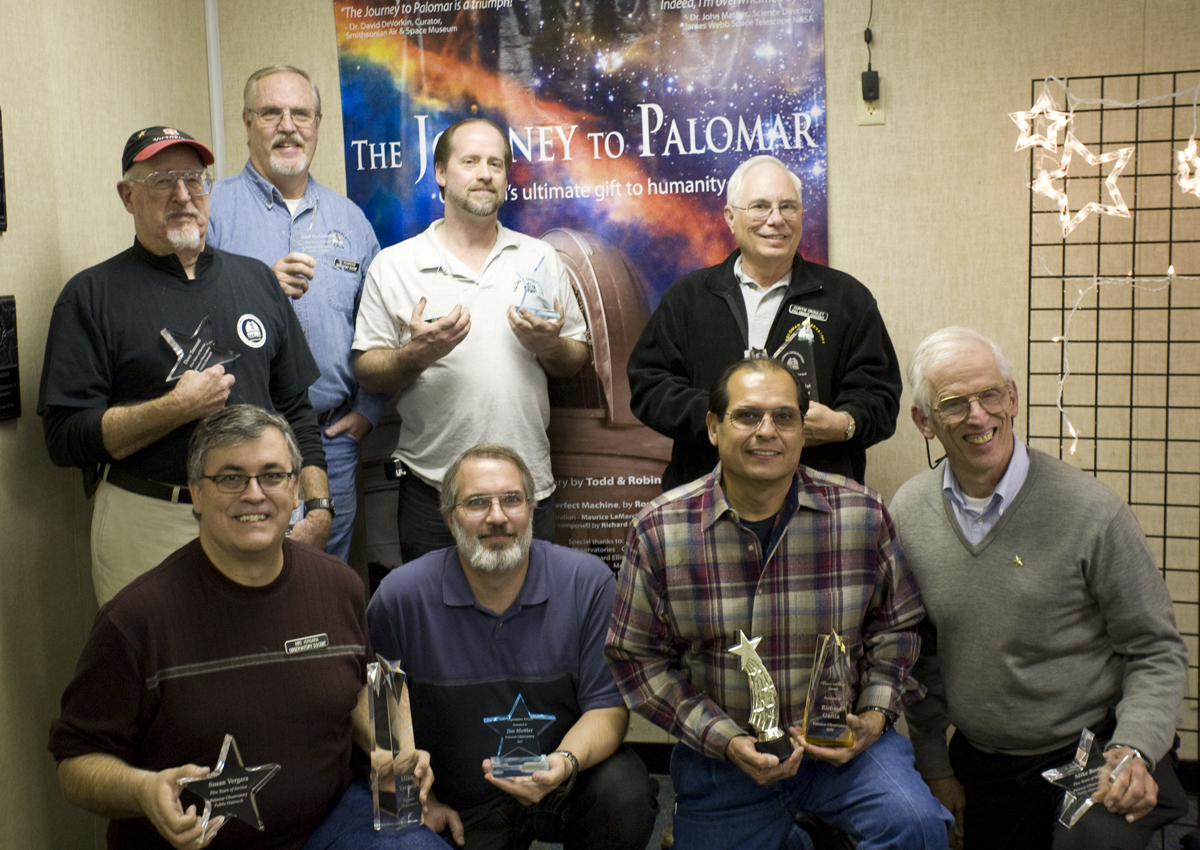
They help tell the observatory's story through tours and many other ways. I am very glad to have them around.
They help tell the observatory's story through tours and many other ways. I am very glad to have them around.
Monday, February 1, 2010
Palomar History Photo of the Week - February 1, 2010
This week's Palomar Observatory History Photo of the Week comes from the Caltech Optical Shop.
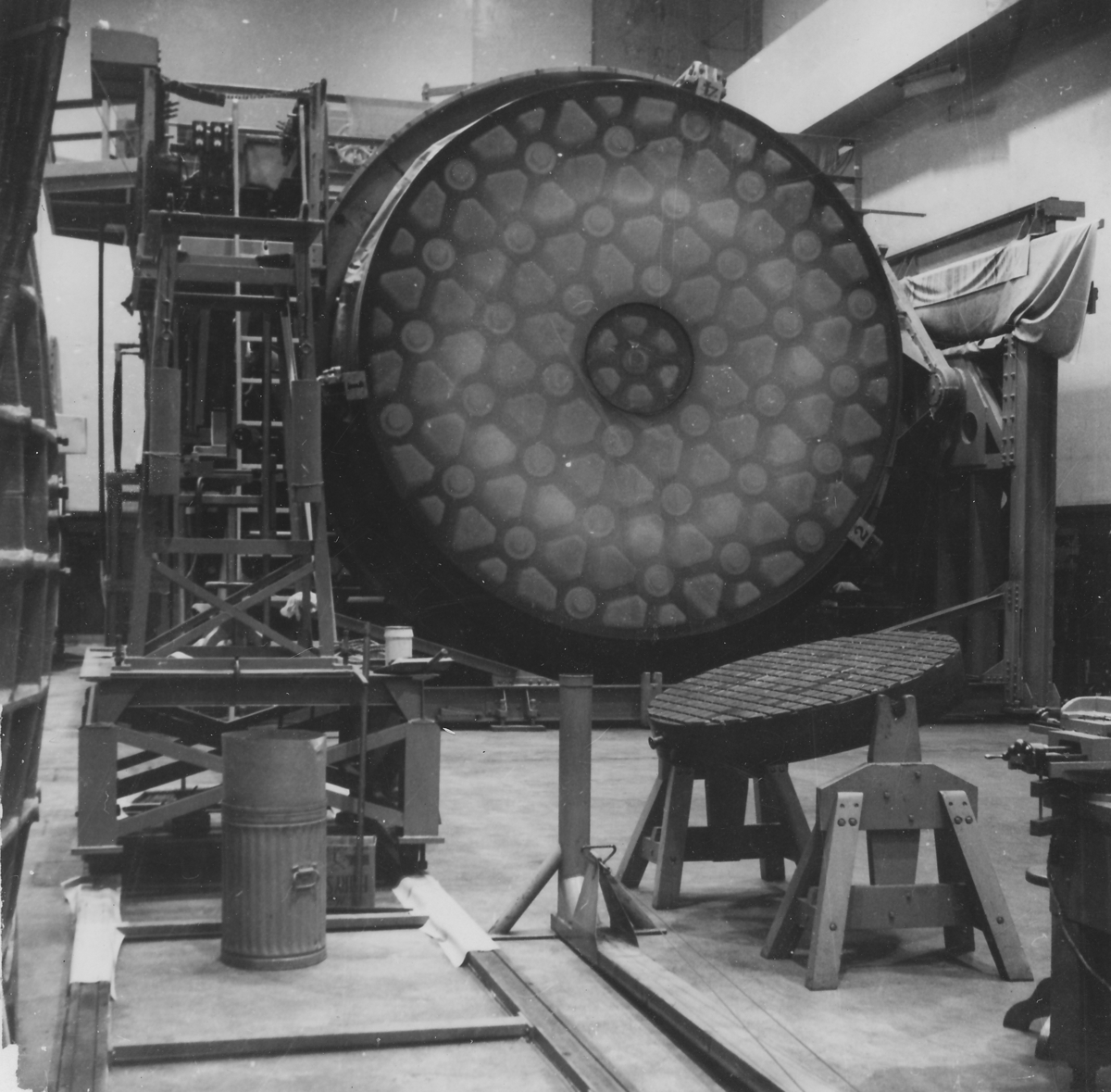
The photo was taken by optician Blake Mitchell on December 15, 1946. Here is Blake's somewhat brief caption to the photo which he wrote on the back of the print:
The photo was taken by optician Blake Mitchell on December 15, 1946. Here is Blake's somewhat brief caption to the photo which he wrote on the back of the print:
I hope to get some more posts this week including a new episode of Palomar in Science Fiction, an update on the work being done on the Hale Telescope's mirror supports and more. Stay tuned.
The 200" disc tipped up for testing. A 50" pitch polishing tool in foreground.
Subscribe to:
Posts (Atom)

 Posts
Posts

