Tuesday, September 14, 2010

Palomar History Photo of the Week - September 14, 2010


Our history photo of the week shows the 200-inch mirror as it looked in the Caltech Optical Shop May 13, 1939. The disc looks dramatically different from how it looked when it arrived three years earlier.

Saturday, September 11, 2010

Last Night from our New All-Sky Camera

Here is how last night looked from our new all-sky camera:


If you look closely (you may need to watch it more than once) you can spot the dome of the Hale Telescope in the upper right - near the edge of trees. Here is a direct link to it on YouTube.

Monday, September 6, 2010

Palomar History Photo of the Week - Labor Day 2010

It is Labor Day here in the U.S. - time to celebrate hard work by hopefully taking a day off from work. A lot of people worked very hard building the 200-inch telescope including these people from the Westinghouse Electric and Manufacturing Company's South Philadelphia plant.


Westinghouse assembled this cast photo of the crew that built the telescope. In this shot they are assembled in the still ring that would later attach the 200-inch mirror to the telescope. We are thankful for the hard work put in by all of the people who helped make the observatory a reality.

Happy Labor Day!

Friday, September 3, 2010

Fire Danger now Very High


As of this morning the Fire Danger in the Cleveland National Forest on Palomar Mountain is now rated at "Very High". Be careful out there.

Hale Telescope Tours Continue on Weekends in September & October

Most of the time when people visit Palomar Observatory they can only see the Hale Telescope from the Visitors Gallery (shown above). If you visit on a weekend through the end of October you can get on the other side for a guided tour.

Tours are offered at 11:30 a.m., 1:00 p.m. & 2:30 p.m. Tickets are $8.00 per person for all ages. Tour tickets are sold in the gift shop the day of the tour on a first-come, first-served basis. The gift shop opens at 10:00 a.m. No prior reservations are taken. The tour is not recommended for children under six years of age. Sorry, no pets.

Tours cover the history and current scientific research of the Palomar Observatory, with a special emphasis on the 200-inch Hale Telescope. Remember it can be pretty cool in the dome as the interior is kept at nighttime temperatures (for an elevation of 5,500 feet). High-heeled shoes are not recommended for the tours.

These one-hour-long tours are held on Saturdays & Sundays only now through the end of October.

Wednesday, September 1, 2010

Preview: Palomar's New All-Sky Camera

Here is a preview shot from Palomar Observatory's new all-sky camera. This photo was taken last night right at moonrise. Our all-sky camera is not yet perfectly focused or installed in its final spot (It will be on the pole in the photo), but in this shot it did capture the Milky Way and a meteor.


I will announce it here when the camera is up and running. From time to time I'll post interesting images or movies as they come in.

Monday, August 30, 2010

Palomar History Photo of the Week - August 30, 2010


This photo of the dome for the 200-inch telescope was taken 73 years ago - August 31, 1937.

Okay, I am one day early. Sorry about that. Still, it is a wonderful photo of the dome under construction. Don't you agree?

Saturday, August 28, 2010

Asteroid Discovery Video

Check out this cool video by Scott Manley of asteroids as they are discovered from 1980 to the present time. Many thousands of the ones shown here were discovered at Palomar Observatory (and lots of other places too).


Check out the full resolution version here at YouTube. You can get the full text there, but note that most of asteroids are discovered in the opposite direction of the sun. That is until the very end when a new set of discoveries shows up, those asteroids discovered by the Wide-field Infrared Survey Explorer.

Friday, August 27, 2010

Astrophoto Friday - Saturn's Moon Titan

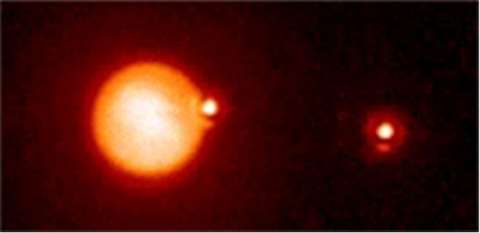
It is Astrophoto Friday! This week's image shows a unique event that was captured by the 200-inch Hale Telescope armed with adaptive optics.

What might look like Pac Man swallowing a dot is actually Saturn's moon Titan occulting (passing in front of) a binary star system (named NV0435215+200905). The two stars are separated in the sky by just 1.5 arc seconds (One arc second is 1/3600 of a degree).
Because fantastic resolving power of the Hale using adaptive optics you can see that the light of the star nearest to Titan is being refracted by Titan's dense atmosphere. Such events are rare, but valuable. The starlight as it is seen passing through Titan's atmosphere is essentially a probe providing clues as to the density, temperature and wind patterns of this distant world. The team of astronomers (Antonin Bouchez, Michael E. Brown, Mitchell Troy, Rick S. Burruss, Richard G. Dekany and Robert A. West) that observed this event December 20, 2001 was fortunate that both of the stars were seen to pass behind Titan. This provided two passes through Titan's atmosphere - effectively doubling what could be learned from the event.

Be sure to check out the movie of the event. As you watch it will look like Titan is still and the stars are moving behind it. As they pass behind Titan be sure to look for the refracted light of each star on either side of Titan's atmosphere. It is an impressive sight!

The result? Jet stream winds were discovered in Titan's atmosphere.

For those so inclined you can read a pdf of one of the scientific publication that came out of these observations.

Thursday, August 26, 2010

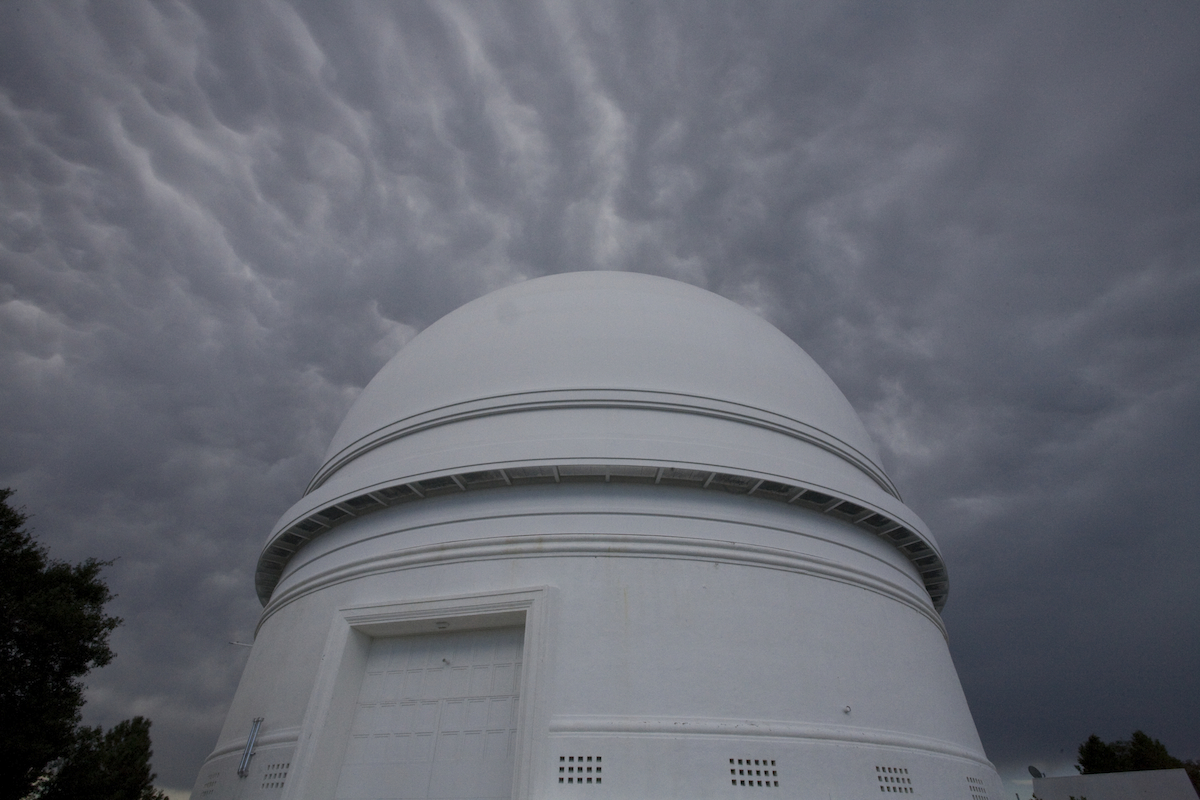
Mammatus Clouds Over Palomar

There has been some strong thunderstorm activity nearby the observatory today. While we haven't had any rain, there has been lightning in the area and an impressive display of mammatus clouds.

Here is a close-up of the mammatus clouds:
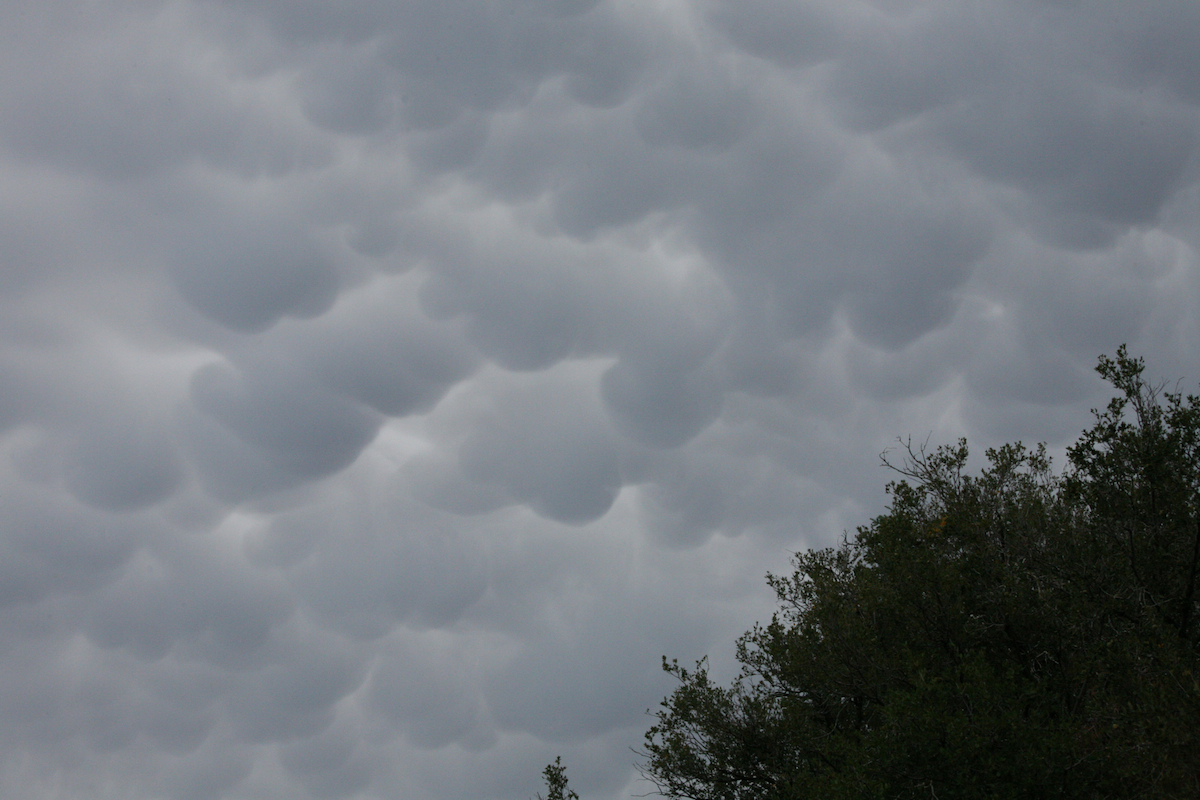
Thunderstorms can bring dangerous weather here in the back country. It is important for visitors to the area to pay attention to any weather alerts and to do their best to use common sense to try to be safe, especially when there is lightning in the area.

Update: Clouds cleared by sunset and a full night (9.5 hours) of observing was enjoyed by astronomers using the Hale Telescope.