You can read summaries of his impressive career from Carnegie Observatories, Nature, Astronomy Now, and Sky & Telescope.
Tuesday, November 16, 2010
Allan Sandage, 1926 - 2010
Observational cosmologist Allan Sandage has passed away. In memory of his brilliant career our history photo of the week is 1950s photo of Dr. Sandage in front of the 200-inch Hale Telescope.
You can read summaries of his impressive career from Carnegie Observatories, Nature, Astronomy Now, and Sky & Telescope.
You can read summaries of his impressive career from Carnegie Observatories, Nature, Astronomy Now, and Sky & Telescope.


Saturday, November 13, 2010
Hale Telescope Under Moonlight
Here are two photos of the 200-inch Hale Telescope illuminated by moonlight. Both were taken on Friday November 12, 2010.
 The Hale Telescope is used virtually every clear night of the year for astronomical research. The research mission on that particular night was imaging and spectroscopy of ultra luminous infrared galaxies discovered by the Wide-field Infrared Survey Explorer mission.

The Hale Telescope is used virtually every clear night of the year for astronomical research. The research mission on that particular night was imaging and spectroscopy of ultra luminous infrared galaxies discovered by the Wide-field Infrared Survey Explorer mission.
Friday, November 12, 2010
Astrophoto Friday - the California Nebula
This week Astrophoto Friday brings us the California Nebula.

The California Nebula (also known as NGC 1499) is an emission nebula consisting largely of ionized hydrogen gas. It was named for its resemblance to the state of California - home to the Palomar Observatory. The nebula is located approximately 1,000 light years from our solar system in the direction of the constellation of Perseus.
The bright blue star Xi Persei (to the right of the nebula) most likely is the source of illumination for the nebula.
This image is a composite from two black and white images taken with the Palomar Observatory's 48-inch (1.2-meter) Samuel Oschin Telescope as a part of the Second Palomar Observatory Sky Survey (POSS II). The images were recorded on two glass photographic plates - one sensitive to red light and the other to blue. The plates were scanned and color combined to produce the image seen here.
Palomar's Beautiful Universe
You may remember Wally Pacholka's panorama of the Milky Way & the dome of the Hale Telescope. It was an Astrophoto Friday image here back in June.
The editors of Sky & Telescope have chosen to place a cropped version of Wally's picture on the cover of the 2011 edition of their Beautiful Universe publication.
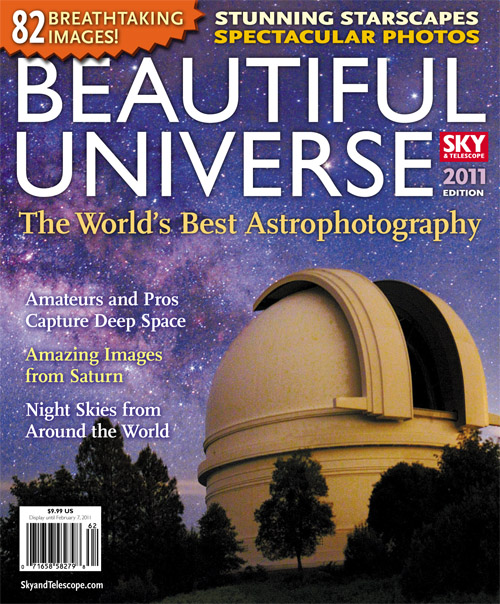
You can buy it directly from S&T's online store and it should be in your local newsstands next week.
The editors of Sky & Telescope have chosen to place a cropped version of Wally's picture on the cover of the 2011 edition of their Beautiful Universe publication.
You can buy it directly from S&T's online store and it should be in your local newsstands next week.
Monday, November 8, 2010
Palomar History Photo of the Week - On Top of the World
This week's history photo of the week is another photo from the wonderful collection of photos taken by and of Lee A. Farnsworth, Jr. This particular shot was taken September 17, 1942 and that is Lee standing on top of the dome for the 200-inch telescope.
 Click to see a larger version and you be able to see some of the structure of the telescope through the partially opened dome slit.
Sunday, November 7, 2010
"Winter" Visiting Hours Return
Starting Monday, November 8 the observatory return to "winter" visiting hours. We will be open to the public daily (except December 24 & 25) from 9:00 a.m. until 3:00 p.m.
The observatory will also be closed if conditions are hazardous due to things like extreme weather (mostly snow & ice). Look to the blog here for updates if you are uncertain about our current status.
The observatory will also be closed if conditions are hazardous due to things like extreme weather (mostly snow & ice). Look to the blog here for updates if you are uncertain about our current status.
Friday, November 5, 2010
Tonight's Delta II Launch - as seen from Palomar
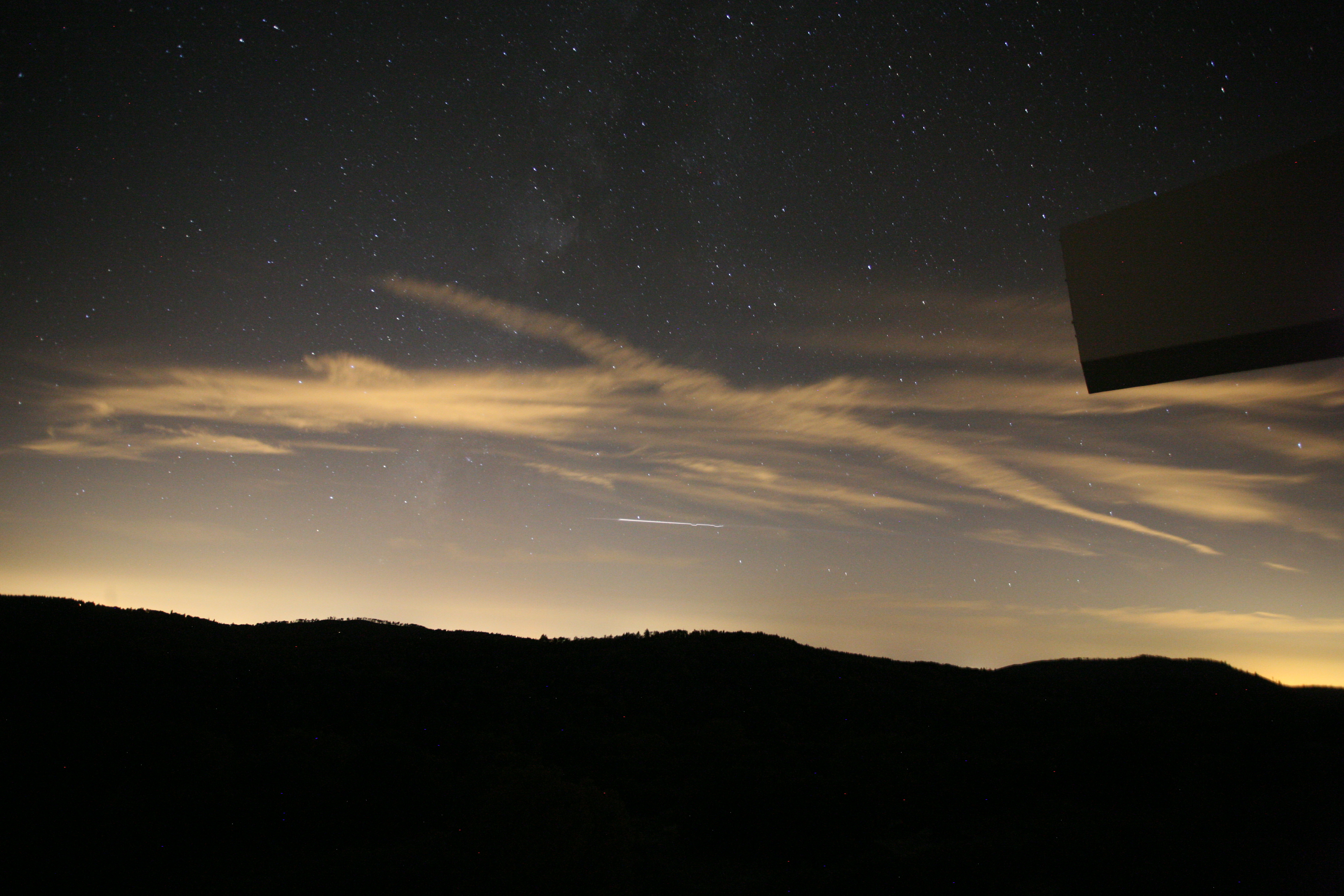
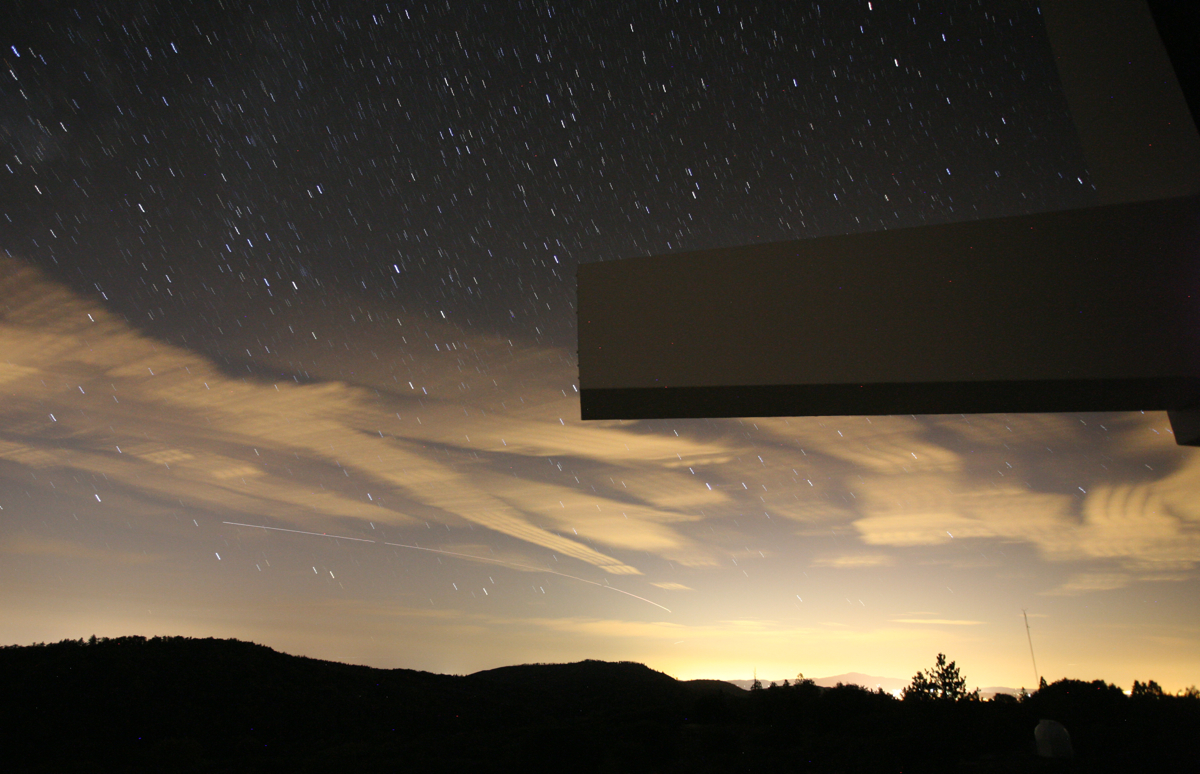
A Delta II rocket was launched tonight from Vandenberg Air Force Base. Here is the view from the catwalk of the 200-inch Hale Telescope:
Click to embiggen (full resolution version is here). Light pollution and cirrus clouds dampened the view somewhat. The top photo is 3 30 second exposures combined. The rocket trail is the line beneath the clouds.

This one is just a 30-second exposure. A higher resolution version of the image is here.
Click to embiggen (full resolution version is here). Light pollution and cirrus clouds dampened the view somewhat. The top photo is 3 30 second exposures combined. The rocket trail is the line beneath the clouds.
This one is just a 30-second exposure. A higher resolution version of the image is here.
Astrophoto Friday - the Whirlpool Galaxy
M51, the Whirlpool Galaxy, is 37 million light years distant but still a jewel of the heavens. Here it is as captured by the Palomar Transient Factory (PTF) survey using Palomar's 48-inch Samuel Oschin Telescope.
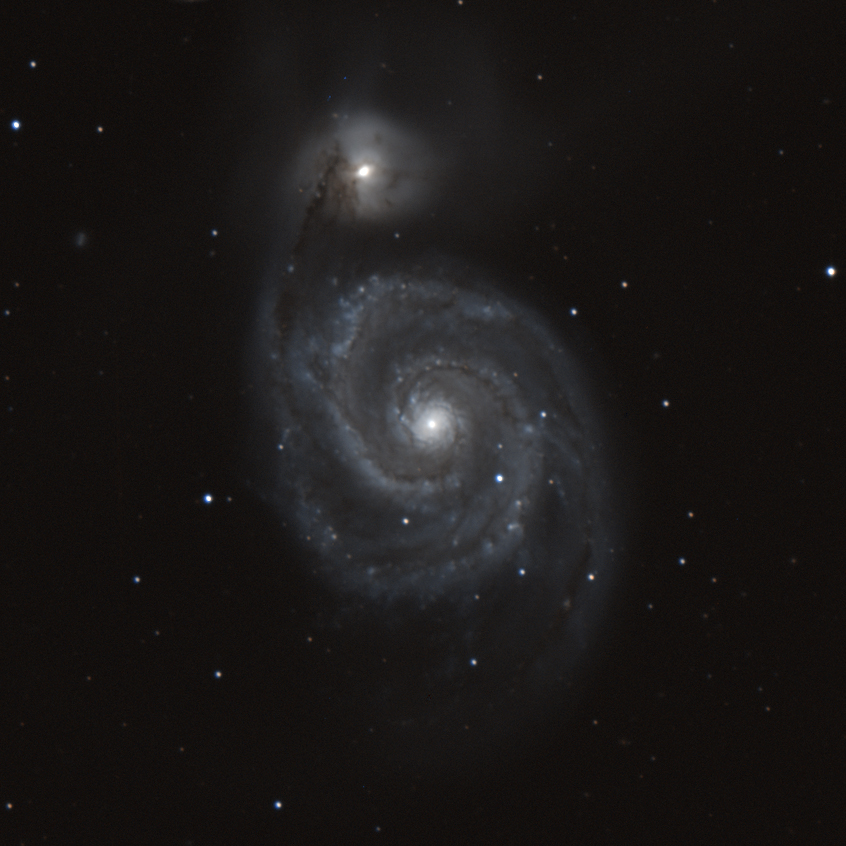
For those keeping score, the PTF survey has discovered 882 supernovae.
The Whirlpool Galaxy can be found in the northern constellation of Canes Venatici (the hunting dogs).
For those keeping score, the PTF survey has discovered 882 supernovae.
The Whirlpool Galaxy can be found in the northern constellation of Canes Venatici (the hunting dogs).
Thursday, November 4, 2010
Palomar History Photo of the Week - the Arrival
Here is a photo taken by Lee A. Farnsworth, Jr in the fall of 1938. It was taken from the catwalk of the dome of the 200-inch telescope looking down on some of the first telescope parts to arrive.
 In back is the prime focus cage. In the middle is the ring that surrounds the 200-inch mirror that holds it to the telescope's "tube". Note the people and cars which help to give a sense of scale.
Fly to the Virgo Cluster of Galaxies
I showed this video in a talk I gave recently and, by request I am posting it here too. It is a flight through our galaxy past familiar objects like the Horsehead Nebula, the Crab and then out of the Milky Way Galaxy past Andromeda, M33, M81& M82 and out to the Virgo Cluster of galaxies.
Enjoy!
Here is a direct link to the video on YouTube.
Enjoy!
Here is a direct link to the video on YouTube.
Subscribe to:
Posts (Atom)

 Posts