Here's a vintage (possibly 1937) news reel about construction of the 200-inch telescope from HowStuffWorks. Sorry, but you'll have to endure a short ad first.
I know that there are more of these out there, so if anybody knows of any other such films feel free to drop me an email or leave a reply in the comments.
Saturday, January 24, 2009


Monday, January 19, 2009
New Winter Visiting Hours
Starting today the Palomar Observatory will be closing an hour earlier for the rest of winter. Our new visiting hours:
From November through March: 9:00 a.m. - 3:00 p.m.
From April through October: 9:00 a.m. - 4:00 p.m.
From November through March: 9:00 a.m. - 3:00 p.m.
From April through October: 9:00 a.m. - 4:00 p.m.
Saturday, January 17, 2009
Palomar Goes Green
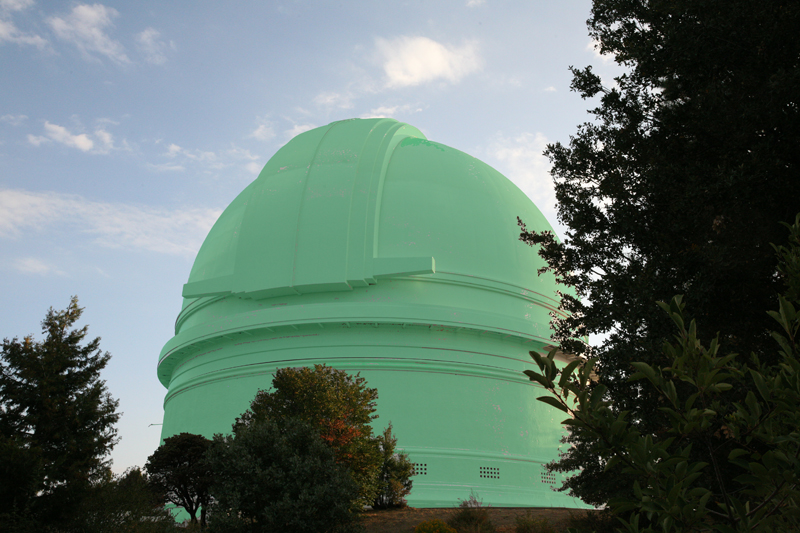 Palomar has gone green. Ok, the dome is still white (really, this is just a visual metaphor), but the observatory is working to cut its use of electricity. One of the ways that this is happening is through changes in the lighting behind the back-lit displays for visitors.
Here's one of the many displays in the observatory's visitor center:
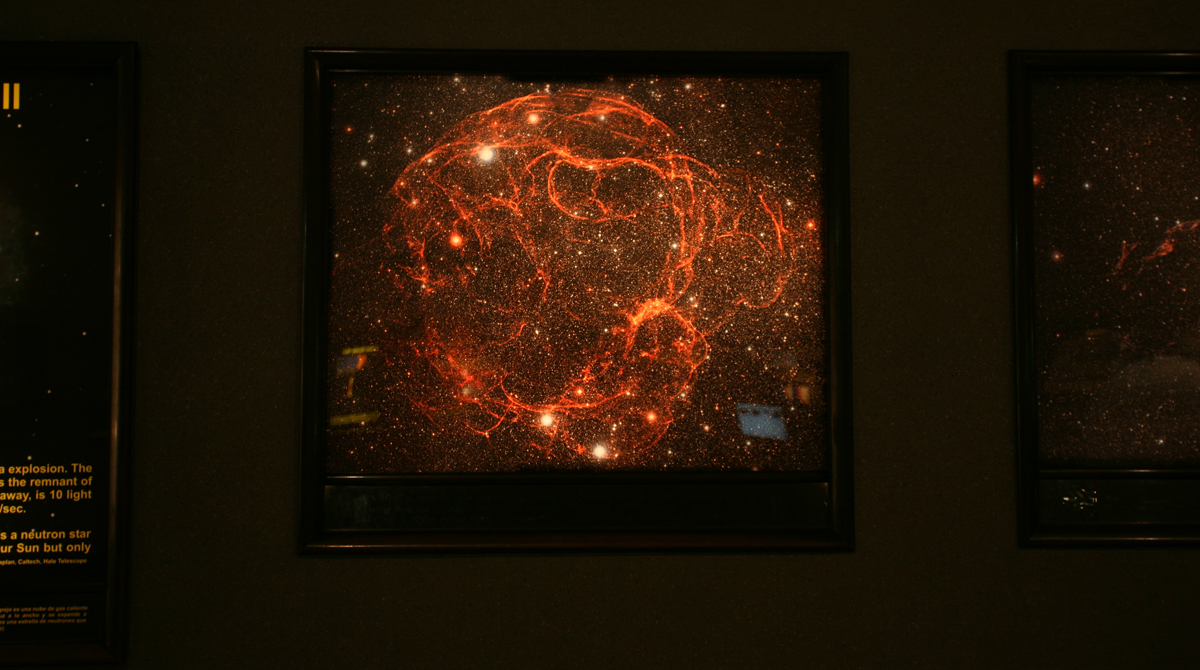 It shows a supernova remnant known as Simeis 147. The image comes from the second Palomar Sky Survey and was nicely processed by Davide De Martin over at Sky Factory.org. (Visit his site there's lots of cool stuff there!)
The fixtures for the displays are more than 50 years old. Until recently each of the 30 displays had six 15-watt bulbs on the inside. On average they are turned on 8.5 hours a day. With the observatory being open to the public 363 days a year, the displays consume over 8.3 megawatt hours a year!
We’ve just made the switch to 15-watt compact fluorescent (CFL) bulbs. They are so much brighter than the old incandescent bulbs that we are able to drop each display down from six bulbs to two – cutting our energy use by 33.3%. That's a savings in money and a reduction in the amount of greenhouse gases that would otherwise be produced. So we get to show off cool photos of supernovae and telescopes but in a greener way.
Here's the display from above opened up. Inside is six 15-watt incandescent bulbs:
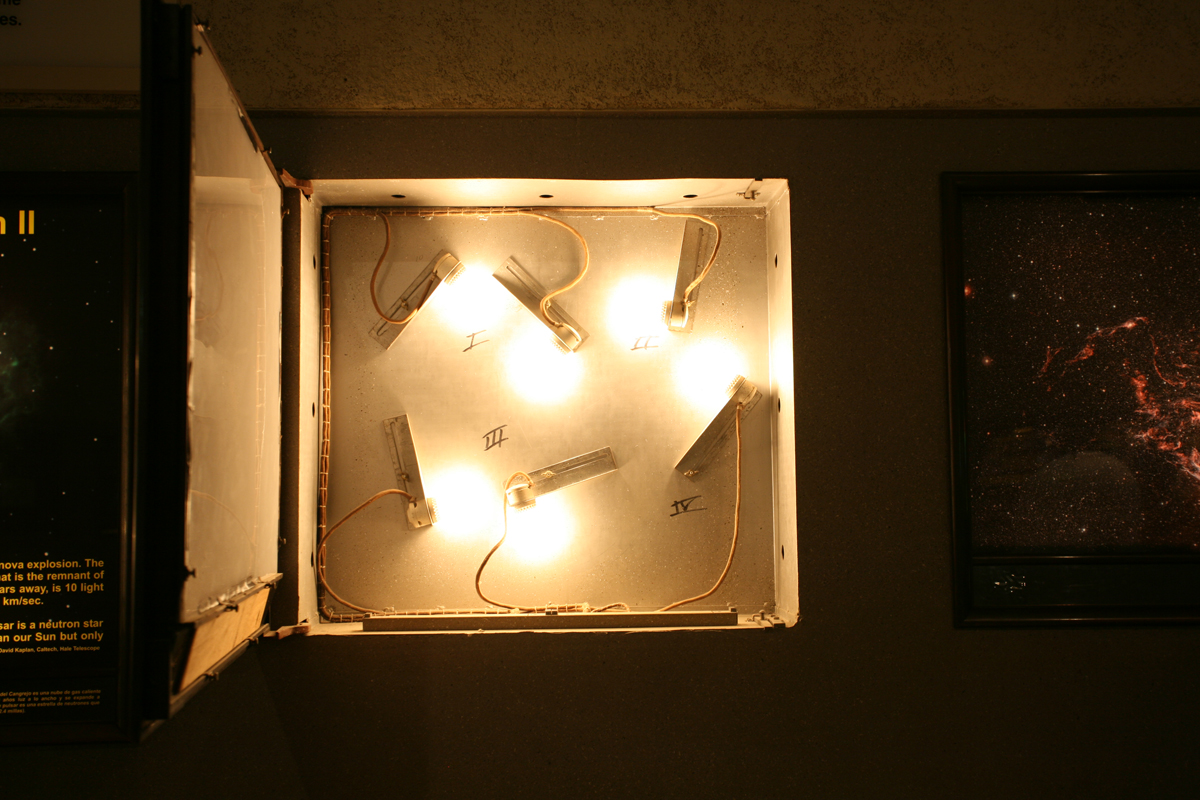 Now replaced with just two 15-watt CFLs:
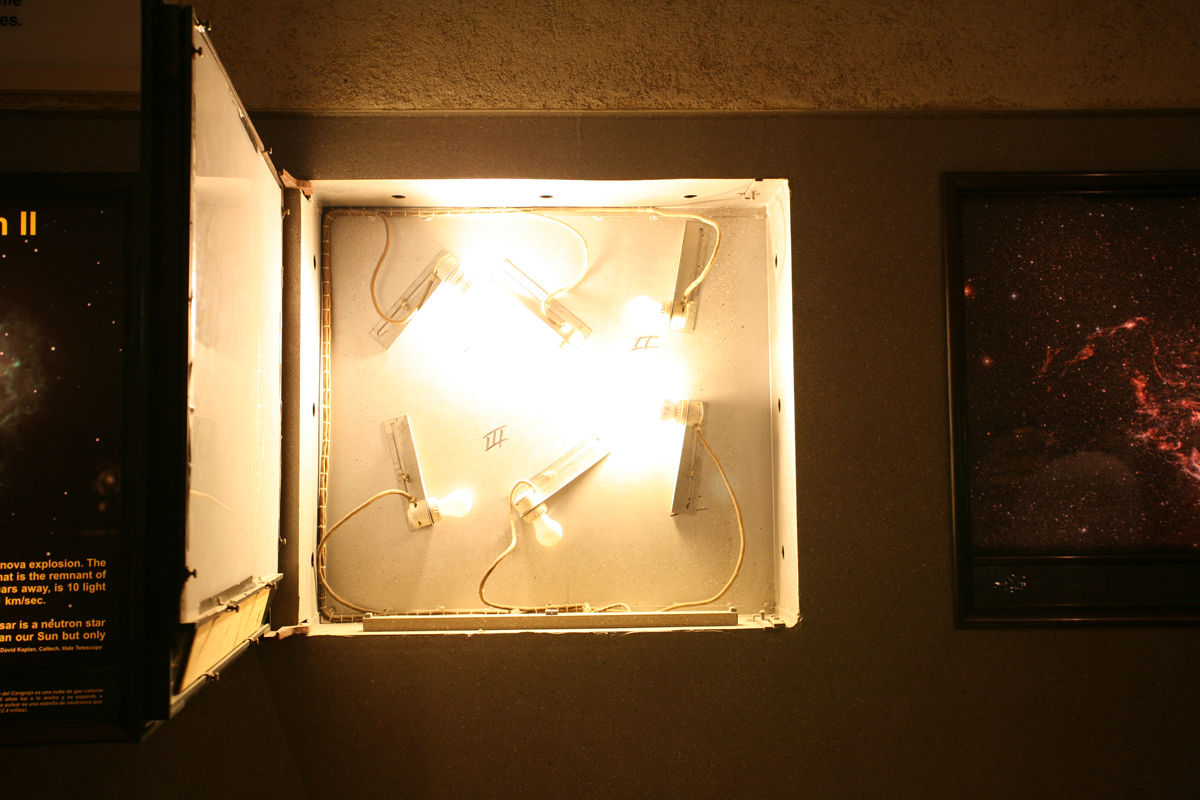 As you can see the CFLs are brighter. It may look like all six bulbs are on in this shot, but it is just 2 of the CFL's and 4 dead incandescents (to fill the otherwise empty sockets).
If you are making the switch at home remember that a 15-watt CFL is as bright as a 60-watt incandescent bulb. Be sure to use a lower wattage on those CFLs to prevent overlighting and any extra contributions to light pollution.
To reap even greater savings and cut on light pollution, remember to use the off switch.
Friday, January 16, 2009
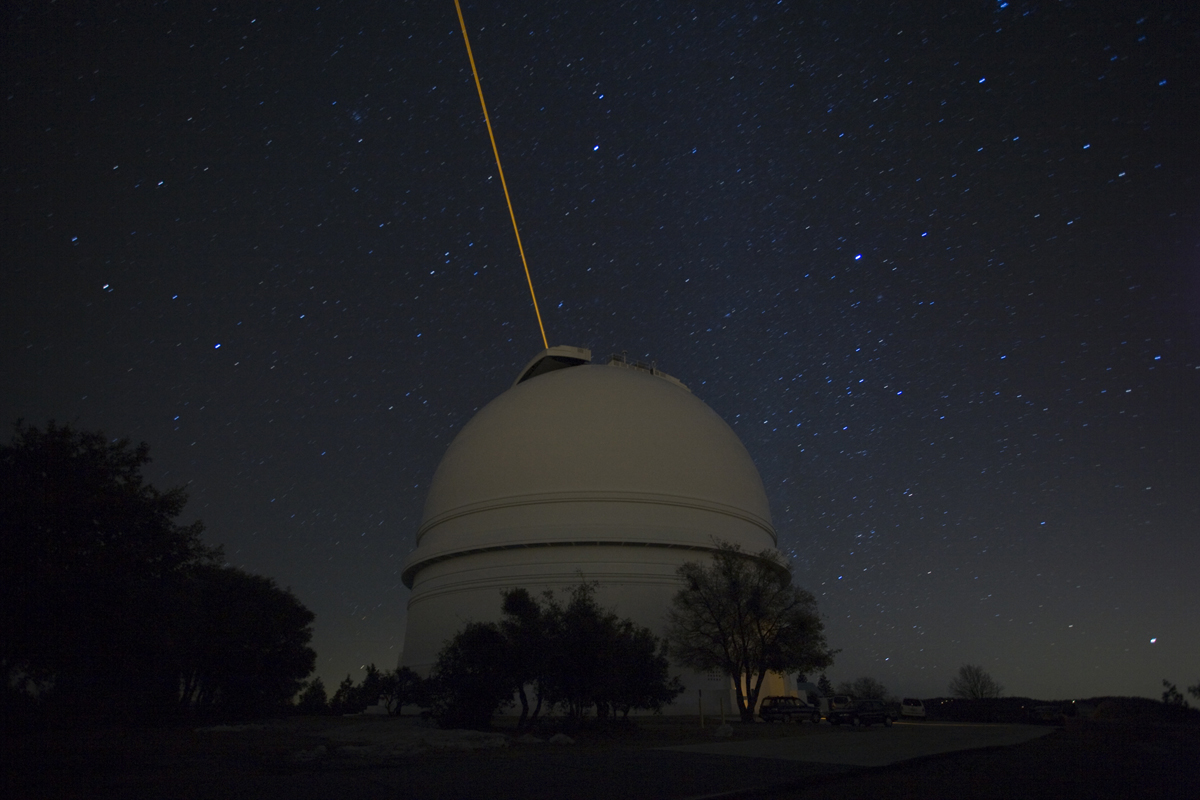
January Laser
Last night: Clear skies. January stars. Hale Telescope. Adaptive optics. Laser guide-star.

Friends in High Places
I have always heard that it is good to have friends in high places. I don't suppose this is what is meant by that though.
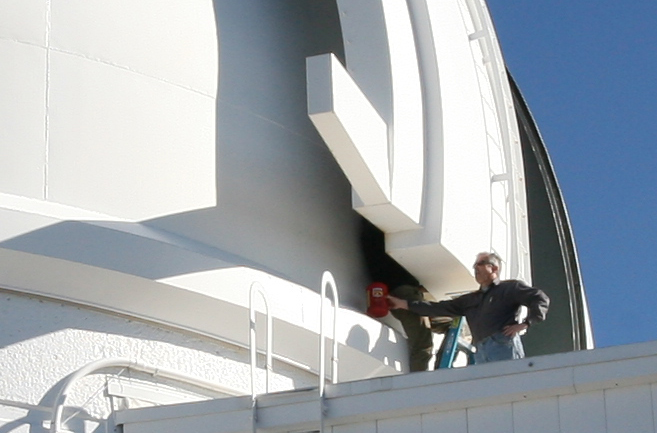
 Here's two members of the Palomar Observatory Mountain Operations day crew (Bruce and Drew) working on the dome shutters for the 60-inch telescope. As you look at the photo above you may have a hard time seeing them. Take a look at the cropped version below. Can you see both of them?
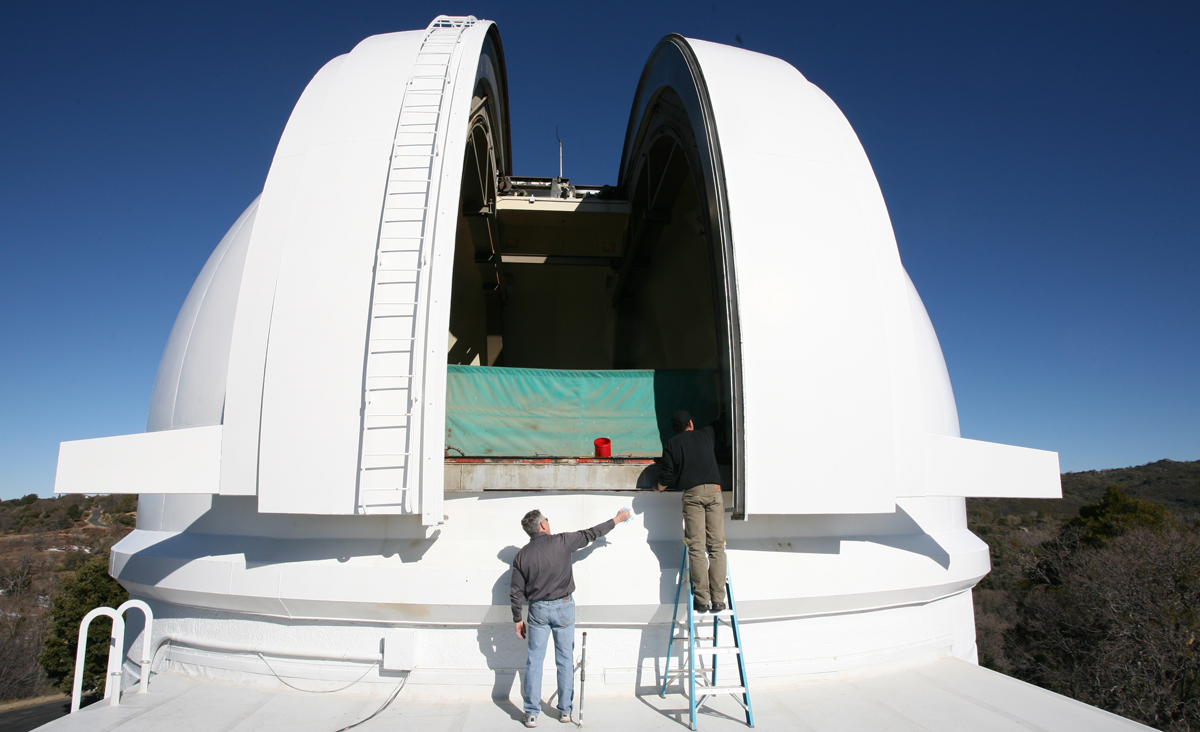
 It was time to once again inspect, scrape and grease the rails that the dome shutters ride on. Its a dirty job, but somebody's gotta do it.

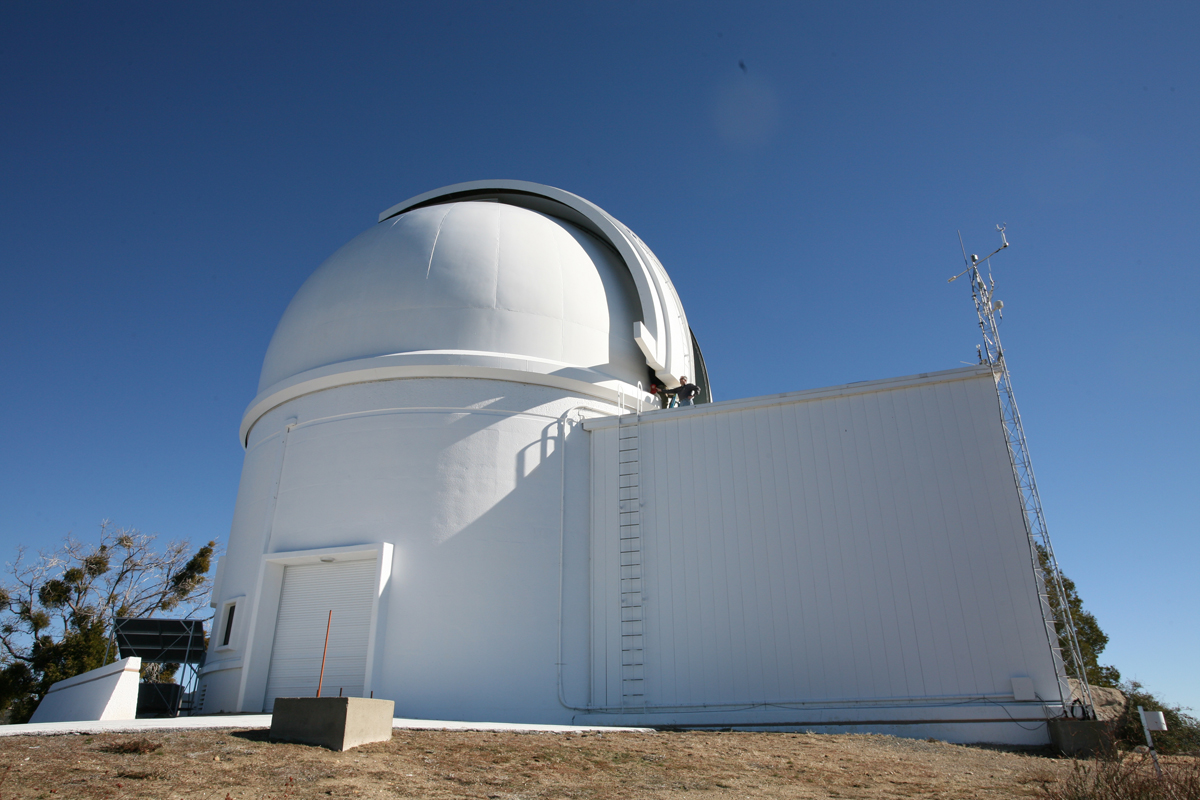 Here's two members of the Palomar Observatory Mountain Operations day crew (Bruce and Drew) working on the dome shutters for the 60-inch telescope. As you look at the photo above you may have a hard time seeing them. Take a look at the cropped version below. Can you see both of them?
 It was time to once again inspect, scrape and grease the rails that the dome shutters ride on. Its a dirty job, but somebody's gotta do it.
Thursday, January 15, 2009
5 Minute Travels Visits Palomar Observatory
Anything Goes Productions has a series of cool 5-minute travel features. They recently visited Palomar Observatory. Have a look:
Another night comes to an end
Here's a really short time-lapse of images captured every 3 minutes by the Hale Telescope webcam from the end of last night. Observing continued to just past sunrise.
A higher resolution Quicktime version is here.
I came in to work before they closed up and was greeted to this view:
 A beautiful morning. Too bad I didn't have my "real" camera with me. This shot was captured with my phone.
A higher resolution Quicktime version is here.
I came in to work before they closed up and was greeted to this view:
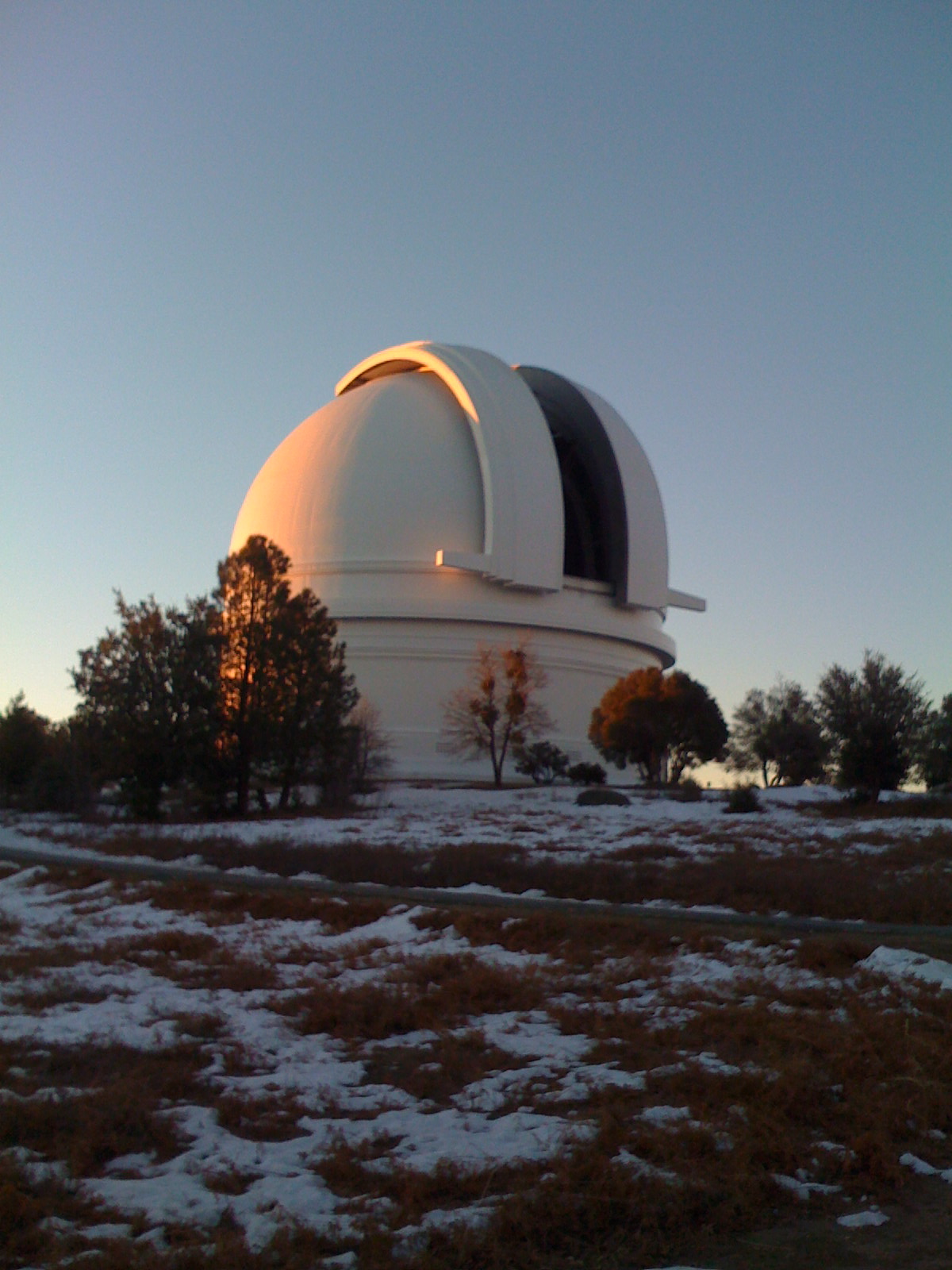 A beautiful morning. Too bad I didn't have my "real" camera with me. This shot was captured with my phone.
Monday, January 12, 2009
365 Days of Astronomy Podcasts
Time keeps on slipping into the future and I forgot to mention that Palomar Observatory is a sponsor for the International Year of Astronomy's 365 Days of Astronomy podcasts. Our first sponsored episode was the January 7th episode which happens to feature some folks from the American Association of Variable Star Observers talking about variable stars. We'll be sponsoring more episodes during the year and you'll get the chance to hear me on January 26th and throughout the year as well.
Saturday, January 10, 2009
Palomar in Science Fiction - IV
The 1951 sci-fi disaster movie When Worlds Collide offers up the end of the Earth. In it a star with a planet of its own hurls into the solar system bringing our planet to its doom.
 In the film the discovery is made at the Mt. Kenna Observatory in South Africa. Have a look at the Mt. Kenna Observatory. Does it look familiar to you?

 Clearly both of the matt paintings were based on the 200-inch Hale Telescope at Palomar.
Here's a short clip for you:
The movie is available on DVD. If you watch you'll also see a background painting showing the 100-inch Hooker Telescope on Mt. Wilson.
 In the film the discovery is made at the Mt. Kenna Observatory in South Africa. Have a look at the Mt. Kenna Observatory. Does it look familiar to you?
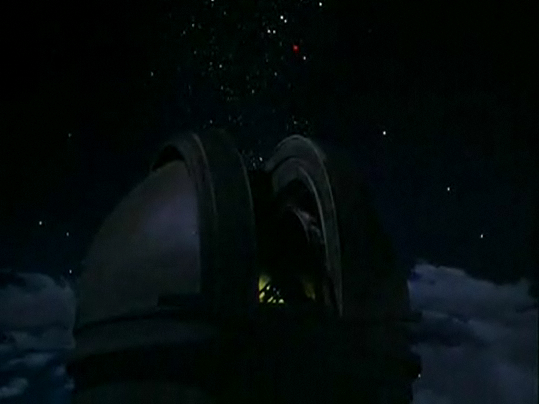
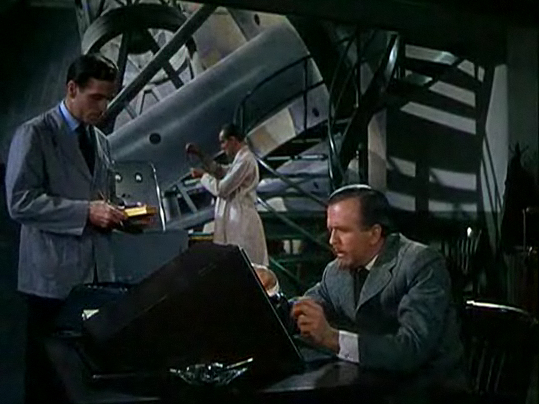 Clearly both of the matt paintings were based on the 200-inch Hale Telescope at Palomar.
Here's a short clip for you:
The movie is available on DVD. If you watch you'll also see a background painting showing the 100-inch Hooker Telescope on Mt. Wilson.
Friday, January 9, 2009
Palomar Skies on Wordle

Here's the last several postings from Palomar Skies reduced to a graphic from Wordle. I haven't yet decided if this is a useful application or not but it does look cool.
Subscribe to:
Posts (Atom)

 Posts

