Showing posts with label Edwin Hubble. Show all posts

Friday, April 30, 2010

Astrophoto Friday: Spiral Galaxy NGC 7217

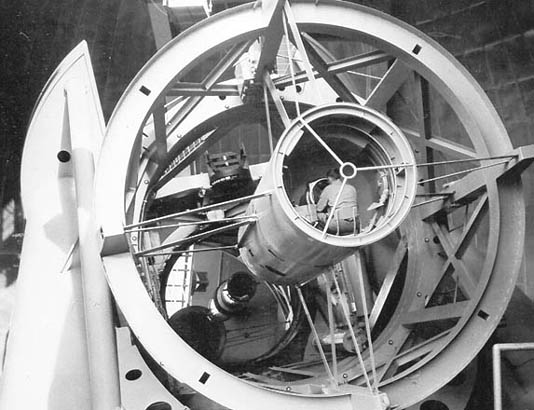
This week we have another vintage photo for Astrophoto Friday. It is a picture of a spiral galaxy known as NGC 7217 that was taken with the 200-inch Hale Telescope by Edwin Hubble the night of October 13, 1950.

NGC 7217 is located about 50 million light years distant in the direction of the constellation of Pegasus.

Saturday, June 13, 2009

Edwin Hubble: the Podcast


On June 8 (Yes, I am still catching up) Doug Allen posted Who Was Edwin Hubble? one of the 365 Days of Astronomy podcasts. You can get it from their website or here from iTunes. There are lots of super podcasts on astronomy. Have you been listening?

Saturday, November 8, 2008

The Great Galaxy in Andromeda


Here's another scan of a vintage PR shot from Palomar. This is of M31, the Andromeda Galaxy. The image was captured by the 48-inch Schmidt telescope at Palomar (now known as the Samuel Oschin Telescope) and was copyrighted by Caltech in 1959. Believe it or not, we still have a limited quantity of this poster for sale in the observatory's gift shop.

M31 has been an important galaxy in the history of astronomy. As the closest spiral galaxy to the Milky Way it has served as an important stepping stone out into the universe. In the 1920s Edwin Hubble used the 100-inch Hooker Telescope on Mt. Wilson to determine that the Andromeda Galaxy is a separate system from the Milky Way. His determination of its distance was off by a factor of two - a measurement that was later corrected by Walter Baade, using the 200-inch on Palomar. Modern estimates place the distance at 2.9 million light years.

M31 was photographed using the Samuel Oschin Telescope as a part of the Second Palomar Sky Survey. The photographic plates from that survey have been digitized and the images are available online. Davide De Martin of SkyFactory.org has used that data to produce a beautiful image of the galaxy.

Thursday, March 6, 2008

Edwin Hubble: the man, the legend, the stamp

Today astronomer Edwin Hubble is honored by the U.S. Postal Service as a part of their American Scientists stamps series. Also immortalized is theoretical physicist John Bardeen, biochemist Gerti Cori and structural chemist Linus Pauling. Here is the description that the U.S. Postal Service provided for Hubble:

Astronomer Edwin Hubble (1889-1953) played a pivotal role in deciphering the vast and complex nature of the universe. His meticulous studies of spiral nebulae proved the existence of galaxies other than our own Milky Way, paving the way for a revolutionary new understanding that the cosmos contains myriad separate galaxies, or “island universes.”
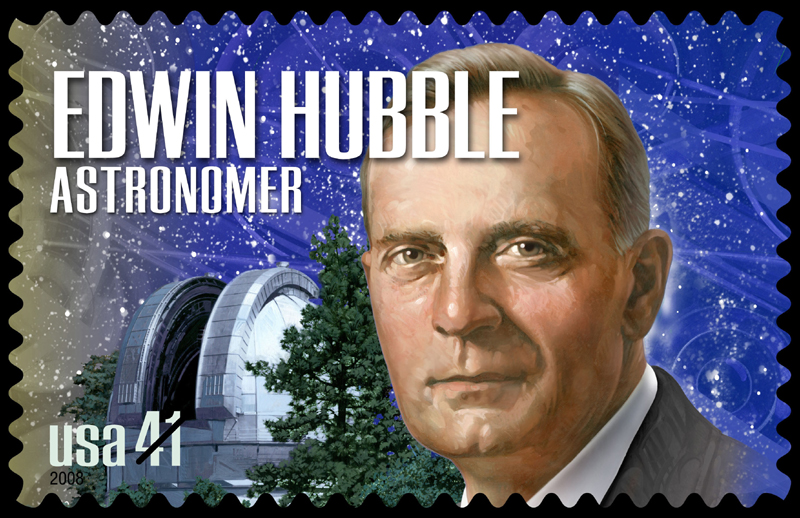

Image © 2007 USPS. All Rights Reserved.


Most of the great successes of Hubble's career were achieved not at Palomar but at Mt. Wilson. So it is only fitting that the dome of the 100-inch Hooker Telescope be shown behind him. The "spiral nebulae" referred to in the USPS description are what modern astronomers refer to as spiral galaxies.

Back in the 1920s no one was certain if they were part of our own Milky Way Galaxy or separate galaxies unto themselves. In 1923 Hubble used the 100-inch telescope to resolve and measure Cepheid variable stars in the Andromeda Galaxy (M31). Cepheid stars vary in brightness in a regular way that is directly proportional to their brightness. Once it is known how bright they really are and how bright they appear, it is possible to determine their distance.

Hubble found that the Cepheids in M31, and thus the galaxy itself, are 1 million light-years distant. (Modern figures put the distance at 2.9 million light years.) The only conclusion was that M31 and the other "spiral nebulae" were separate galaxies, completely distinct from our Milky Way.

Hubble pushed the bounds of known space even further with his 1929 discovery that the universe is expanding. This had a profound influence on cosmology and was the first clue pointing towards the Big Bang.

Hubble didn't get a lot of observing time at Palomar. The 200-inch telescope project took a long time to complete and Hubble passed away just five years after its dedication

If you are interested in reading about the life of Edwin Hubble I strongly recommend that you track down a copy of Gale E. Christianson's Hubble biography Edwin Hubble: Mariner of the Universe. If you are in a hurry, or just need something more right now you can read his biography posted on the Hubble Space Telescope website.

Saturday, January 26, 2008

The Big Eye Opens

Fifty nine years ago today astronomer Edwin Hubble took the first photos through the 200-inch Hale Telescope. Even though the Big Eye was not yet 100% finished (there was still work to perform on the mirror) it was time for some optical tests.

The first object studied using the Hale was Hubble's Variable Nebula (NGC 2261). The exposure was made by Edwin Hubble from the prime focus observing cage on the night of January 26, 1949. The glass photographic plate was labeled: PH-1-H (Palomar, Hale, # 1, Hubble).

Edwin Hubble began his studies of the nebula that now bears his name at the Yerkes Observatory in 1916. Later it became the first object that he photographed through the 100-inch Hooker Telescope at Mt. Wilson Observatory.

The nebula is a fan-shaped cloud of gas and dust known as a reflection nebula. It is illuminated by a young star known as R Monocerotis (R Mon). The star is located in the bright region at the lower part of the nebula which is 2,500 light years from Earth. Hubble noticed that the nebula seemed to undergo rapid variations in its appearance.

Also photographed that night were giant elliptical galaxy M87 (NGC 4486), spiral galaxies NGC 5204 & NGC 3359 and globular star cluster M3 (NGC 5273). Here's a modern modern image of M3 taken with the Hale.