Thursday, February 14, 2008

Happy Birthday Fritz Zwicky

February 14, 2008 marks the 110th anniversary of the birth of astrophysicist Fritz Zwicky. His amazing scientific career is relatively unknown to the general public, but he remains a giant in the astronomical community.

Zwicky came to Caltech in 1925 and was a faculty member there for more than 40 years. He was a member of the staff of the Mount Wilson and Palomar Observatories until his retirement in 1968. He also worked as the research director Aerojet Engineering Corporation from 1943 to 1961.

Telescope operator Ben Traxler worked with Zwicky, Hubble, and all the astronomers from the early days at Palomar. Traxler remarked that Zwicky’s “very fertile intellect was busy at all times” and his research efforts certainly confirm that.

In an article titled “Idea Man” published in 2001 Stephen M. Maurer wrote that Zwicky will be “remembered as a gifted observational astronomer who had discovered more supernovae than everyone else in human history combined. Today, Zwicky’s reputation is bigger than ever, except that now astronomers think of him as a theorist. When researchers talk about neutron stars, dark matter, and gravitational lenses, they all start the same way: ‘Zwicky noticed this problem in the 1930s. Back then, nobody listened . . .’”

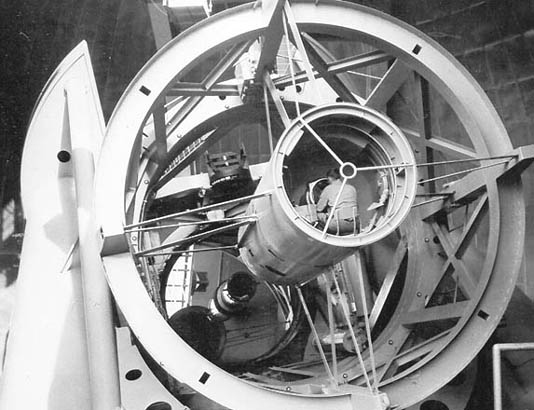
That’s right, supernovae, neutron stars, dark matter and gravitational lenses. Those are all active topics of modern astronomy that Zwicky was exploring more than 70 years ago. Much of his thinking in those areas was brought about by his work with the wide-angle 18-inch and later the 48-inch Schmidt telescopes at Palomar. The Schmidt telescope was a brand-new concept in astronomy that made it possible to photograph wide areas of the sky quickly with little distortion even on the edge of the field of view. It was Zwicky who brought Bernhardt Schmidt’s invention to Palomar and the world.

Starting in 1936 Zwicky used the 18-inch Schmidt to make the first rapid survey of the heavens, mapping out hundreds of thousands of galaxies. With it he also began his searches for exploding stars known as supernovae (With Walter Baade he even coined the term “supernova”), discovered that galaxies come in clusters and obtained the first evidence for dark matter. His searches for supernovae were extremely fruitful, having discovered more than 120 of them during his lifetime – at the time that was more supernovae than all other astronomers combined. He was the first to suggest, and correctly so, that a supernova marks an ordinary star’s transition to a collapsed, super dense object known as a neutron star.

Fritz Zwicky passed away in 1974. He received many honors during his lifetime. In 1949 he was presented with the Presidential Medal of Freedom by president Truman, for his work on rocket propulsion during World War II. The Royal Astronomical Society presented him with their most prestigious award, the Gold Medal, for "distinguished contributions to astronomy and cosmology", acknowledging his work on neutron stars, dark matter, and cataloging of galaxies. Zwicky was also honored by having an asteroid (1803 Zwicky) and a lunar crater named for him.

Today’s astronomers are still following in Zwicky’s footsteps. Palomar’s 48-inch Schmidt (since renamed the Samuel Oschin Telescope) is used nightly to survey the sky, hunting for supernovae, gravitational lenses and more. Astronomers have found a renewed interest in Zwicky’s concept of sky surveys. Entire giant telescopes are about to be built for that purpose. Beyond his observational work Zwicky’s theoretical advances laid the foundation for modern astrophysics, which owes him a great debt.

Tuesday, February 12, 2008

On Top of the World

Last Saturday I had the opportunity to again visit the top of the dome for the 200-inch Hale Telescope. The atmosphere was remarkably transparent and I managed to snap a few quick photos as I panned around. Here are two hastily assembled panoramas from the visit. Be sure to click on them to enlarge the view.


From left to right in the first shot are the snow covered peaks of San Gorgonio and San Jacinto; the ladder and lightning rod on top of the dome; and the dome for the 48-inch Samuel Oschin Telescope with Palomar's High Point beyond that.


The second panorama is immediately to the left of the first. The Warner Springs area is in the valley with the San Ysidro Mountains beyond. Between the domes for the 18-inch Schmidt and 60-inch telescopes lies the Mendenhall Valley with in the background Volcan Mountain beyond. The ridge on the right, behind the 60", is part of Palomar Mountain.

As soon as I get the chance to put them together I'll post the rest of the view.

Tuesday, February 5, 2008

Road Show

If anyone is interested. I'll be giving a talk for the Orange County Astronomers on Friday, February 8th @ 7:30 p.m. What's on tap for the talk?

"In honor of its sixty year anniversary, Scott Kardel of Palomar Observatory will outline the future of this astronomical workhorse on the mountain.

In this era of large and giant telescopes the old "Big Eye" on Palomar continues to be used nightly. Astronomers continue to build new and innovative instruments for the Hale, keeping it in the forefront of modern astronomy. New instruments that have just arrived and will soon be coming will bring advances in adaptive optics, new exoplanet discoveries, and allow the Hale to detect and map emission from the intergalactic medium."

Saturday, February 2, 2008

Science News from the Past

Science News, the weekly news magazine of science has a cool timeline feature with stories from the past. They just posted some information dating from 70 years ago this week.

In their January 29, 1938 issue. they reported that "The dome for the great 200-inch telescope on Mt. Palomar is practically finished structurally, and California Institute of Technology engineers can now breathe easier while completion and installation of equipment take place under its shelter during the next couple of years. By February 1, the dome itself will be complete."

Friday, February 1, 2008

Say Goodbye to Palomar

After a combined 47 years of service to the observatory Mike and Barbara Doyle are saying goodbye to Palomar.

Mike served mostly as an electronic technician before moving up to assistant superintendent. During my brief term of service here I have known him to be a dedicated and vital part of the Palomar team. He has provided great support and advice to myself and the observatory's public outreach program.

Barbara has worked in the observatory's accommodations for the astronomers, known as the Monastery, and also has been the powerhouse behind the observatory's gift shop. She has professionally greeted and explained the observatory to many thousands of visitors over the years.

I join the entire Palomar staff and our team of docents in wishing them well in their new venture. They will certainly be missed but their hard work, commitment to doing things right and friendship will linger with us for some time to come.


On his last day with the observatory, as he had done many times before, Mike climbed deep within the mighty Hale Telescope. This last time it wasn't to keep the ol' gal running, it was for the memories and the photo op. :)

Saturday, January 26, 2008

The Big Eye Opens

Fifty nine years ago today astronomer Edwin Hubble took the first photos through the 200-inch Hale Telescope. Even though the Big Eye was not yet 100% finished (there was still work to perform on the mirror) it was time for some optical tests.

The first object studied using the Hale was Hubble's Variable Nebula (NGC 2261). The exposure was made by Edwin Hubble from the prime focus observing cage on the night of January 26, 1949. The glass photographic plate was labeled: PH-1-H (Palomar, Hale, # 1, Hubble).

Edwin Hubble began his studies of the nebula that now bears his name at the Yerkes Observatory in 1916. Later it became the first object that he photographed through the 100-inch Hooker Telescope at Mt. Wilson Observatory.

The nebula is a fan-shaped cloud of gas and dust known as a reflection nebula. It is illuminated by a young star known as R Monocerotis (R Mon). The star is located in the bright region at the lower part of the nebula which is 2,500 light years from Earth. Hubble noticed that the nebula seemed to undergo rapid variations in its appearance.

Also photographed that night were giant elliptical galaxy M87 (NGC 4486), spiral galaxies NGC 5204 & NGC 3359 and globular star cluster M3 (NGC 5273). Here's a modern modern image of M3 taken with the Hale.

Snow Shots

Some more snow shots from the recent snowfall on Palomar:


With beauty comes danger

Several inches of snow falling from the 135-foot high dome can deliver a dangerous impact.

Thursday, January 24, 2008

Winter Wonderland

Winter weather has been pounding Palomar Mountain the last few days & nights. There's been just 5 hours of observing time logged over the last 5 nights - compare that with the 38 hours logged in the previous 3 nights. The photo above shows an impressive snowdrift against the big doors on the dome that houses the 200-inch Hale Telescope. The small entrance door was actually frozen shut this morning. More snow, rain and fog is likely to negatively impact the next several nights.

Of course this kind of weather is bad for astronomy, but good for the forests of Palomar Mountain. After several years of drought and intense fires last fall a little rain or snow now and then can be a welcome sight.

I'll post more snow pics tomorrow if conditions permit.

Monday, January 21, 2008

How Far the Stars?


Here's the open star cluster known as M45 or the Pleiades. This image is a composite from two black and white images taken with the Palomar Observatory's 48-inch (1.2-meter) Samuel Oschin Telescope as a part of the Second Palomar Observatory Sky Survey (POSS II). The images were recorded on two glass photographic plates - one sensitive to red light and the other to blue. The plates were scanned and color combined to produce the image seen here.

The cluster is easily seen this time of year with no optical aid needed at all.

Four yeas ago today astronomers announced a revised distance estimate to the star known as Atlas within the Pleiades star cluster using data gathered by the Palomar Testbed Interferometer. Atlas, according to the findings, is 440 (+/- 6) light-years distant.

The distance measurement was in disagreement with the results obtained by the Hipparcos Space Astrometry Mission, which placed the cluster some 10% closer than other measurements. The Pleiades is the second closest star cluster to our solar system. Having an accurate distance to the closest star clusters is very important as they are used as stepping stones to all the rest.

Saturday, January 19, 2008

Thanks for the Memories


Earlier this week I had the pleasure of meeting Ronald Florence, author of The Perfect Machine. It was Ronald's first return to Palomar in more than a decade. We spent a few hours poking around domes and going over what is new and old around here.

His book is a complete history of the building of the Hale Telescope and the Palomar Observatory. As a tour guide and trainer of tour guides at the observatory I have worked hard to transfer much of the knowledge contained within its pages into my head and into the heads of others. Tour groups work their way through the dome as our visitors hear a distillation of the facts and figures, blended with the stories from The Perfect Machine. When it comes to the Hale Telescope its science awes and its history grounds.

Without his wonderful book my job would be enormously more difficult and I am indebted to Mr. Florence.

Thank you.