Wednesday, April 15, 2009

Giant Telescopes in 3D

Todd Mason, of The Journey to Palomar fame, is at it again. A while ago I told you that on his new website, he has wonderful visualizations of what the next generation of giant telescopes will look like. He has just added a page of cool 3D images of these giant scopes: the Thirty Meter Telescope, the Giant Magellan Telescope, and the Large Synoptic Survey Telescope (those are links to the individual project websites). He has also posted a 3D movie too. In the 3D movie you'll the Hale Telescope and the giants that are to come.

So grab your red/blue glasses and take a peak into the future. In 3D.

Dark-Sky Talk Tonight & Dark Sky Week

David Crawford, founder of the International Dark-Sky Association, and Lisa Bruhn, president of the San Diego chapter of the IDA, will be presenting tonight at the monthly meeting of the San Diego Astronomy Association. The meeting is at 7 p.m. tonight at the Mission Trails Regional Park Visitor Center.

Attending tonight's presentation will get you ready for International Dark-Sky Week, which happens to be next week: April 20 - 26. IDSW kicks off on April 20 with the World Night in Defense of the Starlight.

Two years ago I attended the first International Starlight Conference, held on the island of La Palma. It was a meeting of people from around the world where, with the support of UNESCO, IAC, IAU, and other organizations, it was agreed to promote the World Night in defense of the Night Sky and the Right to Observe the Stars, as a cultural, scientific and environmental humankind heritage.

Check out their website for more and ask yourself, do you have the right to see starlight?


Tuesday, April 14, 2009

Flame On!

Here is the Flame Nebula and Alnitak, the left-most star in the belt of Orion, as captured by the QUEST camera which was installed (from 2003 until last fall) on Palomar's 48-inch Samuel Oschin Telescope.
Be sure to click on the image to enlarge it.

Click here for a much wider view of the same part of the sky, captured with the same telescope (during the Second Palomar Observatory Sky Survey), and nicely processed by Davide De Martin at Skyfactory.org.

Of course if you want a much closer look at the Flame Nebula have a look at this image captured by the 200-inch Hale Telescope. It is an near-infrared image so it looks quite different from the other two. You'll see quite a bit more stars in the near-infrared view. Why is that?

You can find more cool images captured by QUEST here.

Of course QUEST is now gone and a new camera and a new science program have replaced it - the Palomar Transient Factory.

Keeping Up With the Outer Solar System

In late March I mentioned that Caltech's Mike Brown was looking for a name for the satellite of Pluto. He's picked one so be sure to visit Mike Brown's Planets to find out what name was chosen and why.
Speaking of Mike Brown, he has been looking for more objects like Sedna but none have been found yet and that is telling about the solar system. He has also published some work on Haumea and its satellites.

Monday, April 13, 2009

Reminder: 400 Years of the Telescope Tonight!

Remember, for those in the San Diego area, that 400 Years of the Telescope is on tonight at 10:30 on PBS. It is a good show and well worth your time.

I am in it, but if you blink at the wrong time you'll miss me.

Saturday, April 11, 2009

Russell Porter's Missing Sundial


Back in the 1970s a Sundial, made by Russell W. Porter, vanished from the Caltech campus. It remains missing. Read all about it here from the Caltech News and here from Sky & Telescope.

I will gladly kick in some bucks as reward money if it is returned.

Friday, April 10, 2009

New Asteroids Honor Luiseño People Native to Palomar

Earlier this week I was honored to play a small role in a ceremony here at Palomar Observatory's Outreach Center as three asteroids were named to honor the Luiseño People who are native to Palomar and the surrounding area.

The asteroids, were discovered by my friend and 200-inch telescope operator Jean Mueller. Jean found the asteroids years ago while operating the Samuel Oschin Telescoope as part of the Second Palomar Observatory Sky Survey.

During the course of the sky survey, she scanned most of the plates under high magnification. She looked closely at the images as they were developed searching for comets, supernovae (exploding stars) and fast moving asteroids. In the course of her work, Mueller discovered 15 comets, 107 supernovae and 14 asteroids!

The rules for naming comets and supernovae don't allow the discoverer to have any say in their names, but for asteroids the discoverer has the honor to bestow names. Asteroids, also called minor planets, are first "numbered" after accurate orbits have been determined. Many of the asteroids that she discovered are Apollo-type asteroids. Apollo asteroids have orbits that cross the orbit of Earth and have the potential to someday impact Earth. There are rules to naming Apollo asteroids that are governed by the 15-person Committee for Small-Body Nomenclature of the International Astronomical Union. It was only recently that cultures such as the Luiseño could be honored in this way.

The new asteroid names honor figures from the Luiseño creation stories. The names selected were Tukmit (Father Sky), Tomaiyowit (Earth Mother), and Kwiila (black oak).

At Tuesday's ceremony we heard from Jean who said "It has been a dream that I could follow through with the naming of these asteroids for the Luiseño people and to honor their culture and history. I started thinking about this probably 15-20 years ago and took my first steps toward this back in 2003."

That is Jean above. Below is Chris Devers, Chairman of the Pauma Band of Luiseño Indians. (holding plaque at left) some of the Pauma kids, myself & Jean (holding a plaque at right).

Chairman Devers had this to say during the ceremony, “On behalf of the Pauma Band of Luiseño Indians, I would like to thank Palomar Observatory and Miss Mueller. And we appreciate her dedication to her field and her recognition of our people, our history and our culture." He spoke about the meaning of the names from their creations stories and the "great connection between the stars and the Tribe".

After the presentation of the asteroid plaques the kids gave a wonderful thank you blessing.

The students also brought along some of their artwork depicting the asteroids and/or their interpretation of the asteroids' names. Scroll on down to have a look at their efforts. Some of it is quite good, far exceeding my feeble skills.


This last one looks scary to me!

Here are photos of the asteroids, along with more information on their names and their discovery information.

Asteroid (12711) Tukmit was discovered January 19, 1991. Tukmit is Father Sky in the Luiseño creation story. He was made from nothingness and together with Tomaiyowit bore the First People. The First People became all the people, animals, plants, and inanimate objects of the earth, the basis of Luiseño existence. (Orbit Diagram)

Asteroid (11500) Tomaiyowit was discovered October 28,1989. Tomaiyowit is Earth Mother in the Luiseño creation story. She, together with Tukmit gave birth to the First People, which are all things and features of the earth forming the basis of Luiseño existence. (Orbit Diagram)

Asteroid (9162) Kwiila was discovered July 29, 1987. Kwiila is one of the First People in the Luiseño creation story. Kwiila means black oak, which is indigenous to Palomar Mountain where the Luiseño traditionally gathered acorns during the summer months. (Orbit Diagram)
My next podcast for the 365 Days of Astronomy will include some of the sounds from the naming ceremony. But until then look for the song on this page.

The story got some nice coverage from the San Diego Union Tribune, and was even on the front page of the North County Times the Valley Roadrunner newspapers. The story has also been picked up by Indianz.com and Kumeyaay.com.

Top 10 Telescopes of All Time

In honor of the 400th anniversary of the telescope Popular Science Magazine has named their Top 10 Telescopes of All Time. Guess which one is # 8?

Ok, this isn't "the next post" that I referred to earlier. That is coming shortly.

Alien volcanoes & More!

At 6 pm tonight you can catch author/artist Michael Carroll presenting Alien Volcanoes at the Ruben H. Fleet Science Center in San Diego. I understand that he gives a great presentation, so you should check it out if you can.

If you missed me yesterday on These Days you can catch it here.

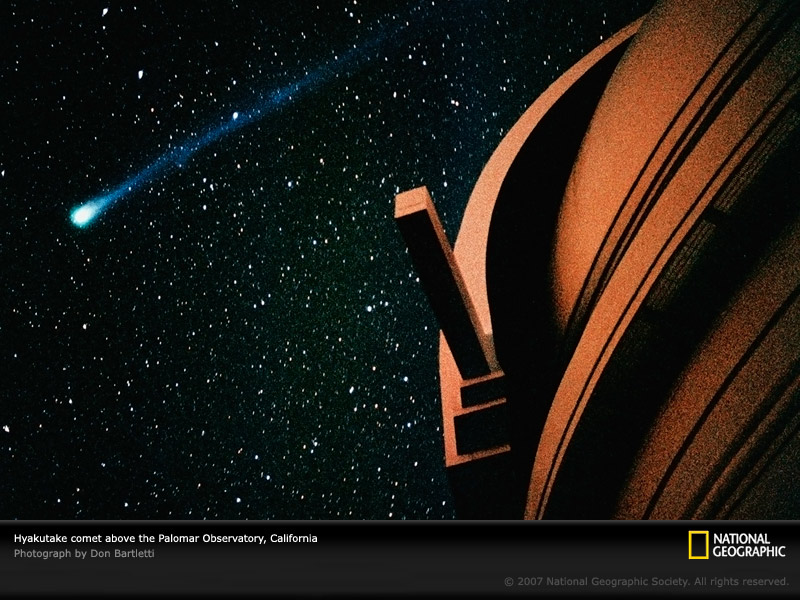
I just found this shot of comet Hyakutake from 1996 taken from just outside the dome of the Hale Telescope. It is available as desktop wallpaper for your computer from National Geographic. Maybe it can help to tide you over until the next bright comet visits our skies.


My next post (later today) will be about something quite cool that happened here earlier in the week.

Wednesday, April 8, 2009

400 Years of the Telescope on PBS

To continue your celebration of the International Year of Astronomy you should plan on watching 400 Years of the Telescope on PBS.

The folks over at Interstellar Studios have done a fantastic job with the production (Yes, I've already seen it). They visited just about every major telescope on the planet. The documentary is narrated by Neil deGrasse Tyson and features a moving score by Mark Slater, but the stunning imagery of the show (in HD) will overwhelm you.


It will be aired Monday, April 13 @ 10:30 p.m. in San Diego, but be sure to check here to see when and where it will be shown in your area.

You can see the trailer for the program on their website and below:


Tomorrow (Thursday) morning I will be on KPBS Radio's program These Days with Kris Koenig director/producer of 400 Years of the Telescope to discuss the new documentary, the what's new in astronomy and even Palomar Observatory. You should be able to listen live just after 10:00 a.m. PDT or check out the archive of the show later on.