Palomar Skies a blog with news and information about the Palomar Observatory. Postings here will cover current research, history and public outreach events taking place at the observatory.
Alas, we will be unable to offer our guided tours of the 200-inch Hale Telescope on Sunday, April 17.
Tours for Saturday, April 16 (held at 11:00 a.m., 1:00 p.m. & 2:30 p.m.) will be held as scheduled. More information on our program of public tours can be found here on the observatory's website.
Here is a view of the dome of the Hale Telescope that was taken yesterday morning from up on the observatory's water tower.
The photo was taken by observatory employee Scott Calman. It is part of a panorama that captures one other Palomar dome and much of the surrounding landscape.
You can find the panorama here. The dome of the 200-inch telescope is at left (looking southwest). To its right is the dome of the 24-inch telescope and the observatory's visitor center/museum (looking due west). Near the far right are the snow-capped peaks of San Gorgonio and San Jacinto to the northeast.
I have posted Palomar panoramas before, but it is always time for another one that captures the view from a different perspective.
Sorry I didn't get this posted earlier, but the observatory is open to the public again and back on its regular non-winter visiting hours where we are open from 9:00 a.m. until 4:00 p.m.
I gave an invited talk about Palomar Observatory to an audience at the Corning Museum of Glass. It was an important presentation for me as Corning is the birthplace of Palomar's 200-inch mirror. I had the chance to fill everyone in on what the astronomers have been doing with it over the years. I was happy that there was a nice crowd for the talk and that they asked me many follow-up questions. I even got a positive review in the Corning newspaper. More importantly I had the chance to meet some great people, look through some historical archives and explore the fabulous collection in the museum.
It should be no secret that my favorite piece in the Corning Museum of Glass is the first disc that was cast for the 200-inch telescope. The casting ultimately turned out to be a failure (read about it here), but it became the first piece in what is now a world-famous collection of glass.
Here is a short video that I shot showing the 20-ton failed disc:
I also had the chance to finally meet glass artist Mark Peiser. Mark has created a series of pieces inspired by the 200-inch mirror for the Hale Telescope. (You can read some earlier posts about Mark's work here and here).
Here I am with Mark in the Rakow Research Library. One of Mark's pieces, seen between us, from his "Palomar Series" is on display as a part of the Mirror to Discovery exhibit at the Rakow. Mark recently sent me some photos of some of his newer pieces in his Palomar Series. I will likely make another post on them in (hopefully) the near future, but here is a preview showing one called "Palomar Rising":
I also had the honor of meeting some of the family of Dr. George V. McCauley, the man from Corning Glass Works who was in charge of creating the glass giant.
That's me with Dr. McCauley's daughter, Anne Price and her son Rick and his wife Sheila. Behind us is a portion of the Mirror to Discovery exhibit in the Rakow Research Library. In the glass case are some cool Palomar/Corning artifacts including this unassuming gem:
It is the drawing board that Dr. McCauley used to design the 200-inch mirror. For a nice look at his design visit this page from the Corning Museum of Glass and look for the image "Plan View and Cross Section of Mirror" and you'll find out a surprise about the 200-inch.
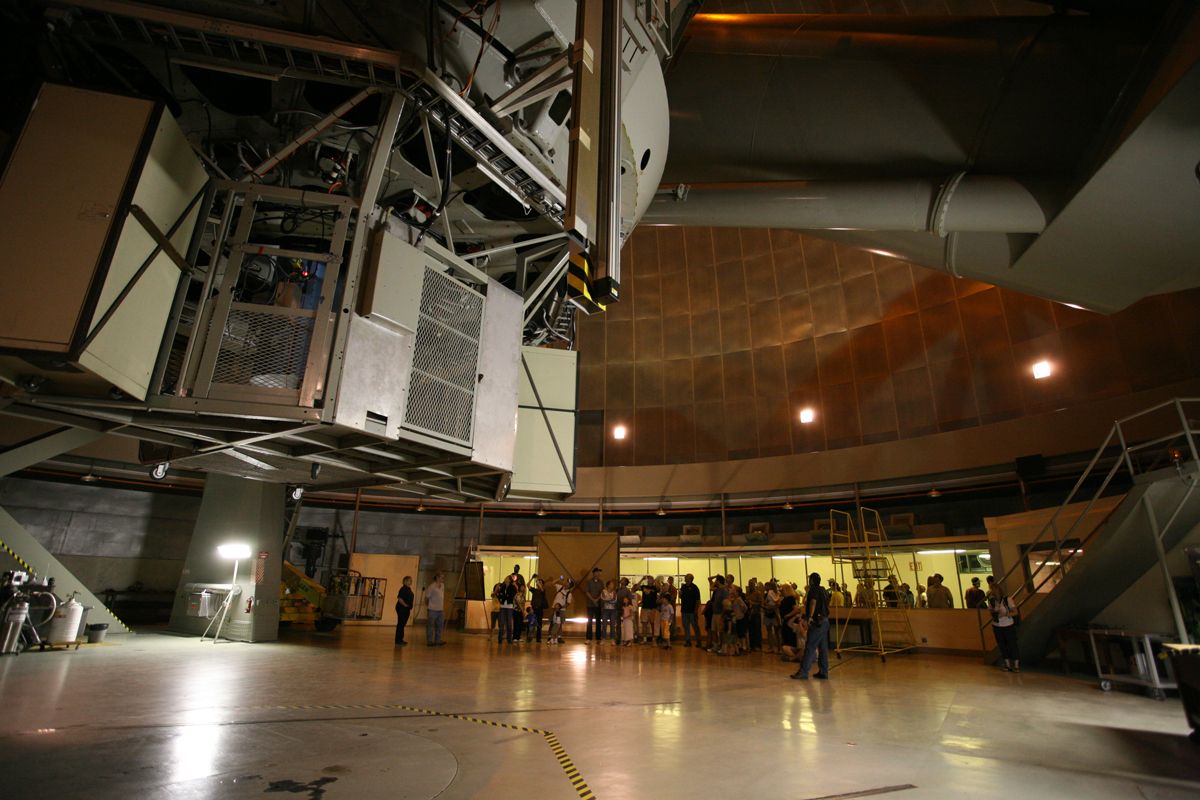
One final thing about the Mirror to Discovery exhibit in the Rakow Research Library, the staff there developed some trading cards for the kids that take a tour through the exhibit. They show the story of the making of the 200-inch mirror, the disc that is on display in the museum and even some astrophotos from Palomar. It is a nice set of cards and I couldn't resist taking a picture of them here at Palomar with the Hale Telescope in the background.
In case you were wondering, the 200-inch mirror is enclosed in the steel ring with the black circles.
Finally, I would like to extend my personal thanks to everyone at the Rakow Library and the Corning Museum of Glass for making this such wonderful visit. It was an honor for me to be able to represent the observatory at the birthplace of the Hale Telescope's mirror.
Can you spot the people on the catwalk? Click the image to enlarge. Read on to see how you can get there too.
Guided tours of the 200-inch Hale Telescope return this weekend. The hour-long tours are given on Saturdays and Sundays from April through October at 11:00 a.m., 1:00 p.m. and 2:30 p.m. Tickets are sold in the Palomar Observatory Gift Shop on a first-come, first-served basis.
The tours explain how the telescope works, its history, research and (weather permitting) includes a visit to the outside catwalk. More details on the tours can be found here.
Yes, the observatory is back open to the public and we have returned to our non-winter hours - meaning that we are now open daily from 9:00 a.m. until 4:00 p.m.
I had an amazing time in Corning, NY. I will be posting about that soon.
Yes, Palomar Observatory is still closed to the public due today.
I will be traveling for the next several days and may not be able to update the blog. Don't forget that you can check to see if the observatory is open or not by calling (760) 742-2119.
This dramatic photo expertly captured the drama as on March 25, 1934 men working with molten Pyrex glass were pouring what was then the biggest mirror ever made. This casting was unsuccessful, but a second attempt to pour the 200-inch Pyrex disc was successfully completed December 2, 1934.
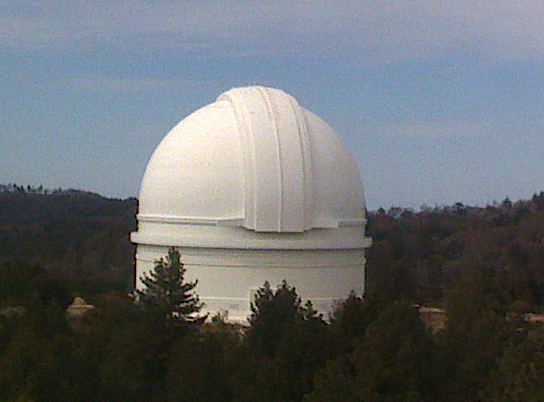 The photo was taken by observatory employee Scott Calman. It is part of a panorama that captures one other Palomar dome and much of the surrounding landscape.

 Here I am with Mark in the Rakow Research Library. One of Mark's pieces, seen between us, from his "Palomar Series" is on display as a part of the Mirror to Discovery exhibit at the Rakow. Mark recently sent me some photos of some of his newer pieces in his Palomar Series. I will likely make another post on them in (hopefully) the near future, but here is a preview showing one called "Palomar Rising":
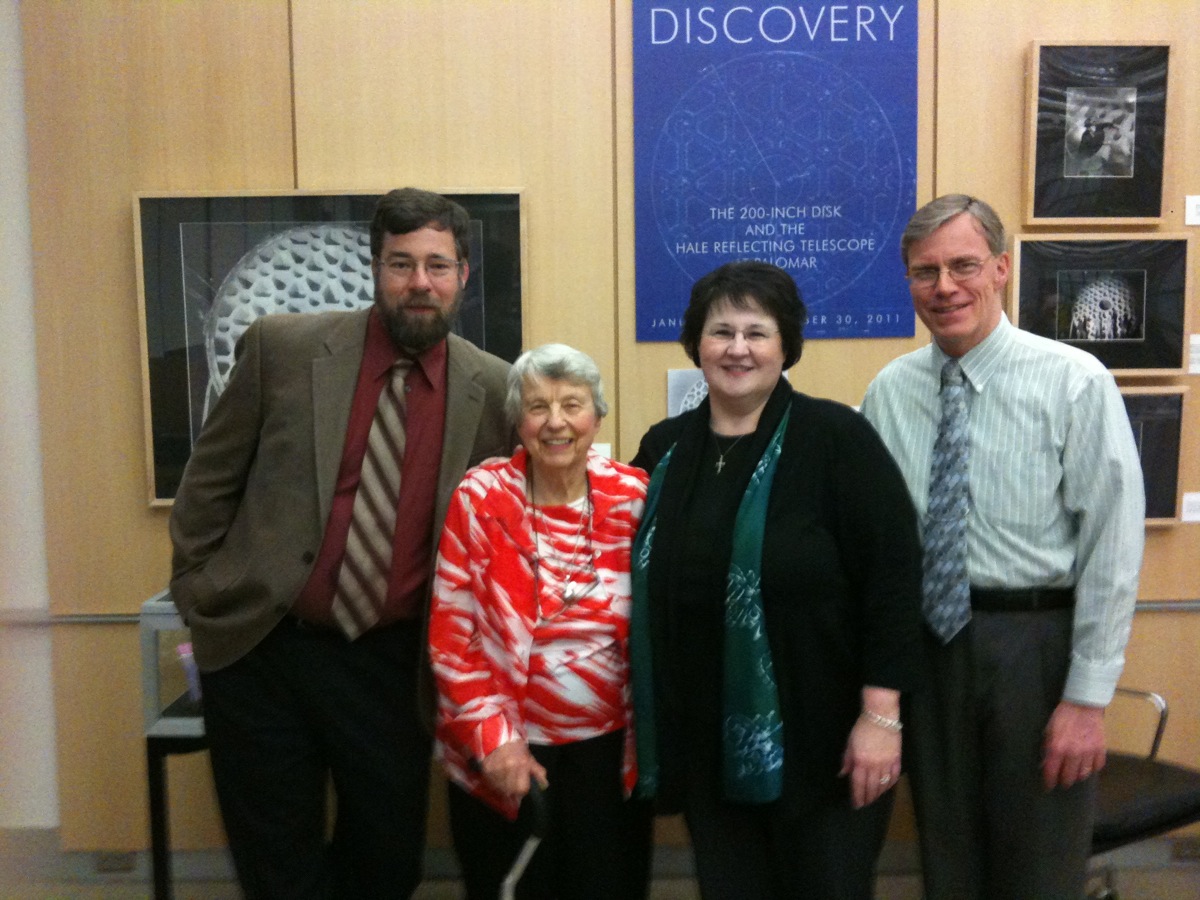 That's me with Dr. McCauley's daughter, Anne Price and her son Rick and his wife Sheila. Behind us is a portion of the Mirror to Discovery exhibit in the Rakow Research Library. In the glass case are some cool Palomar/Corning artifacts including this unassuming gem:
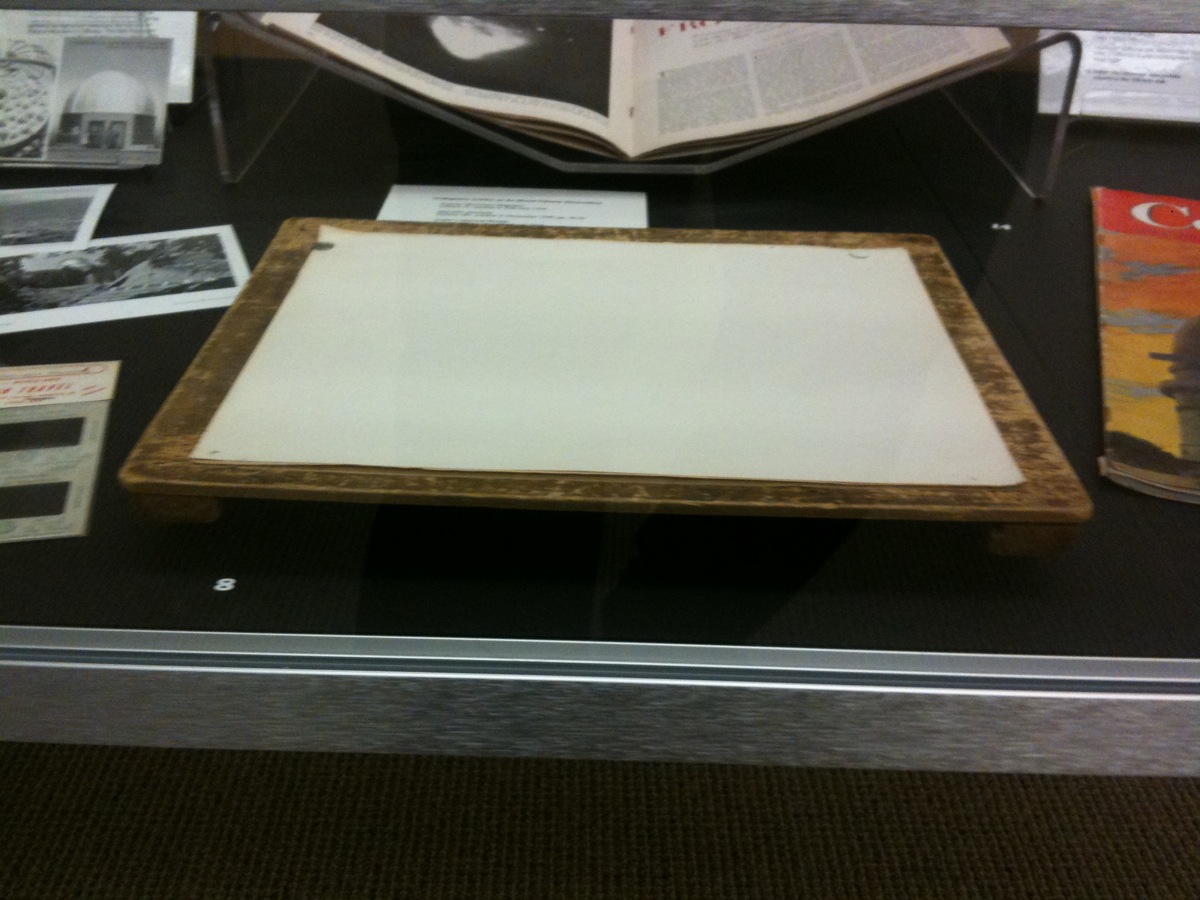 It is the drawing board that Dr. McCauley used to design the 200-inch mirror. For a nice look at his design visit this page from the Corning Museum of Glass and look for the image "Plan View and Cross Section of Mirror" and you'll find out a surprise about the 200-inch.
 In case you were wondering, the 200-inch mirror is enclosed in the steel ring with the black circles.
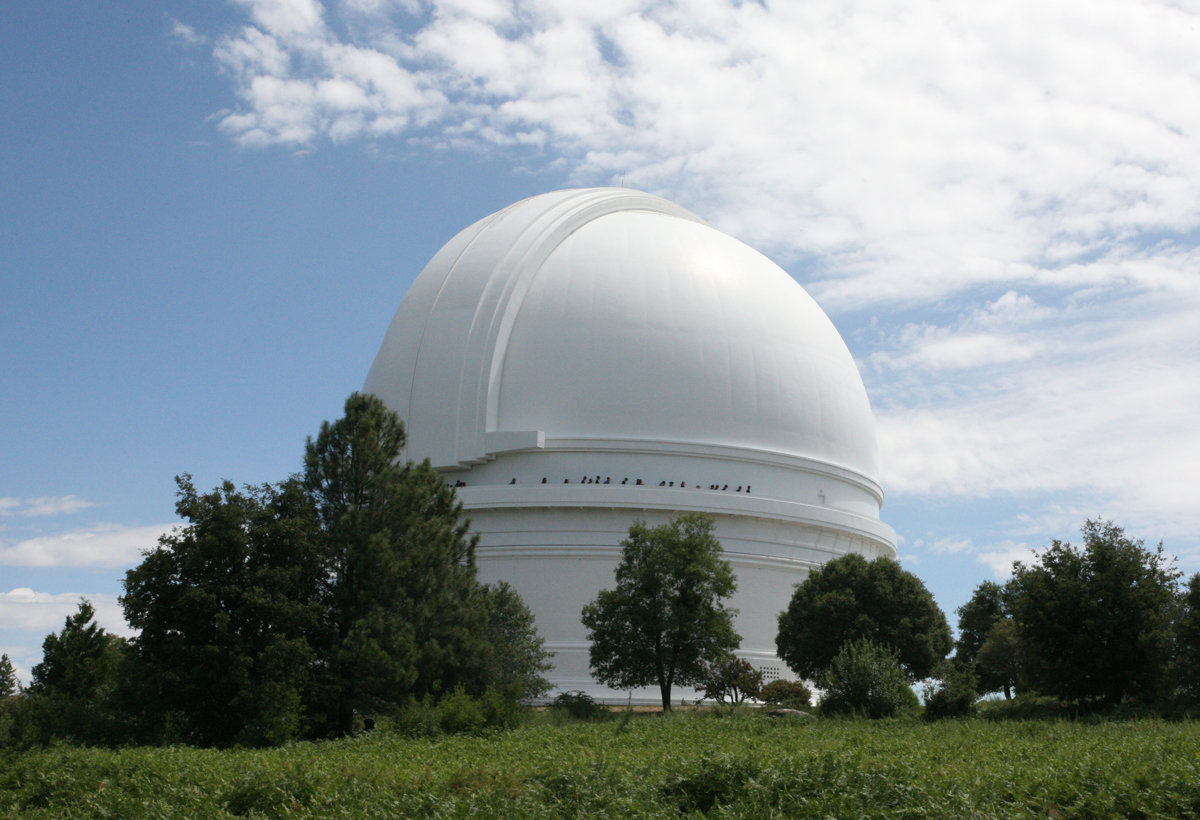 Can you spot the people on the catwalk? Click the image to enlarge.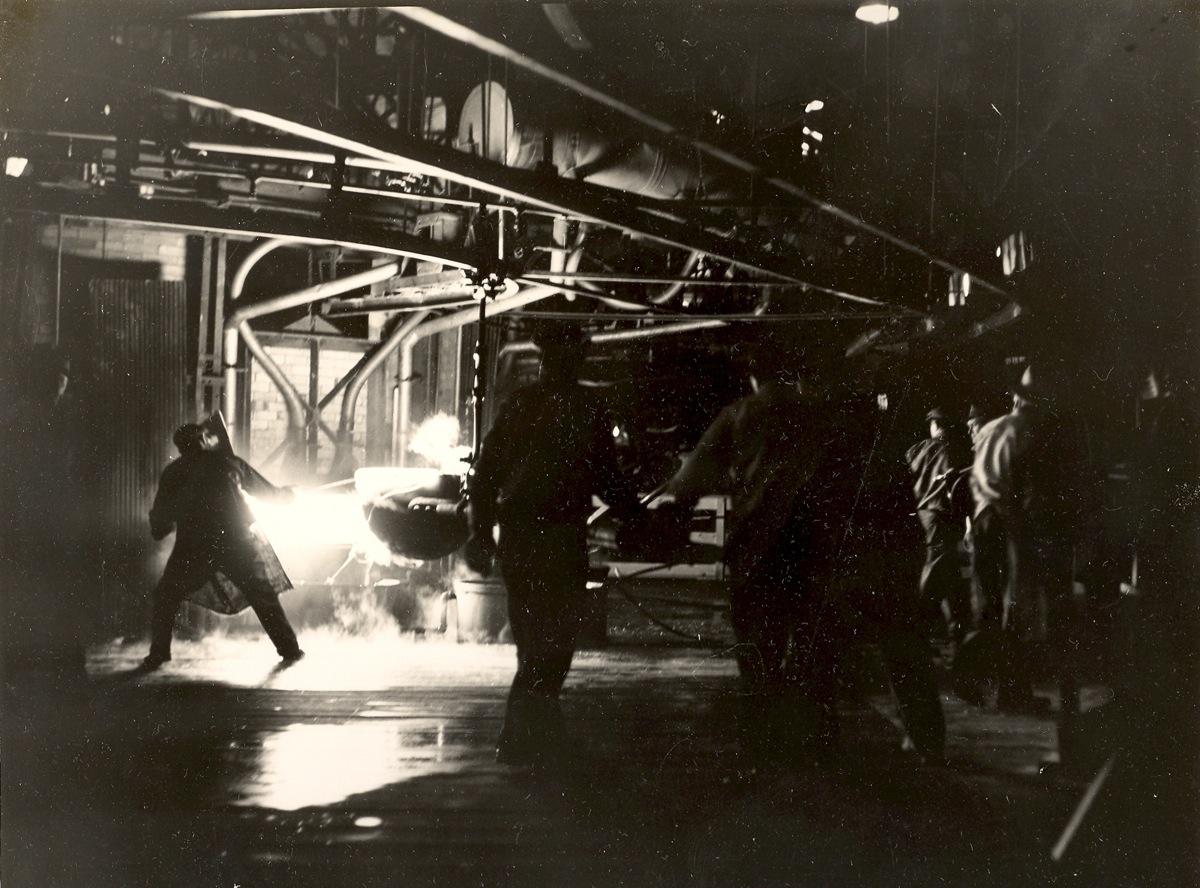

 Posts
Posts


