Showing posts with label Corning. Show all posts

Thursday, April 28, 2011

My Favorite 20-ton Piece of Glass

The folks over at the Corning Museum of Glass are asking people to vote for their favorite piece of glass in their collection. Can you guess which one happens to be my favorite?*

Here is a video that they produced that explains it:


Here is a direct link to the video on YouTube.

Last March Robert Cassetti, who is seen in the video, happened to give me a wonderful tour of the fabulous glass collection at the museum. If you are at all interested in unique and amazing glass artistry I encourage you to explore all 60 pieces that are highlighted for the museum's 6oth anniversary.

*By the way, the 200-inch mirror that is actually in service at Palomar is my favorite piece of glass. However, it is not on display, nor does it weigh 20 tons.

Saturday, April 2, 2011

A Visit to Corning, NY


I gave an invited talk about Palomar Observatory to an audience at the Corning Museum of Glass. It was an important presentation for me as Corning is the birthplace of Palomar's 200-inch mirror. I had the chance to fill everyone in on what the astronomers have been doing with it over the years. I was happy that there was a nice crowd for the talk and that they asked me many follow-up questions. I even got a positive review in the Corning newspaper. More importantly I had the chance to meet some great people, look through some historical archives and explore the fabulous collection in the museum.

It should be no secret that my favorite piece in the Corning Museum of Glass is the first disc that was cast for the 200-inch telescope. The casting ultimately turned out to be a failure (read about it here), but it became the first piece in what is now a world-famous collection of glass.

Here is a short video that I shot showing the 20-ton failed disc:


Here is a link to the video on YouTube.

I also had the chance to finally meet glass artist Mark Peiser. Mark has created a series of pieces inspired by the 200-inch mirror for the Hale Telescope. (You can read some earlier posts about Mark's work here and here).

Here I am with Mark in the Rakow Research Library. One of Mark's pieces, seen between us, from his "Palomar Series" is on display as a part of the Mirror to Discovery exhibit at the Rakow. Mark recently sent me some photos of some of his newer pieces in his Palomar Series. I will likely make another post on them in (hopefully) the near future, but here is a preview showing one called "Palomar Rising":


I also had the honor of meeting some of the family of Dr. George V. McCauley, the man from Corning Glass Works who was in charge of creating the glass giant.

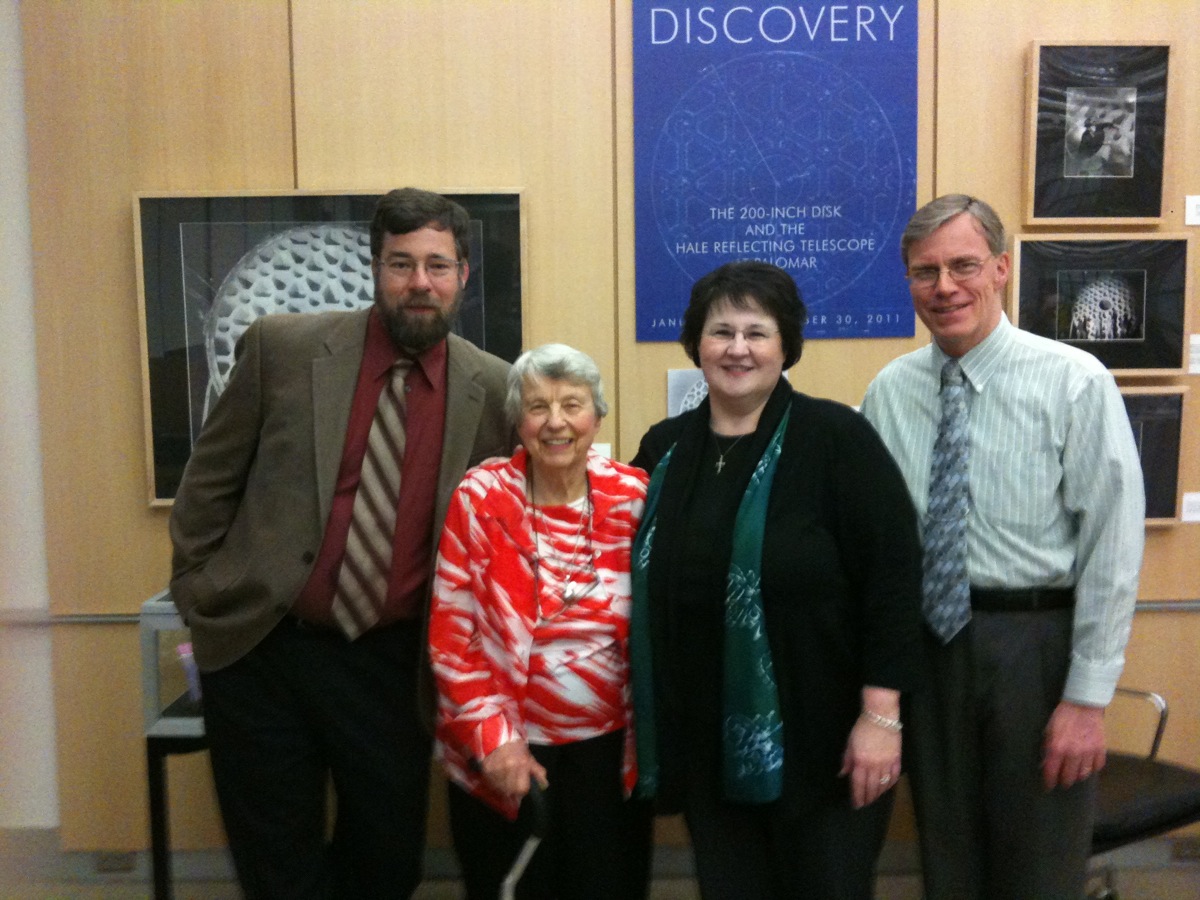
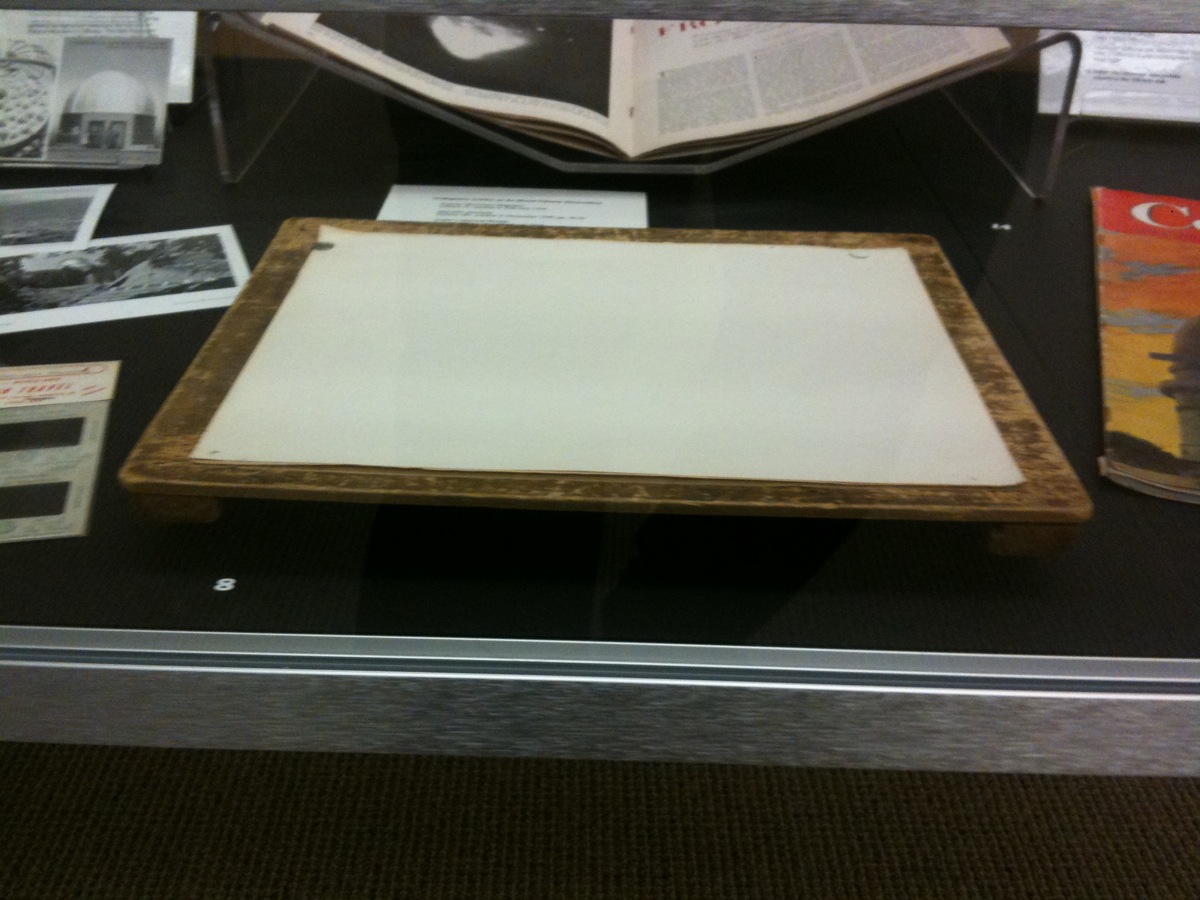
That's me with Dr. McCauley's daughter, Anne Price and her son Rick and his wife Sheila. Behind us is a portion of the Mirror to Discovery exhibit in the Rakow Research Library. In the glass case are some cool Palomar/Corning artifacts including this unassuming gem:

It is the drawing board that Dr. McCauley used to design the 200-inch mirror. For a nice look at his design visit this page from the Corning Museum of Glass and look for the image "Plan View and Cross Section of Mirror" and you'll find out a surprise about the 200-inch.

One final thing about the Mirror to Discovery exhibit in the Rakow Research Library, the staff there developed some trading cards for the kids that take a tour through the exhibit. They show the story of the making of the 200-inch mirror, the disc that is on display in the museum and even some astrophotos from Palomar. It is a nice set of cards and I couldn't resist taking a picture of them here at Palomar with the Hale Telescope in the background.

In case you were wondering, the 200-inch mirror is enclosed in the steel ring with the black circles.

Finally, I would like to extend my personal thanks to everyone at the Rakow Library and the Corning Museum of Glass for making this such wonderful visit. It was an honor for me to be able to represent the observatory at the birthplace of the Hale Telescope's mirror.

Friday, March 18, 2011

Palomar History Photo of the Week - Molten Glass


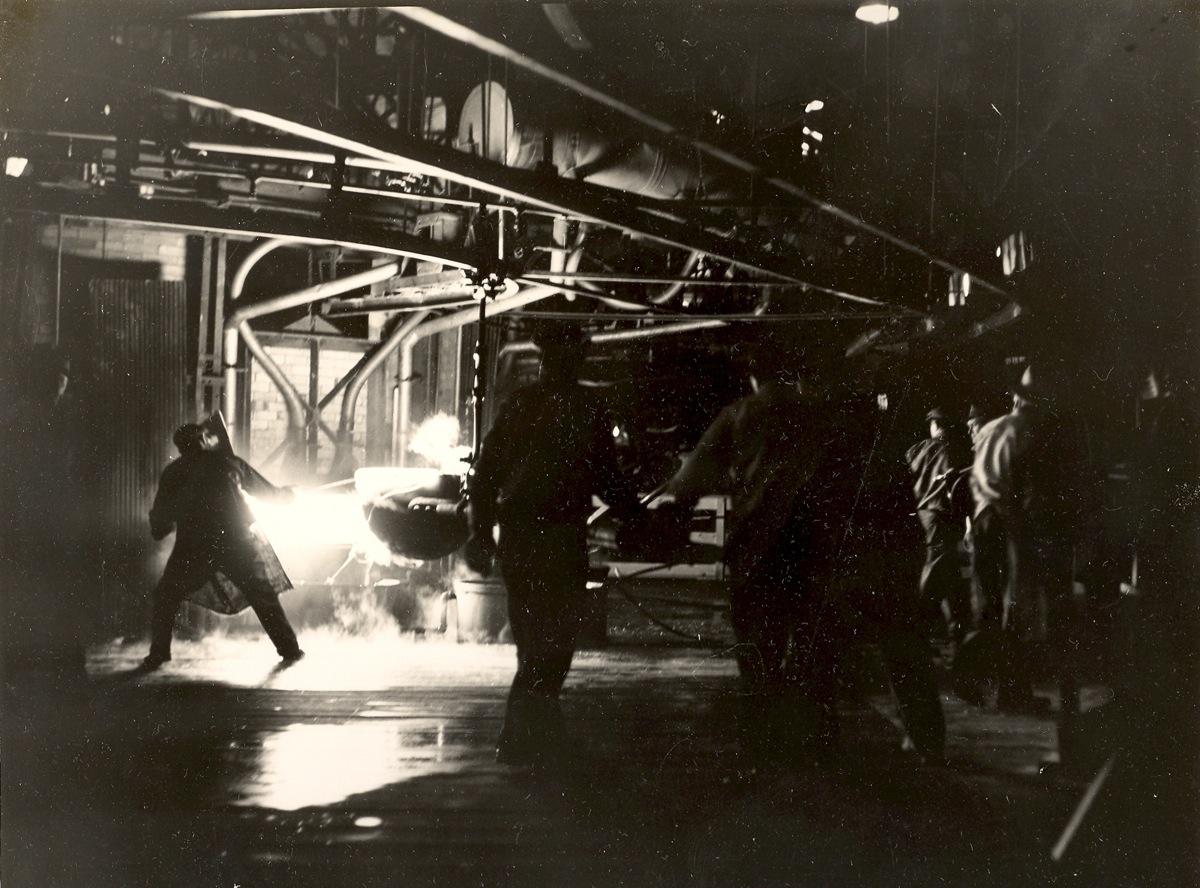
This dramatic photo expertly captured the drama as on March 25, 1934 men working with molten Pyrex glass were pouring what was then the biggest mirror ever made. This casting was unsuccessful, but a second attempt to pour the 200-inch Pyrex disc was successfully completed December 2, 1934.

Thursday, March 10, 2011

Speaking at Corning

In just two weeks I will be giving a talk at the Corning Museum of Glass, the birthplace of Palomar's 200-inch mirror.

I am looking forward to having the opportunity to see their new Mirror to Discovery exhibit and to visit again with the first, failed disc that was cast for Palomar.


The talk will not be on the history of the creation of the glass giant, nor on the construction of the 200-inch telescope or the 1000-ton dome that houses it. Instead, the talk will focus on what the astronomers at Palomar have done and are doing with the giant telescope that was made possible by Corning Glass Works.

I am told that the talk will also be available on line. I will post details of how to catch it as soon as they come in.

Sunday, March 6, 2011

Palomar History Photo of the Week - Corning Glass Works

March is a good time to celebrate the contribution that Corning Glass Works made in creating Palomar Observatory's 200-inch mirror. 77 years ago this month they made their first attempt at casting the 200-inch. It was unsuccessful, but you can check out a previous post on it here.

If you get the chance you really should see the first disc, which is on display at the Corning Museum of Glass. You can also check out their Mirror to Discovery exhibit, at which can be seen until the end of October in their Rakow Library.


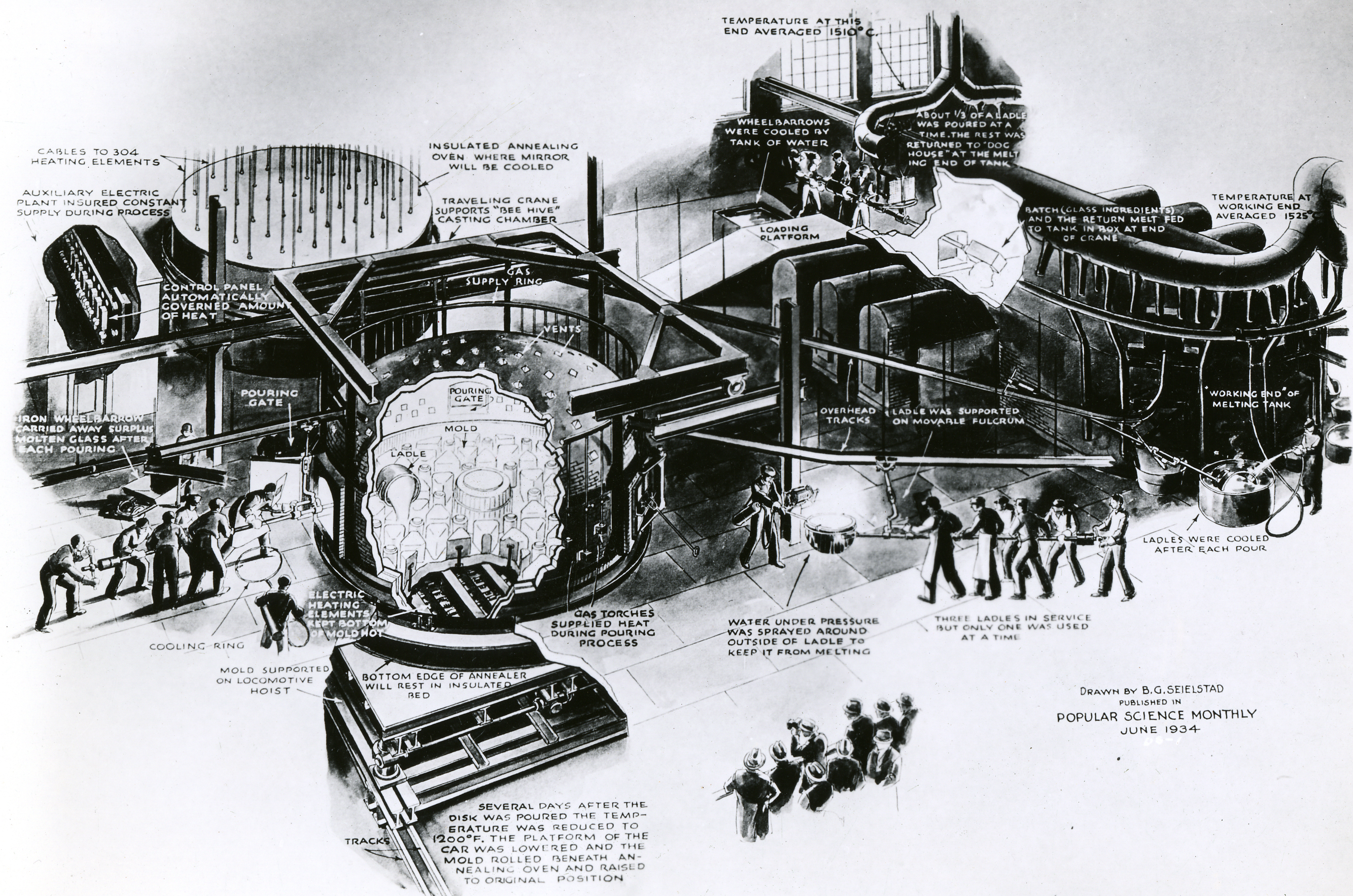
Our "photo" this week is a detailed drawing of Corning's factory as it was set up for casting the 20-ton disc. Click on the image or this link to see a huge and richly detailed version of the drawing from the June 1934 issue of Popular Science Monthly.

This month also marks the 75th anniversary of the beginning of the trip westward for their second, successful disc. I will be posting other images this month that fit with both anniversaries.

Thursday, May 6, 2010

I Can See for Miles and Miles . . . .

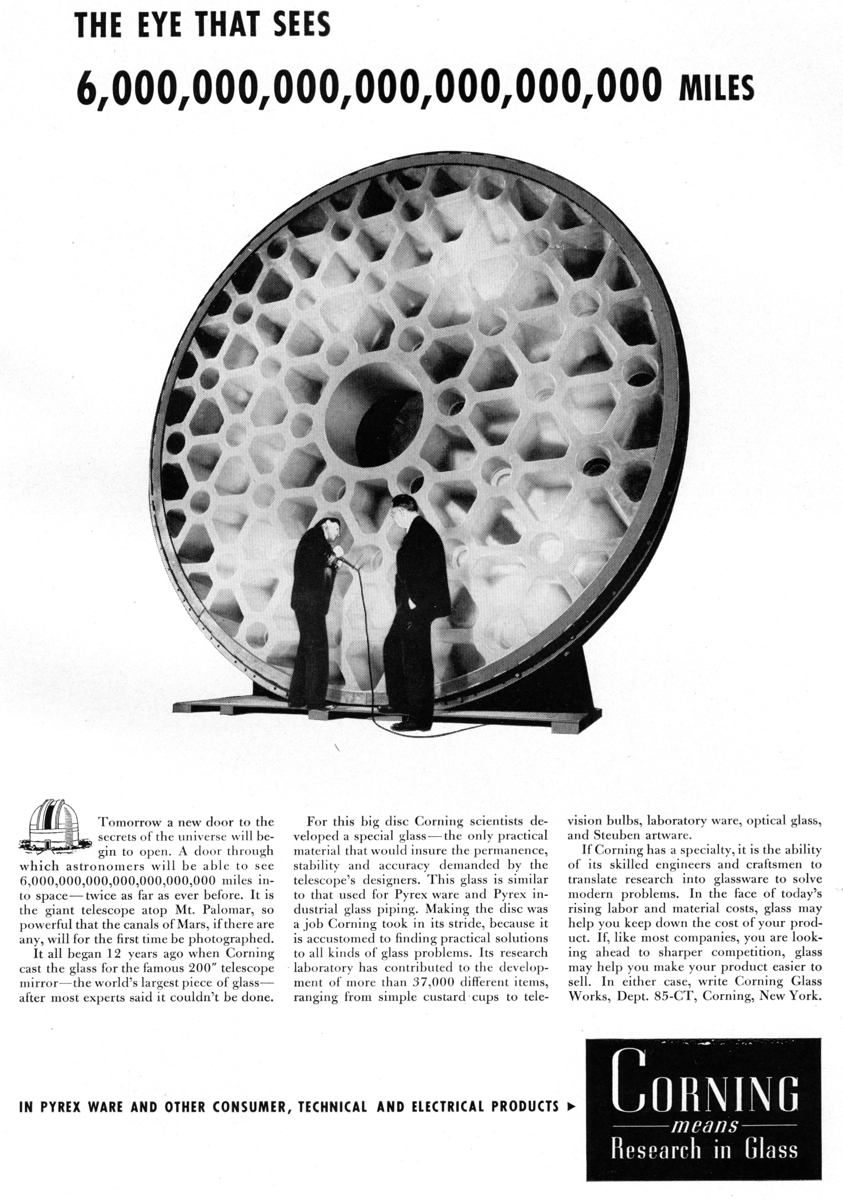
Here is another ad that features Palomar Observatory. This one, from Corning, was run in the 1948 Caltech yearbook, The Big T.

Click to embiggen and you'll be able to read the text of the ad. The photo shows the honeycombed back side of the 200-inch disc. Standing with it is Dr. George V. McCauley (left) and Dr. J. C. Hostetter. Dr. McCauley directed the project of the casting the huge Pyrex disc.

The ad includes some interesting copy with lines like "the giant telescope atop Mt. Palomar, so powerful that the canals of Mars, if there are any, will for the first time be photographed."

Of course in 1948 just about every astronomer was already convinced that the "canals of Mars" were nothing more than an optical illusion. Curiously enough the Chief of Aviation and Optical Division of the Corning Glass Works, Dr. O. A. Gage gave a radio address in April 1936 (about twelve years before this ad came out) on the 200-inch mirror. In the address he said that there will be "no inroads on the inhabitants of Mars" - meaning no one was going to see any canals. Too bad the person who wrote the ad didn't check with Dr. Gage. His speech was printed in the Journal of the Royal Astronomical Society of Canada and contains some interesting stuff. You can see it here.

Oh, and 6,000,000,000,000,000,000,000 miles is a little over a billion light years. With modern digital detectors astronomers using the 200-inch telescope can see at least eleven times further than that.

Wednesday, March 25, 2009

75 Years Ago Today

75 years ago today, the first 200-inch mirror blank was cast at the Corning Glass Works in Corning, NY. The casting was unsuccessful as the ceramic cores on the underside of the mold broke loose and floated to the surface. I posted about this last year, but today I have some wonderful things to share.

Word got out prior to the casting and a great many spectators came to see the crew handle the molten glass to as they worked to fill the mold. Have a look at the photo and you can see just how close the crowd was to the crew.

Time Magazine's on-line archives has the story, Pouring Day, as it appeared in their April 2, 1934 issue. Be sure to check it out.

Here is the Corning Evening Leader from March 26, 1934. Be sure to click on it to enlarge and read the articles.

It is interesting to me that one of the sub headlines reads "Glass Works Officials Believe Efforts Have Been Successful" yet next to it is an article "Plan To Cast New Disc If Necessary". Of course the casting was not successful and the officials, namely Dr. George McCauley who was in charge of the project, knew that they would need to try again.

They went ahead and gave the big disc a rapid annealing. When it came out of the annealing oven it looked like this:

Not a pretty site, is it? While the disc was still molten the workers attempted to remove the ceramic cores that had floated to the surface. With plans underway for a second pouring, it was decided to re-melt the first pouring in an attempt to salvage it. Alas, during that process the disc was cracked.

So what do you do with a 20-ton failure? Put it on display and hope people come to see it. It became the first center piece of what is now the Corning Museum of Glass.

Last November I had the opportunity to visit, spend some time in the Corning Incorporated research archives and to finally touch the first 200-inch disc.


Of course Corning triumphed in the end. The second pouring, attempted 8 1/2 months later, was successful. That disc is still in use nightly at Palomar.

The failed disc is an impressive display at the Museum of Glass. Here are a few more shots to round out the post.

The front side of the disc:


The front side as viewed from below:

The back side of the disc:

Special thanks to Kris in the Corning archives for all the help she gave to me during my visit and for answering my many questions over the years. The old photos and the newspaper are a small part of the vast collection in the Corning archives.

Friday, November 14, 2008

Aluminizing Update # 5

Today the mirror was washed and stripped of aluminum. Starting at 7 am PST on Saturday the crew will give the mirror a final alcohol wash and when they are ready they will lift the top to the vacuum chamber over the mirror tomorrow morning and start pumping down to vacuum.

There will be lots of photos to share here on the blog next week of both the aluminizing and of the amazing trip that I have had to the birthplace of the mirror - Corning, NY. Stay tuned.