Saturday, October 31, 2009

High Flying Over Palomar

On warm days when the thermals are just right we often see a lot of gliders flying around the observatory. From time to time they pass close enough that you can actually hear them flying.

I guess that is why Pilot Getaways magazine was interested in featuring the observatory in an article on the local community Ramona, CA. That, and the fact that they had this amazing photo of a glider over the observatory:
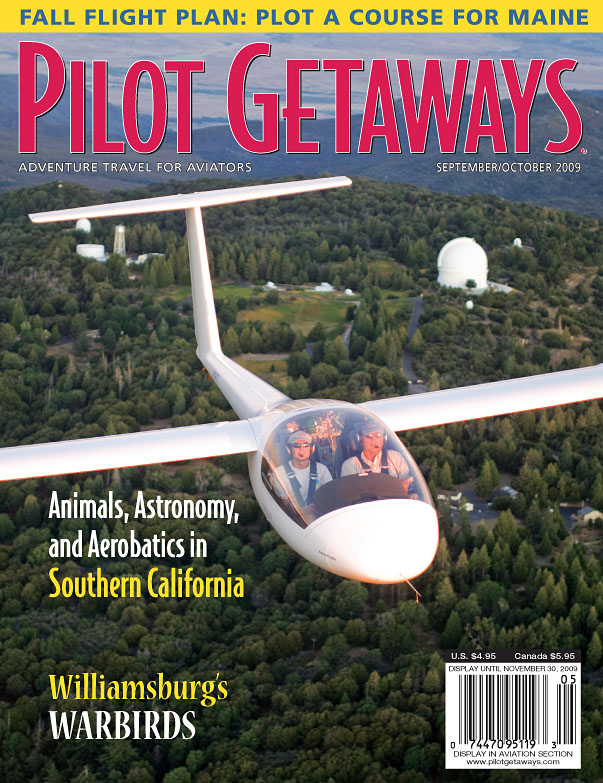

That is a pretty awesome shot. You'll find it on the cover of the September/October issue of Pilot Getaways magazine.

Just underneath the tail of the glider is the dome of the 48-inch Samuel Oschin Telescope, our one million-gallon water tank, water tower and the Power House. Underneath and to the right of the tail is the Palomar Testbed Interferometer. To the right of that is the dome for the 200-inch Hale Telescope. In front of the Hale is the dome of the 24-inch telescope. Behind and a bit to the right of the Hale is the dome of the 18-inch Schmidt. The observatory's Outreach Center (where I am typing this) is just to the right of the pilots and the Cleveland National Forest's Palomar fire station is to the right of that.

Friday, October 30, 2009

Too Far to Be Seen

Sometimes it is pretty exciting when you look for something and don't see it. Last April there was a gamma-ray burst (GRB 090423) detected by NASA's SWIFT satellite. One of the first ground-based telescopes to look for the visible light afterglow was the automated 60-inch telescope at Palomar. The 60-inch was imaging the source within three minutes of the satellite's detection of the GRB. The result? The 60-inch didn't see it.


You might not expect that I would devote any time or space on this blog for talking about something that we didn't see. But that non-detection (unlike LCROSS) was pretty exciting.

As Brad Cenko said in his report:

The lack of an optical afterglow, together with the fact that the X-ray column density is consistent with the Galactic value (Krimm et al., GCN 9198), make GRB 090423 an interesting candidate high-redshift event. We encourage observations at longer wavelengths to search for a NIR counterpart.


Translation: This object should be bright, but it wasn't seen in visible light. That means it could be an extremely distant event. So distant, that the expansion of the universe shifted its light completely out of the optical and into the infrared. That was indeed the case.

Telescopes observing the object in the near infrared and radio wavelengths did indeed see the optical afterglow of the event and it is the most distant object ever observed.

How far is it? Just over 13 billion light-years from Earth. GRB 090423 occurred 630 million years after the Big Bang, when the universe was only four percent of its present age of 13.7 billion years. Explosions like this give us a glimpse into the early universe and confirm the idea that massive stars, like the one that blew up creating the gamma-ray burst, existed even back then.

Goodbye to Sleuth

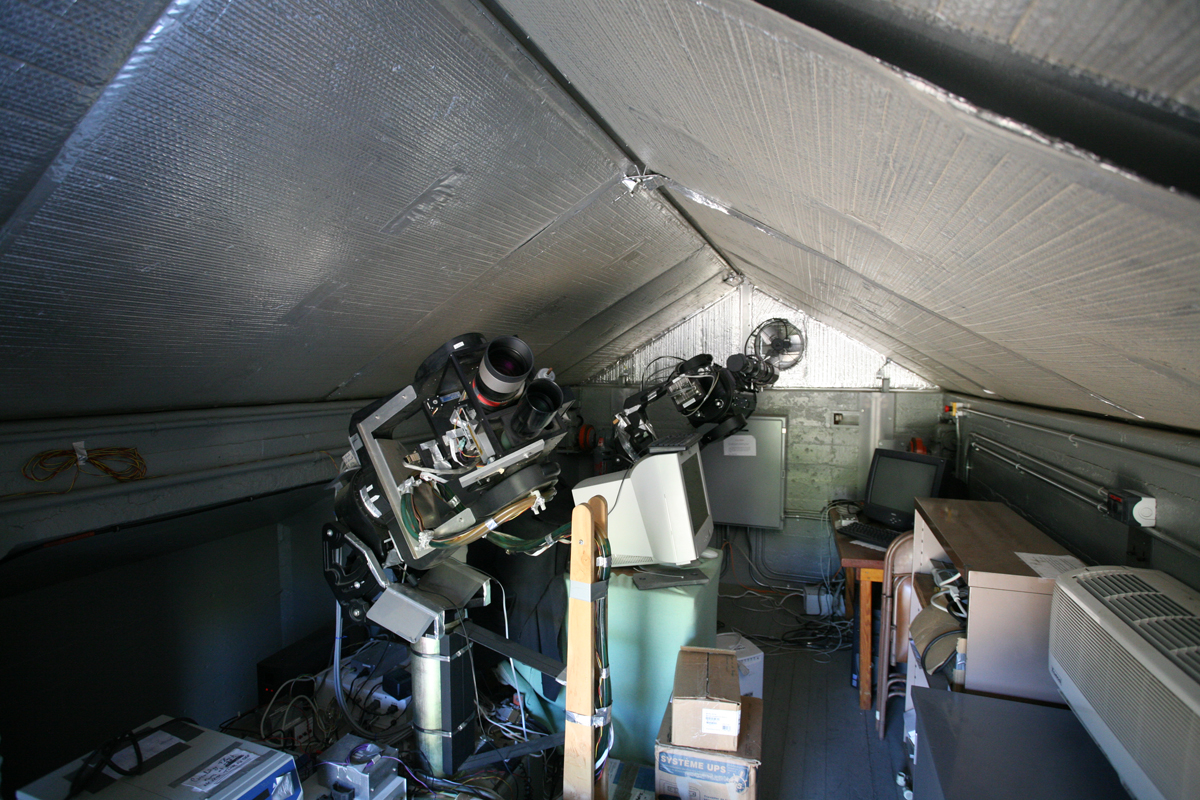
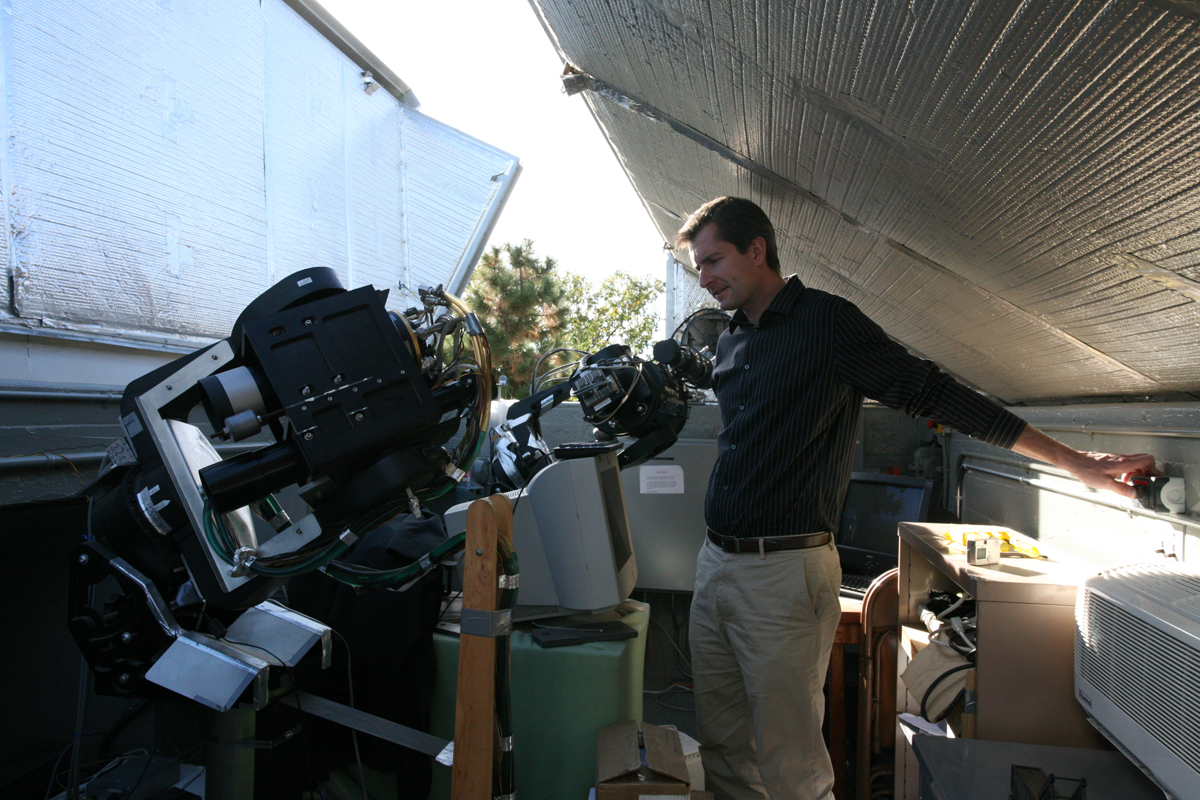
From 2003 - 2007 the tiny, robotic 4-inch sleuth telescope spent its nights at Palomar Observatory hunting down exoplanets. The telescope was part of the Trans-Atlantic Exoplanet Survey (TrES), a network of three such telescope dedicated to looking for exoplantes that are seen to directly transit across the face of their parent star.

At the time the survey began, there was just one known transiting exoplanet. TrES added four more exoplanets to the list. Not bad for such little telescopes.

The project was set up by then Caltech postdoc David Charbonneau (now with Harvard) who returned to Palomar earlier this week to to retrieve his little telescope. Even though the telescope had already been out of service for almost two years it was a bittersweet moment. Nobody like to see a telescope retired. The good news is that Dr. Charbonneau is leaving behind a 10-inch telescope ("Sherlock") that was also used for the project. This telescope, which helped to remove false detections from the list of possible exoplanets, will eventually be used for our public outreach programs.

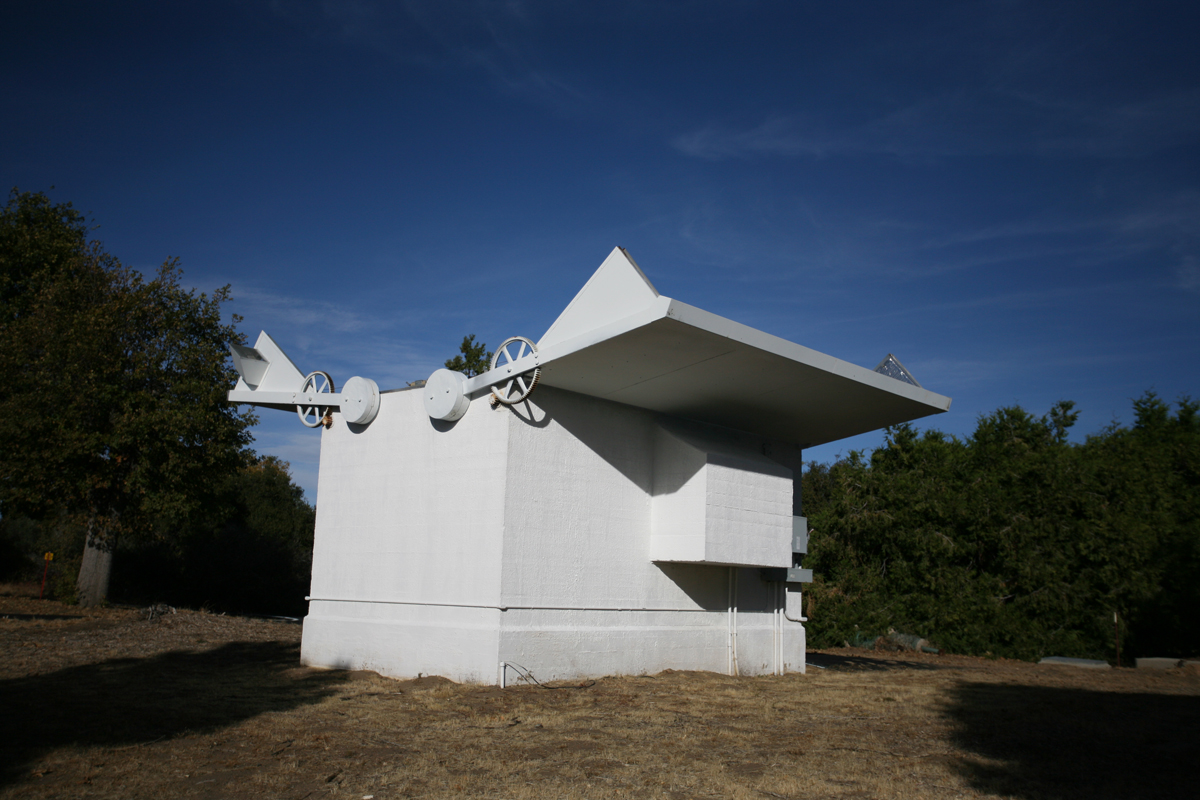
The enclosure that was occupied by Sleuth will be put back into use again. More on that later.

Thursday, October 29, 2009

Last Tours of the Season

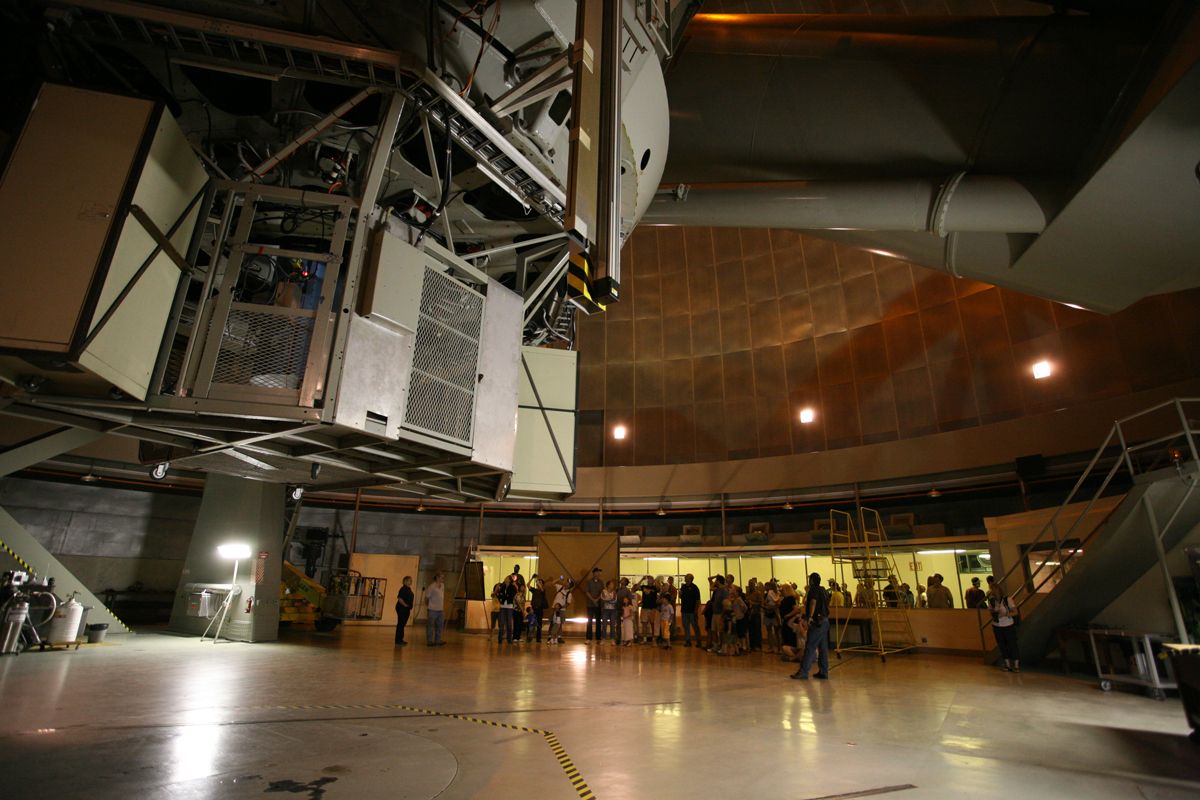
This weekend (Oct. 31 & Nov. 1) will be the last Hale Telescope public tours of the season. If you have been putting off coming for one of the tours this will be your last chance until they resume in April.

The temperature inside the dome is running about 40 degrees right now and will likely stay in the 40s for the weekend. So if you attend, be sure to bring a warm layer (or two)!

The tours will be held at 11:30 a.m., 1:30 p.m., & 2:30 p.m.

Wednesday, October 28, 2009

Borego's Dark Sky Day

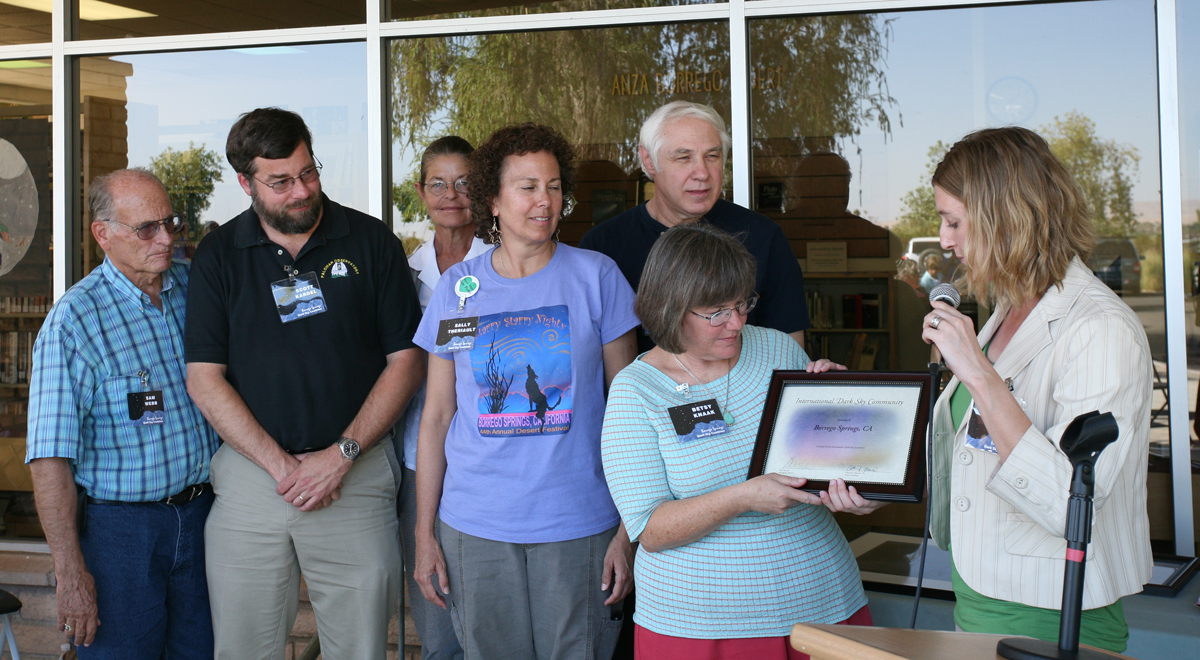
Last Saturday was the big day in Borrego Springs, CA. A number of people were on hand as it was time for the International Dark-sky Association to officially present Dark-sky Community status to Borrego Springs. Here are a few photos from the event, which was held just outside the Borrego Springs Library.


Bill Horn, a San Diego County Supervisor, spoke about the importance of the dark-skies designation to the community and presented an official proclamation for the event.


Click on the image to embiggen. That way you can actually read the proclamation.


Kim Patten of the International Dark-sky Association spoke on the importance of preserving dark skies and the wonderful skies over Borrego Springs.

Here is the Borrego Springs Dark-skies Coalition as they received the framed certificate from Kim Patten of the IDA. Yes, I am in that shot. I worked with this group for two years to help make this a reality.

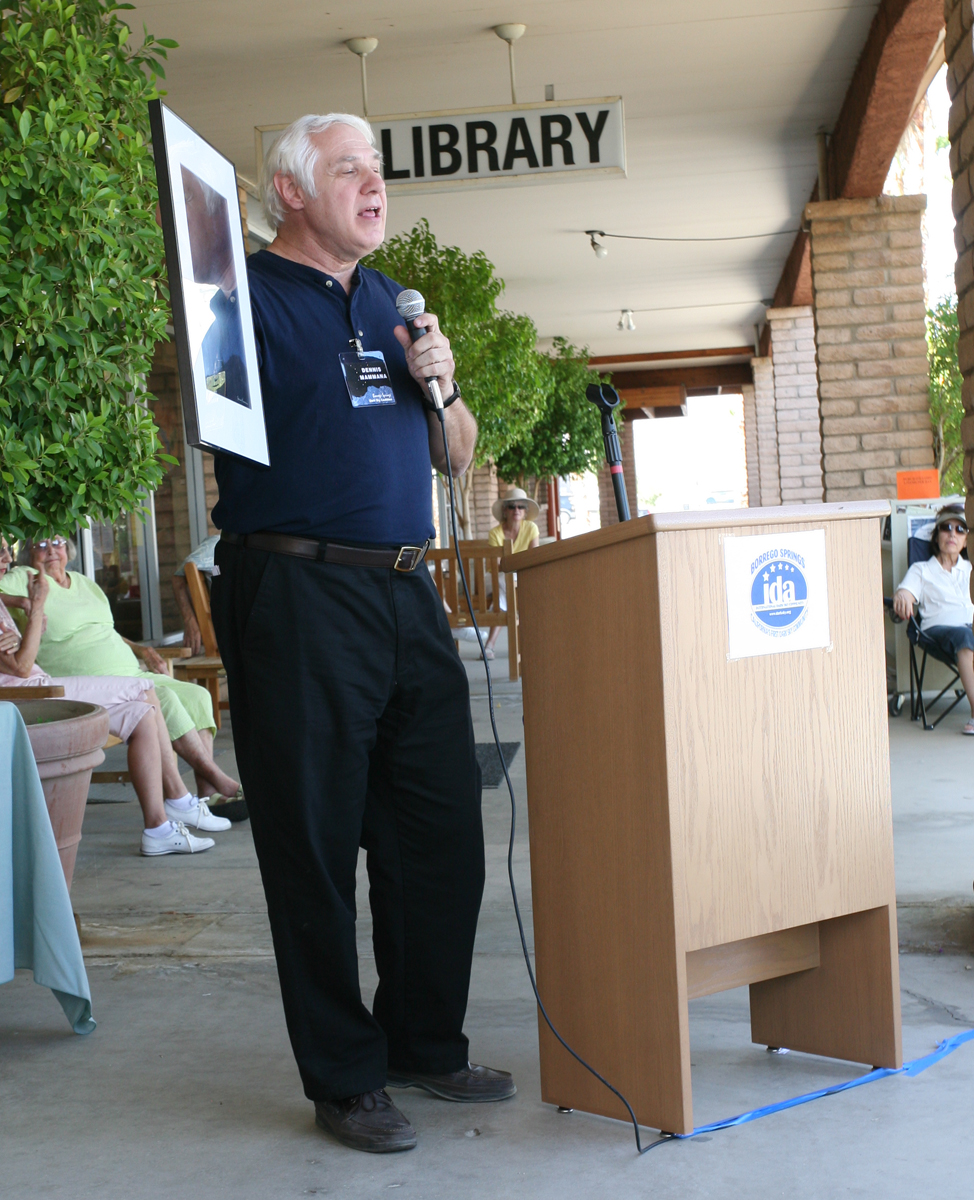
Astrophotographer Dennis Mamanna spoke eloquently about the value of seeing the sky from the desert that surrounds Borrego Springs and then presented one of his astrophotos, taken from the area, for display in the town's public library.

Saturday, October 24, 2009

Dark Skies for Borrego Springs

Last summer I helped to announce that the International Dark-sky Association had proclaimed Borrego Springs, CA to be the world's second International Dark-sky Community.
Today, the official ceremony marking their effort to preserve their night sky will be held in Borrego Springs at 1:00 p.m. in the library as a part of their Borrego Days events. I will be attending and report on it later.

If you come to Borrego for the ceremony or to view their impressive night sky, be sure to check out The World at Night photo exhibition. The amazing exhibition of astrophotographs runs at the Borrego Art Institute through November 8, 2009. An if you are in town this evening you can catch Dennis Mammana presenting One People, One Sky! at the Borrego Springs Performing Arts Center. The images in the talk are stunning and include spectacular photos taken by Dennis himself.

Friday, October 23, 2009

No Power

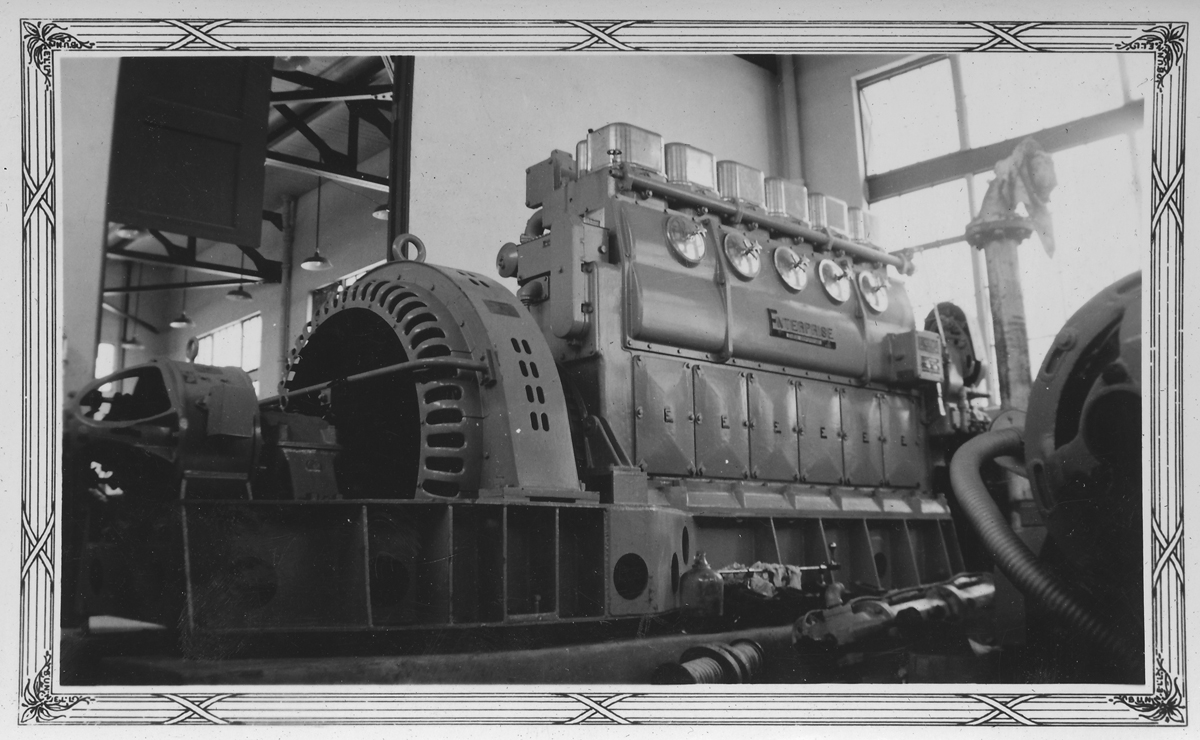
The power company will be doing some work in the area and power will be cut to parts of Palomar Mountain today. The observatory will be running on generators and open to the public. The observatory's public affairs office office is slightly off of the compound and not part of the generator's back up grid. In other words, don't bother trying to call me after 8 am as my phones, message machine and Internet will likely be down.

Pictured above is one of the old diesel Enterprise generators that used to serve the observatory 24/7/365. Back in the early days the observatory was totally off of the grid and ran generators full time. The observatory's main office is still called the Power House even though those generators have now been gone for quite a while.

Thursday, October 22, 2009

Dome Dog

I am having a super busy week with little time for blogging. Here's a photo from the collection of Lee A. Farnsworth, Jr. taken sometime in the early 1940s.

I am not sure of the dog's name, but it appears in several photos.

Saturday, October 17, 2009

This is the Way We . . . . .

This is the way we wash our dome.

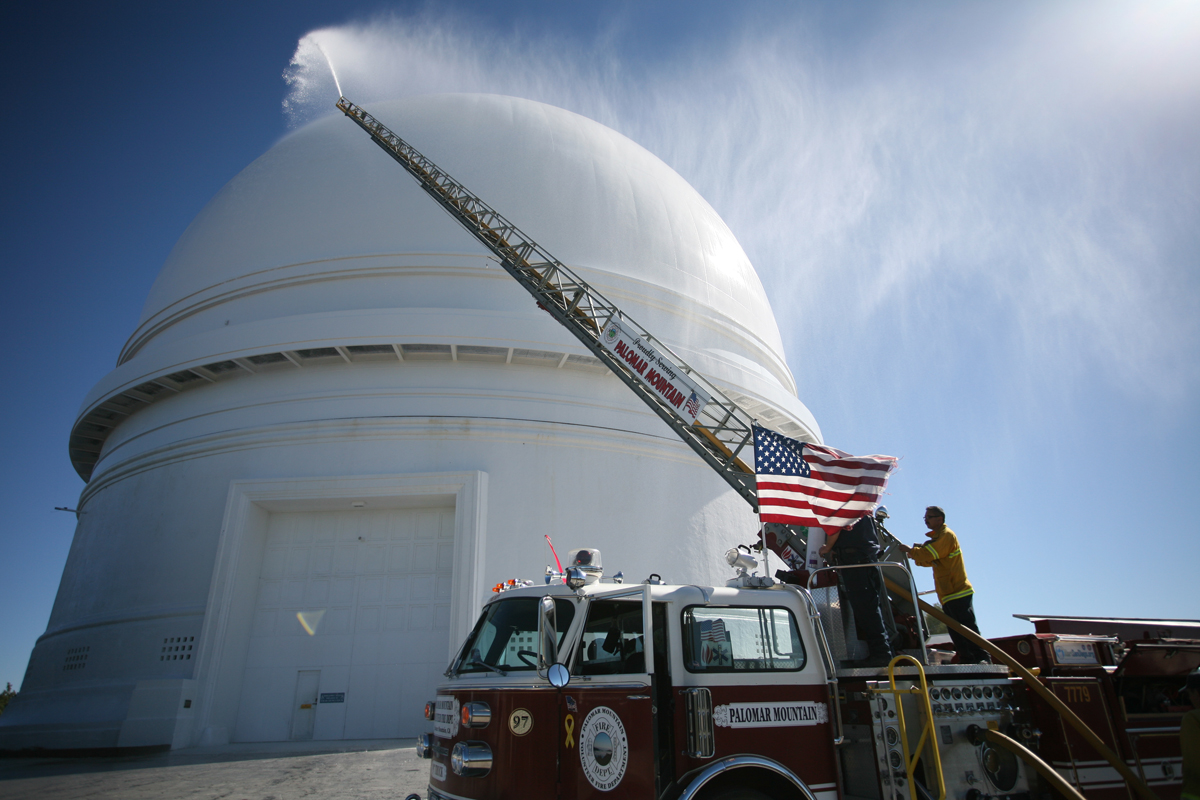
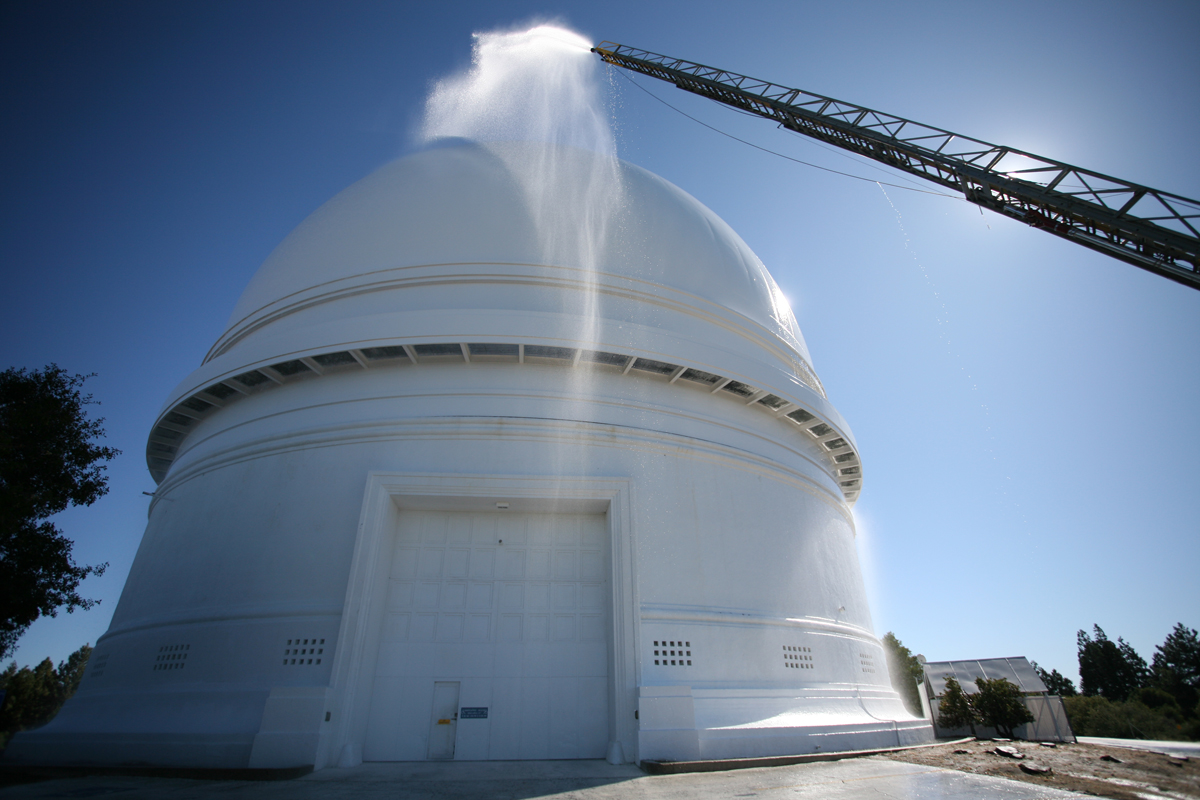
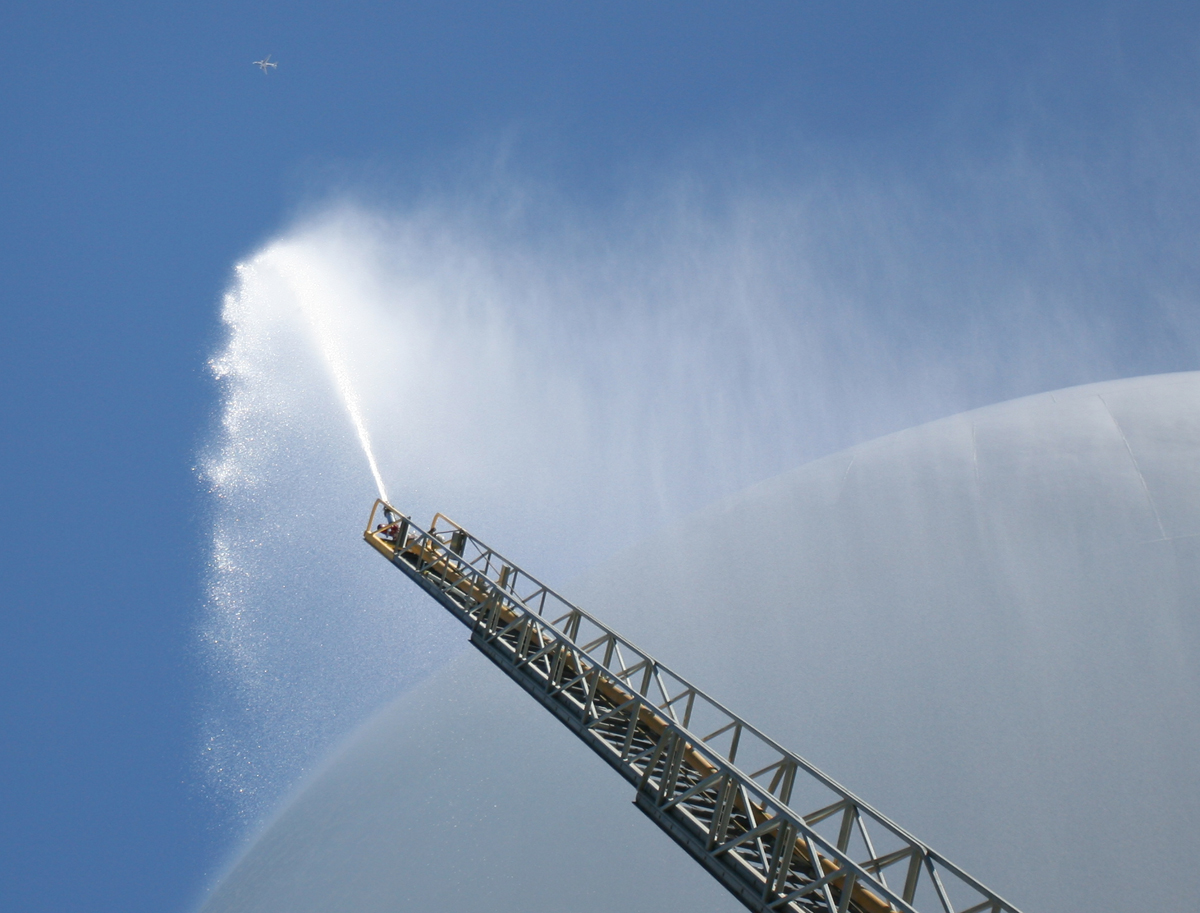
It is possible that, until today, the dome of the Hale Telescope has never been washed except by rain. We decided that it was time to change that. The dome is 135-feet high, making it a rather big job to wash the dome. A guy on a ladder with a garden hose pressure washer just isn't going to get it done.

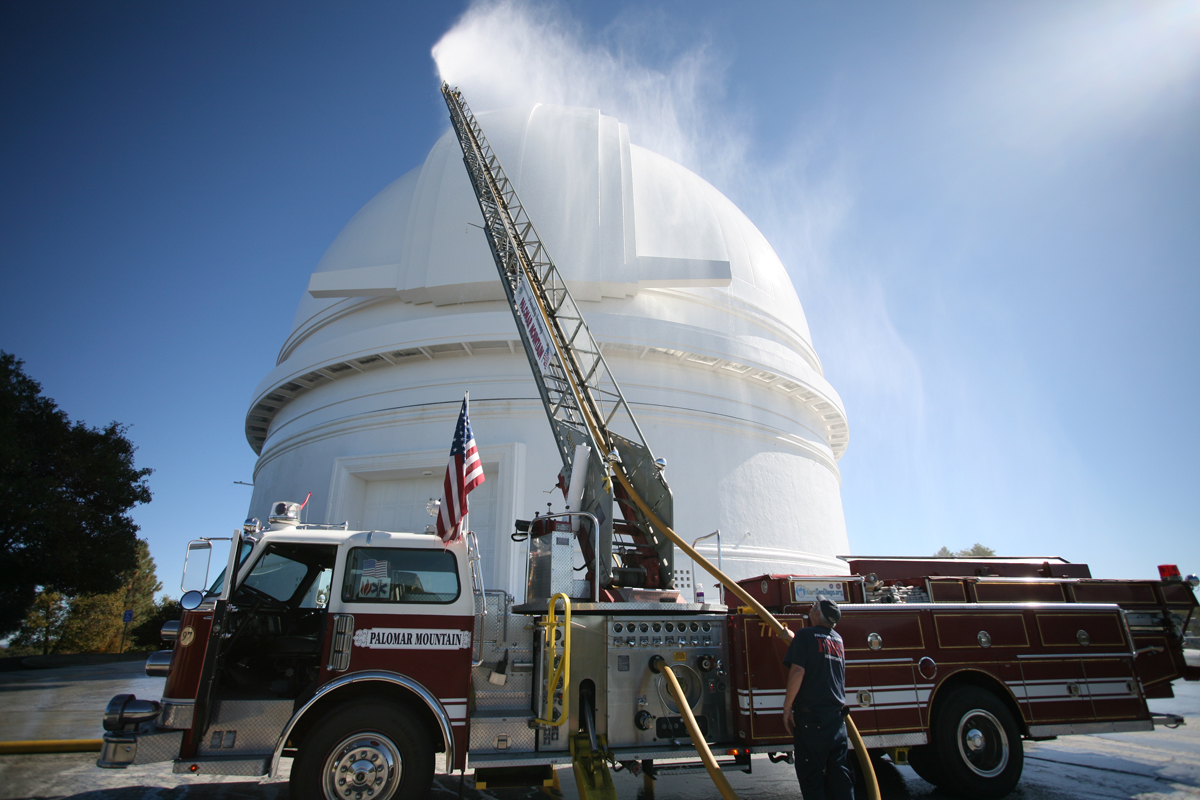
Thankfully, the Palomar Mountain Volunteer Fire Department was able to come to our rescue.

The PMVFD, armed with a ladder truck and fire hose, was easily up to the task.

Seeing the crew in action spraying water onto the dome was a very impressive sight.

When it is time to wash different areas of the dome, you simply turn the 1000-ton dome past the firetruck.

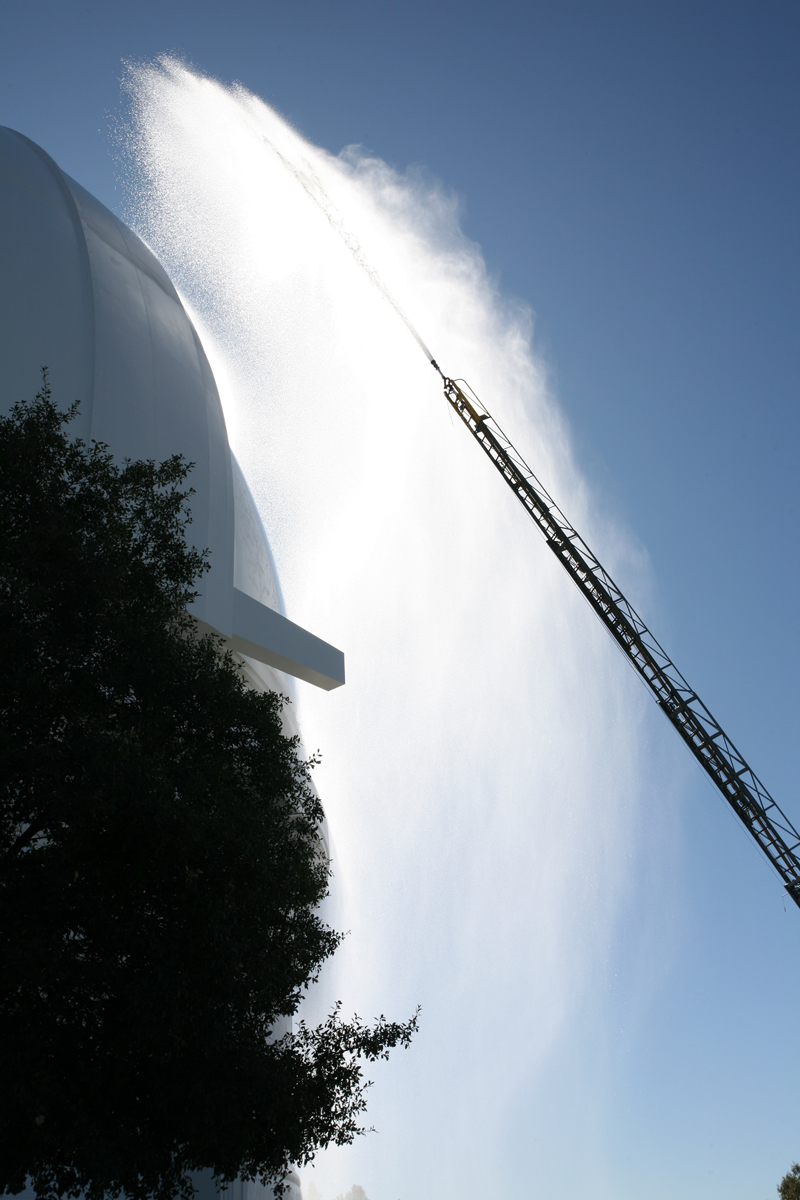
The washing produced quite an impressive spray which led to some interesting photo opportunities.

It is pretty nice to be able to create your own rainbows and have a firetruck and a telescope dome at either end.

They have a pretty powerful pump in the ladder truck and it certainly could shoot water very high into the air. Alas, it wasn't quite able to knock that jet out of the sky. ;)


Thanks to George, Cliff, Greg (on the ladder) and the entire PMVFD for their assistance today.

Russell W. Porter's Palomar Art on Exhibit


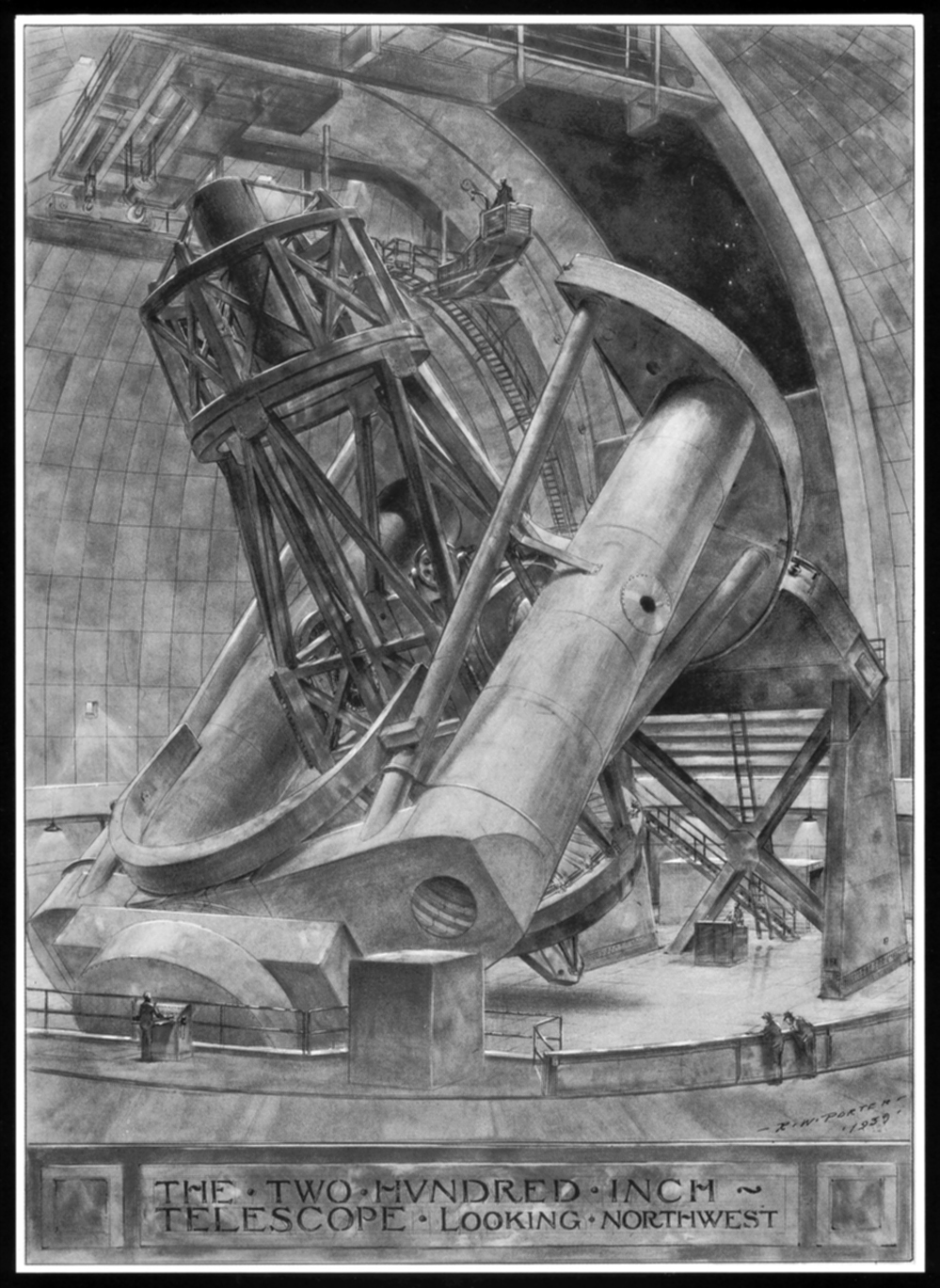
Shown above is Russell Porter's 1939 drawing The Two Hundred Inch Telescope Looking Northwest. It is one of Porter's many fantastic visualizations of the 200-inch telescope project. Porter's work earned him the nickname "cutaway man" because many of his drawings featured cutaway views of the interior of the telescope and its many parts.

Now five of Porters original drawings (3 of the 200" and 2 of the 48"), including the one shown above, are on public exhibition for the first time. They are part of an exhibition at the Art Center College of Design in Pasadena, CA called "Tools".

From their website:

Objects on display are not sleek contemporary designs but rather belong to the worlds of contemporary art, science, and natural history, and can be simultaneously appreciated for their aesthetics and impact on human development, as well as for their utility. The resulting blurred boundaries are the intention of the exhibition's organizers.
The exhibition runs until January 10, 2010.