Showing posts with label 18-inch schmidt. Show all posts

Saturday, May 28, 2011

Milky Way Over Palomar

Astronomer Iair Arcavi comes to Palomar Observatory to use the Hale Telescope to study supernovae as part of the Palomar Transient Factory survey. The survey is going quite well with over 1,110 supernovae discovered so far.

Iair also manages to find the time to do some nighttime photography with his digital SLR camera. I have posted some of his work here before (See his shot of the Milky Way over the Hale Telescope, his 2 Nights at the Palomar Observatory video and his composite of the Perseid meteor shower).

He managed to shoot some more dramatic images of our Palomar Skies just this last week. Both images nicely show off our domes, the heart of the Milky Way Galaxy and how light pollution is brightening our skies.
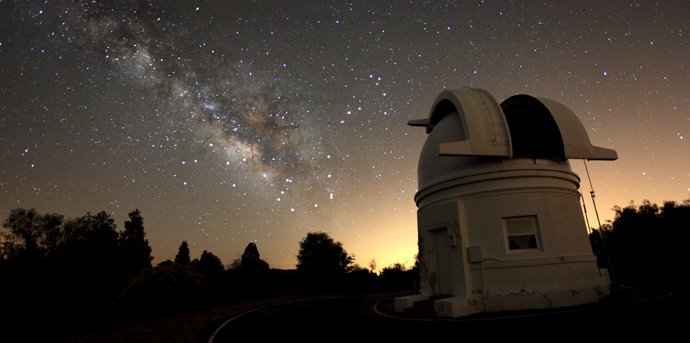
This image shows the dome that used to house the 18-inch Schmidt, Palomar's first telescope. The constellation of Scorpius can be seen just to the left of the dome. Note the bright sky glow to the southwest.

The 18-inch Schmidt is now retired but in its lifetime it was used for a tremendous amount of important work. For instance, just yesterday was the anniversary of that telescope being used to make the 1992 discovery of asteroid Braille (1992 KD). Astronomers Eleanor Helin and Kenneth Lawrence found the asteroid as a part of the Palomar Planet-Crossing Asteroid Survey. Just seven years later Braille was photographed as NASA's Deep Space 1 spacecraft flew past it.
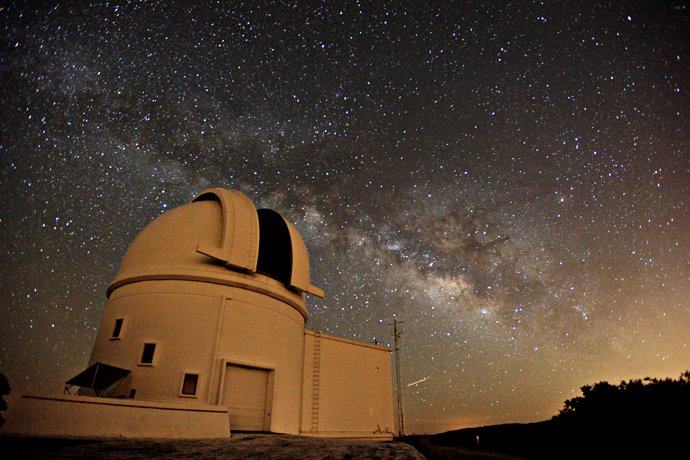
Another of Iair's photos shows the Milky Way behind the dome of Palomar's automated 60-inch telescope. The 60-inch telescope is used nightly to perform follow-up observations on the new transient sources discovered through the Palomar Transient Factory survey. It also is a rapid-response telescope that gives astronomers a look at the optical glow of gamma-ray bursts.

Monday, May 2, 2011

Catwalk Panorama

Hopefully this panorama will show up on all Web browsers. It is an interactive Photosnyth panorama shot a few minutes ago from the catwalk of the 200-inch Hale Telescope. In it you can see the observatory's water tower, the dome of the 48-inch Samuel Oschin Telescope and the dome of the 18-inch Schmidt telescope.


Here is a direct link to the panorama. I hope to shoot more of these in the near future to give people a sense of what it is like to be at Palomar Observatory.

Saturday, July 17, 2010

Asteroid Cronkite


On the night of November 18, 1990 astronomer Elanor Helin, using Palomar's 18-inch Schmidt telescope, discovered an asteroid (arrowed above) that was later found to have an orbit that carried it across the orbit of Mars. Almost exactly six years later the asteroid was named for journalist Walter Cronkite and is now officially known as 6318 Cronkite.

Walter Cronkite passed away one year ago today, just days ahead of the 4oth anniversary of the Apollo 11 landing on the moon. Cronkite famously covered the moon landings and for many of us old enough to remember them it is hard to separate the events that took place in space from the coverage he provided.

It has been a year, but so long Walter you are missed.

Monday, July 12, 2010

Palomar History Photo of the Week - July 12, 2010

Palomar Observatory's first telescope was the 18-inch Schmidt.


This week's Palomar Observatory History Photo of the Week shows the dome of the 18-inch Schmidt while it was under construction. The photo was taken by Lee A. Farnsworth, Jr, who worked here during the construction of the observatory. I don't know the exact date of the picture but it was certainly taken in the spring of 1936.

Saturday, June 12, 2010

Spring on Palomar

"June Gloom" is in full swing for the lowlands below, but on Palomar Mountain we are experiencing a beautiful spring day.

As evidence of the nice weather from above the clouds, here are two photos taken from vantage points seldom seen by the visiting public.

Looking west across a field of western bracken ferns (Pteridium aquilinum) toward the dome of the Hale Telescope.

The dome that once housed the 18-inch Schmidt telescope standing well behind some Lupine (Lupinus albifrons, var. eminens) flowers. These purple flowers can be currently seen in bloom in many places on Palomar Mountain.

Monday, May 31, 2010

Palomar History Photo of the Week - May 31, 2010

Eighty two years ago last week (May 25) the quest to build a 200-inch telescope began as the Rockefeller International Education Board appropriated “not more than $6,000,000” to the California Institute of Technology for the purchase of a site and the construction of an observatory including a 200” reflecting telescope.

Palomar Mountain was eventually chosen as the site for the observatory and as plans were still being finalized for the big telescope a new concept was discovered. This new design, the Schmidt camera, was a wide-field telescope gave crisp star images all the way to the edge of the field of view. The design was not implemented for the big telescope, but it was for Palomar's first telescope - the 18-inch Schmidt.

Here is the almost-completed 18-inch Schmidt telescope in the shops at Caltech on April 16, 1936. The telescope saw first light a few months later on September 5 as Fritz Zwicky began his surveys for supernovae. Across the years this telescope was used by many astronomers to discover asteroids, comets supernovae, galaxies, galaxy clusters and more.

The 18-inch Schmidt is now retired, but it proved to be very successful. So much so that a larger version was built, the 48-inch Schmidt. Now called the Samuel Oschin Telescope, the 48" is still used nightly and is the backbone to the Palomar Transient Factory survey that is discovering supernovae in record numbers.

Friday, May 28, 2010

Astrophoto Friday: A Comet and a Meteor

Astrophoto Friday: Comet Halley and a Meteor. January 1986.


Here is the press caption from when this photo was released:

"This photo of Halley's comet was taken just as a meteor streaked across the sky above Caltech's Palomar Observatory. The photo was taken at 7:11 p.m., PST on January 7 by JPL astronomer Eleanor Helin using the 18-inch Schmidt Telescope at Palomar. The two-minute exposure shows the comet and tail, as well as the sharp streak of a meteor from the Quadrantid meteor shower."

This week hasn't given me much of a chance for blogging even though there are interesting things to share. Hopefully, you'll be seeing more here soon.

Saturday, October 31, 2009

High Flying Over Palomar

On warm days when the thermals are just right we often see a lot of gliders flying around the observatory. From time to time they pass close enough that you can actually hear them flying.

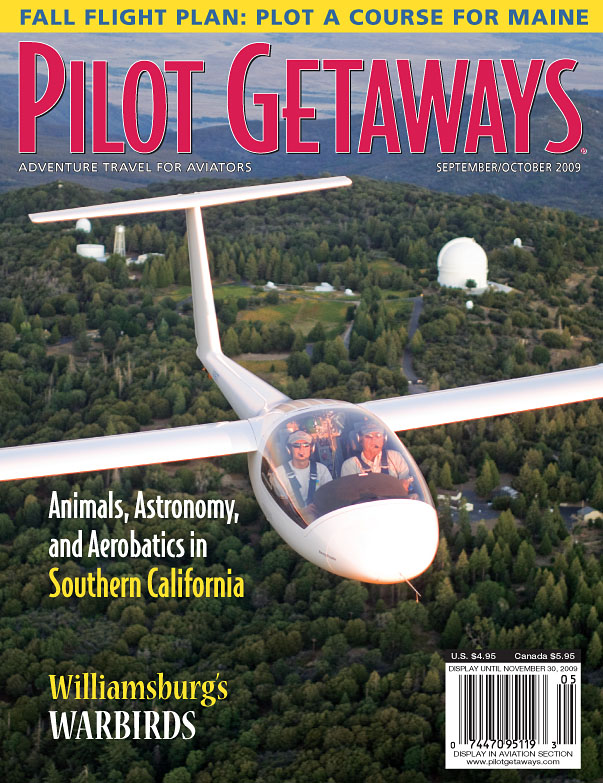
I guess that is why Pilot Getaways magazine was interested in featuring the observatory in an article on the local community Ramona, CA. That, and the fact that they had this amazing photo of a glider over the observatory:


That is a pretty awesome shot. You'll find it on the cover of the September/October issue of Pilot Getaways magazine.

Just underneath the tail of the glider is the dome of the 48-inch Samuel Oschin Telescope, our one million-gallon water tank, water tower and the Power House. Underneath and to the right of the tail is the Palomar Testbed Interferometer. To the right of that is the dome for the 200-inch Hale Telescope. In front of the Hale is the dome of the 24-inch telescope. Behind and a bit to the right of the Hale is the dome of the 18-inch Schmidt. The observatory's Outreach Center (where I am typing this) is just to the right of the pilots and the Cleveland National Forest's Palomar fire station is to the right of that.

Thursday, September 10, 2009

Palomar's 18-Inch Schmidt

Earlier this week (Sept. 6th) marked the 73rd anniversary of first light for Palomar Observatory's first telescope, the 18-inch Schmidt (FYI, many purists prefer to refer to this type of instrument as a Schmidt Camera, but that is a story for another day). I posted some construction photos and info on this last year around this time, but I thought I would update with some news about the telescope itself.

The telescope produced some major discoveries in its day, but that day has passed. It isn't used for astronomy any more and it hasn't been for over a decade now. The telescope no longer even resides in its dome. Here is a shot of how it looked a couple of years ago before it was pulled from its dome:

As you can see below the telescope is in pieces now:


Don't worry. The old 18-inch Schmidt is about to get some TLC and will (hopefully within a year) be proudly on public display. As things get moving I'll post info here to update how things are progressing and give a preview or two as to how it will eventually be displayed.

Friday, July 17, 2009

Remembering Apollo, a Comet Crash & Eugene Shoemaker

Yesterday, July 16th was the 40th anniversary of the liftoff of the Apollo 11 Mission. NPR had a wonderful story on the role of the USGS's astrogeology team in the training of the Apollo astronauts. Click on over to see and hear One Small Town's Big Role In The Apollo Missions.

Some of the time in the story is devoted to Eugene Shoemaker, the father of astrogeology. Gene was an astronaut hopeful, but a medical condition kept him grounded, but without his hard work and guidence the Apollo missions would not have been as scientifically productive as they were. If you visit the NPR page, in addition to listening to or reading the story, be sure to watch the USGS film on rocketpacks. It is fantastic.

Running the story on July 16th, not only marked the Apollo 11 anniversary, but also the anniversary of the first impact of the fragments of Comet Shoemaker-Levy 9 with Jupiter back in 1994. Comet Shoemaker-Levy 9 was discovered at Palomar in 1993 with the 18-inch Schmidt.


The impact of the cometary fragments with Jupiter was one of more important astronomical events of the 20th Century. This animation gives a rapid look at the comet crashes which lasted from July 16 - 22, 1994. The animation does indeed give a proper sense of the affects of the impacts that resulted in Jupiter's atmosphere. Many of the dark clouds that appeared from the impacts were larger than Earth.


If you want to learn more about the amazing life of Eugene Shoemaker, I highly recommend David H. Levy's book Shoemaker By Levy. It is a wonderful, personal look at Gene and his scientific career.

Monday, March 30, 2009

Happy Birthday Bernhard Schmidt

Today is Bernhard Schmidt's birthday. There is no better way to celebrate than by reading this post over at Today in Astronomy.

Friday, September 5, 2008

Palomar's First "First Light"


"First light" is a term astronomers use to describe when a telescope is first pointed at the sky. Seventy two years ago today the 18-inch Schmidt, the first telescope on Palomar Mountain, had its first light as Caltech astronomer Fritz Zwicky began his survey for supernovae.

The telescope has had a long and productive life having been used by many astronomers to make discoveries of supernovae, asteroids and nearly 50 comets. The telescope has since been retired and will eventually go on public display.

Here are a few unique photographs taken by Earl W. Gray (1899 - 1993). Gray worked at Palomar as a building or structural engineer back when construction was taking place on the mountain. His album of photos was donated to the observatory by his family in 1994.
Here is the dome of the 18-inch Schmidt under construction from earlier in 1936. The next photo is pretty unique. It is a photo of the dome of the 200-inch while it was under construction. What it so unusual is that it was taken using the 18-inch Schmidt. It isn't quite into a sharp focus, but I know of no other photo taken using of one research pointed at the dome of another research telescope.


Yes, the 18" used round film. The observatory bought its film from Kodak and then had to cut it into 6-inch diameter circles.

The photo below was obviously taken on a different date, but shows how the 18" was pointed towards the 200" for the photo above.

Tuesday, July 1, 2008

The View from on High (Point)

Here's a view looking down at the observatory from High Point, the highest elevation on Palomar Mountain. Click on the image for a higher resolution view. From left to right is the Oscar Mayer Building which houses the 60-inch telescope; the dome for the 18-inch Schmidt 's dome (partially blocked by trees); the 48-inch Samuel Oschin Schmidt Telescope's dome; the 200-inch Hale Telescope's dome; Utility Hill with the gray "cow barn" (no cows, just storage), 1,000,000-gallon water tank, and water tower; behind and just left of the water tower is the dome for the 24-inch telescope; on the right is the observatory's visitor center. The Palomar Testbed Interferometer is completely hidden by the large grove of trees in front of the Hale Telescope dome.

Please note that the 6,142 foot peak of High Point is not accessible from the observatory.

Monday, January 7, 2008

Here Comes the Sun

22 years ago (January 7, 1976) Eleanor "Glo" Helin discovered asteroid 2062 Aten with the Palomar 18-inch Schmidt.

Aten was the first asteroid found that orbits almost entirely inside Earth’s orbit. As such Aten defined a new class of asteroids. Its semi-major axis (roughly the average distance from the Sun) is smaller than Earth's. In mythology Aten is the Egyptian god of the Sun.

Astronomers made radar measurements with the Goldstone antenna in 1995 to determine its diameter (0.9 km) and found that Aten has an unusually long period of rotation - nearly 41 hours.