Showing posts with label HPWREN. Show all posts

Tuesday, May 11, 2010

Palomar Transient Factory Hits High Gear

Last Thursday there was an Astronomer's Telegram issued about a new supernova discovered earlier that day by the Palomar Transient Factory team.

How does that happen? Wide-field images of the sky are made with Palomar's 48-inch Samuel Oschin Telescope. A new portion of the sky is photographed approximately every 90 seconds. Data is beamed away via High Performance Wireless and Research and Education Network to the Internet and then on to Lawrence Berkeley National Laboratory and the National Energy Research Scientific Computing Center. Once there computers using an "autonomous inspection code" identify new sources and transmit the findings back to Palomar where the robotic 60-inch telescope gets called upon for follow-up observations. Once confirmation of the object is obtained from the 60-inch telescope (and in this case also from PAIRITEL) the next wave of observers is alerted.

In last week's discovery all of this happened as expected. Ultimately a spectrum was obtained with the 10-meter Keck I telescope which was used to identify the transient. The new object was found to be "a peculiar Type Ia supernova". The really amazing thing is that from discovery to spectrum less than half an hour had elapsed! That is an amazingly short period to time to photograph, identify and garner observations from multiple telescopes.

Since it began last year the Palomar Transient Factory has so far discovered and spectroscopically classified 432 supernovae. There should be plenty more discoveries to come.


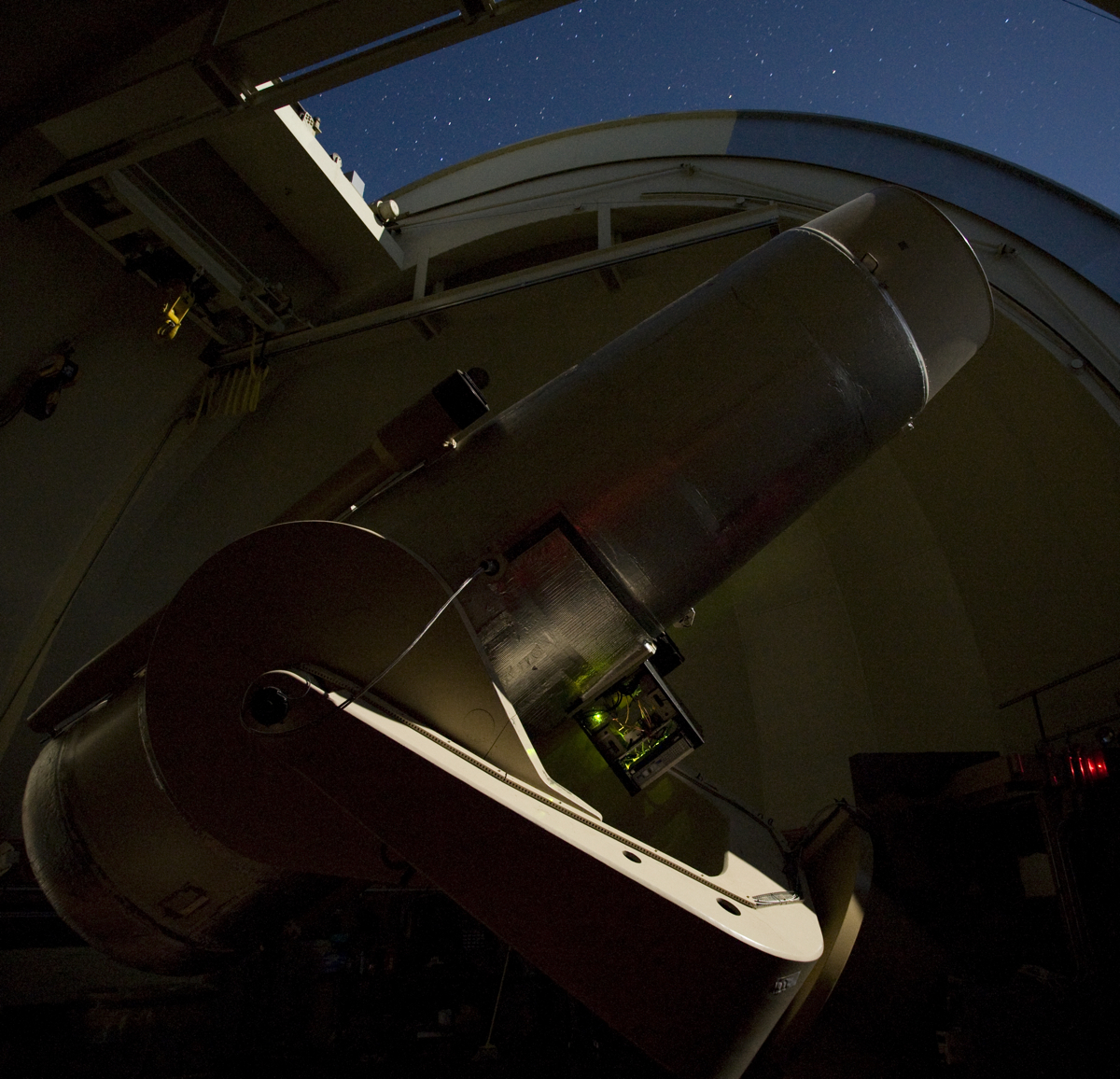
The 48-inch Samuel Oschin Telescope, where the Palomar Transient Factory begins.

Wednesday, December 16, 2009

Palomar Find Makes Discovery News Top 10 of the Decade


Discovery News has put out their list of the Top 10 Discoveries of the Decade and their list of Top 10 Space Discoveries of the Decade.

On both lists is the 2005 discovery of the world known as Eris. Knowledge of the existence of Eris, named after the Greek goddess of discord, helped to push Pluto out of the planetary roll call. In 2006, the International Astronomical Union officially proclaimed both Pluto and Eris to be part of a new, non-planet, classification known as "dwarf planets."

The discovery was made using the Palomar Observatory's 48-inch Samuel Oschin Telescope by the team of Mike Brown (Caltech), Chad Trujillo (Gemini Observatory) and David Rabinowitz (Yale).

The discovery was made as a part of survey of the outer solar system using the Palomar QUEST camera and the Samuel Oschin Telescope at the Palomar Observatory.

Update:

HPWREN Helps Palomar Make the List of the Decade's Top 10 Discoveries

See also Ten Science Discoveries That Changed Our Decade and Top ten science stories of the decade from MSNBC.

Thursday, September 17, 2009

The Web Cam Difference

I have posted about this before (see The Difference Engine), but if you look at HPWREN's display of the Hale Telescope webcam you can get some cool displays when there is activity going on in the dome.

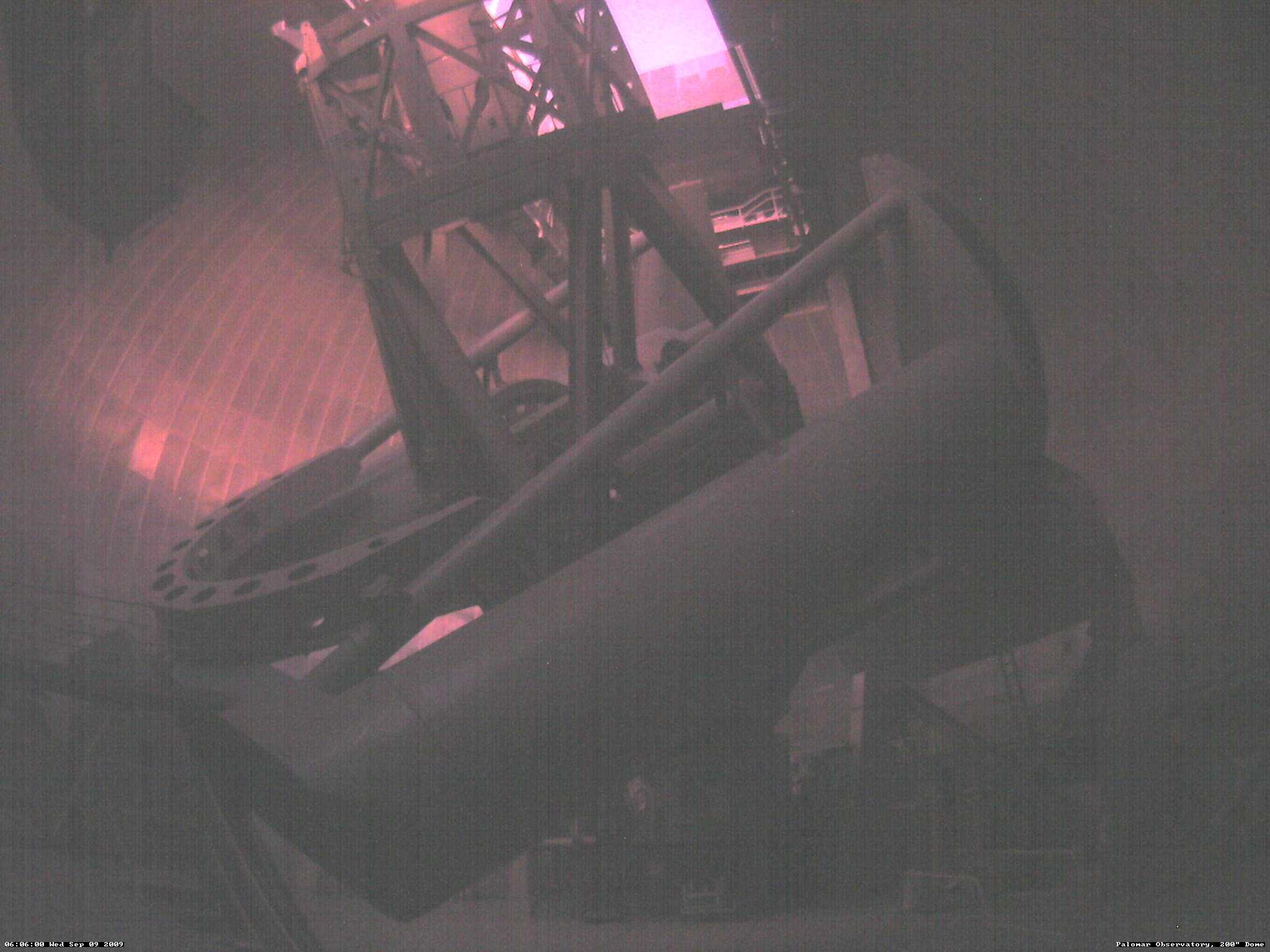
Here is a shot from a few minutes ago:

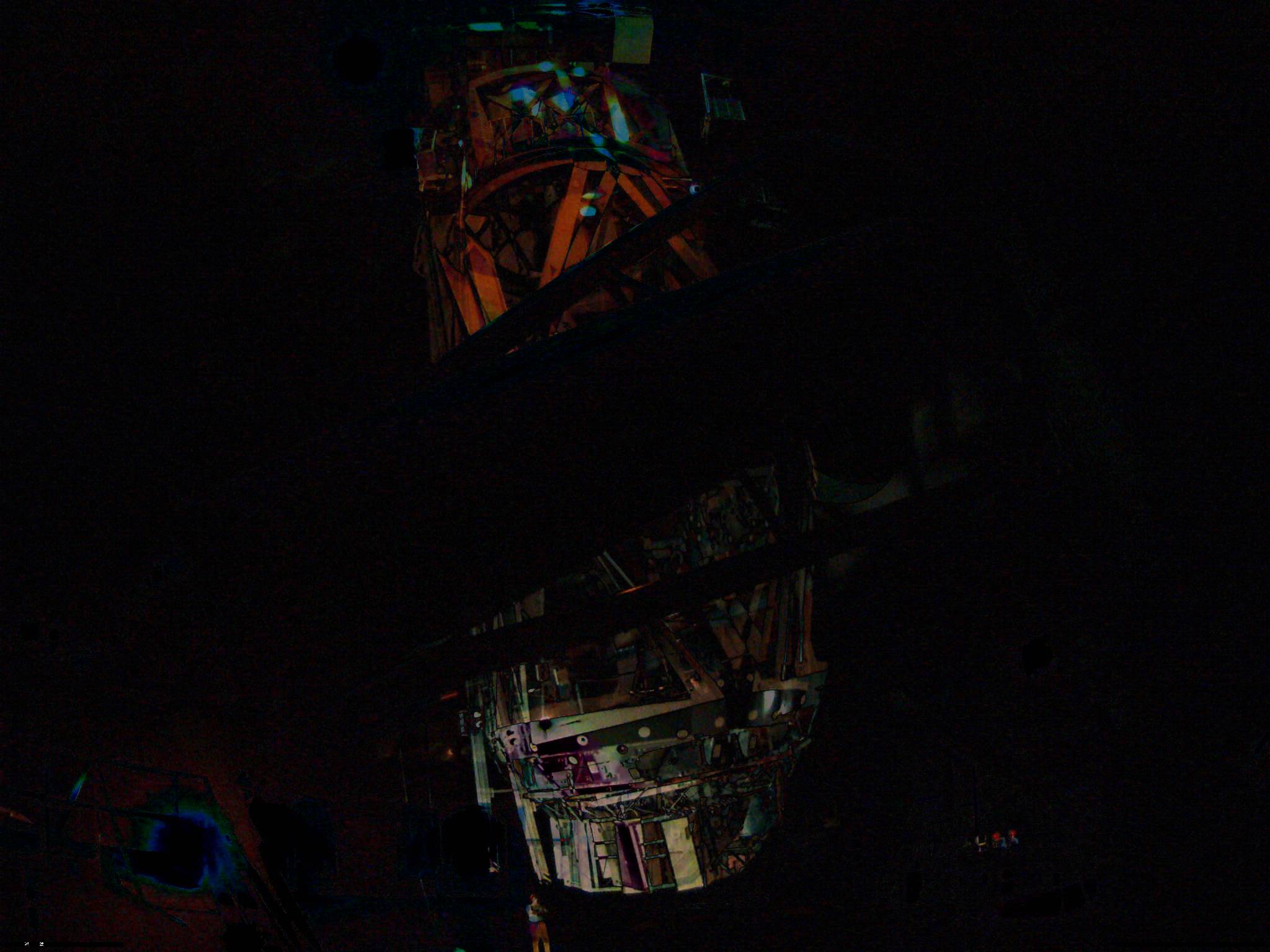
and the resulting differential image:


The differential image is produced by subtracting the newest image from the previous one. This is the same technique that is used by the Palomar Transient Factory (PTF) as they hunt for supernovae and other other variable sources. See my post What Does a Transient Look Like? for details on how that works.

Wednesday, September 9, 2009

200" Web Cam Restored

The dome for the Big Eye was still open when I cam into work this morning which reminded me to tell everyone that the Hale Telescope web cam is back in action. It was out of commission for much of August but restored last week.

The image above was captured this morning during morning twilight as the telescope was looking high in the southeast. The good folks over at HPWREN assemble animations and maintain an archive of images from this and other web cams on their network.

Thursday, July 30, 2009

Rawhide

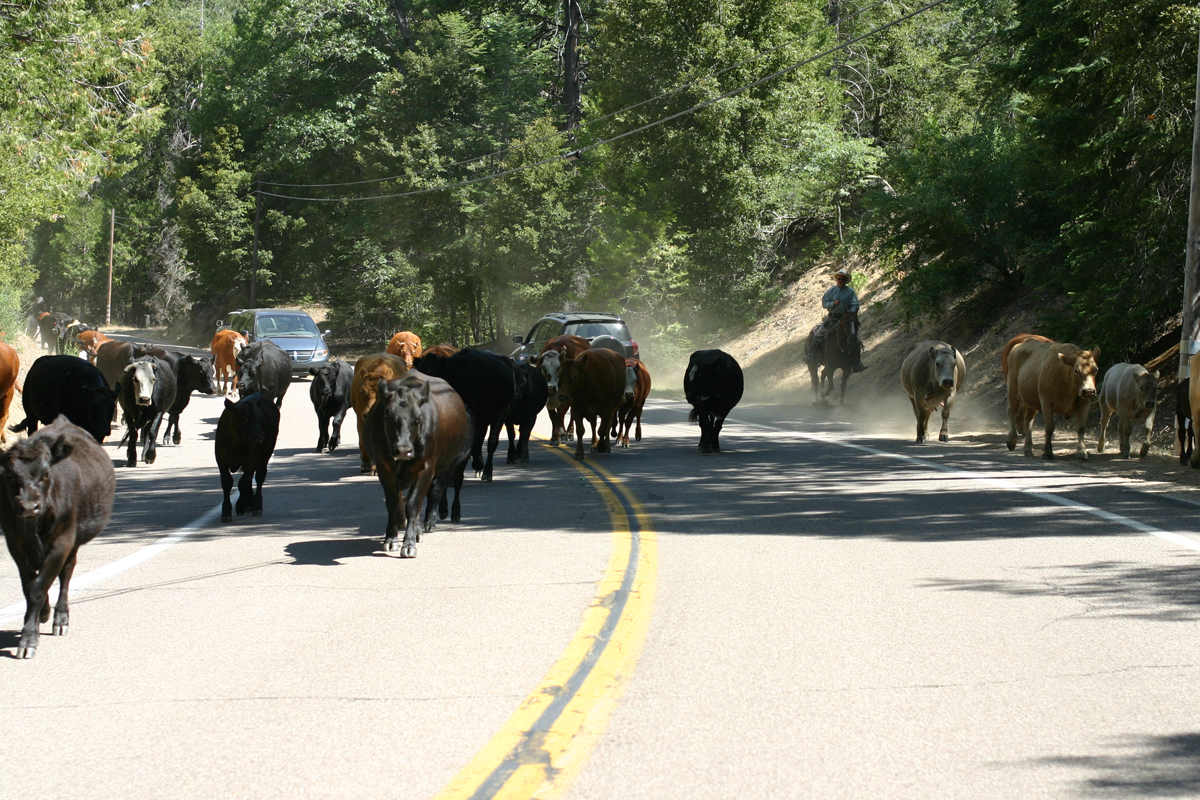
People often ask me about the cattle guards and the cattle signs up on Palomar Mountain. They are often astonished to hear that there are real, live cows up here. Once in a while the evidence is obvious:

About twice a year the ranchers on Palomar Mountain put on a real cattle drive. The last one took place just about 2 weeks ago. I managed to miss it completely, but did see the after affects lying in the road to the observatory.

Thankfully, the folks at HPWREN captured the above image on their way home after a meeting with me and made it their Image of the Week for July 18, 2009.

Wednesday, June 17, 2009

High Point Panorama


HPWREN's image of the week for June 13 is a 360 degree view from High Point on Palomar Mountain. You can't tell it is there in this small version, but the Palomar Observatory is clearly visible in the full-sized version. Head on over to see the full ~64 megapixel image.

Monday, June 15, 2009

Palomar Transient Factory

Unique Sky Survey Brings New Objects into Focus

Partnership involves Caltech's Palomar Observatory and other world leaders in astronomy

San Diego, Calif.–An innovative sky survey has begun returning images that will be used to detect unprecedented numbers of powerful cosmic explosions–called supernovae–in distant galaxies, and variable brightness stars in our own Milky Way. The survey also may soon reveal new classes of astronomical objects.

All of these discoveries will stem from the Palomar Transient Factory (PTF) survey, which combines, in a new way, the power of a wide-field telescope, a high-resolution camera, and high-performance networking and computing, with rapid follow-up by telescopes around the globe, to open windows of discovery for astronomers. The survey has already found 40 supernovae and is gearing up to switch to a robotic mode of operation that will allow objects to be discovered nightly without the need for human intervention.

The Palomar Transient Factory is a collaboration of scientists and engineers from institutions around the world, including the California Institute of Technology (Caltech); the University of California, Berkeley, and the Lawrence Berkeley National Laboratory (LBNL); Columbia University; Las Cumbres Observatory; the Weizmann Institute of Science in Israel; and Oxford University.

During the PTF process, the automated wide-angle 48-inch Samuel Oschin Telescope at Caltech's Palomar Observatory scans the skies using a 100-megapixel camera. The flood of images, more than 100 gigabytes every night, is then beamed off of the mountain via the High Performance Wireless Research and Education Network­–a high-speed microwave data connection to the Internet–and then to the LBNL's National Energy Scientific Computing Center. There, computers analyze the data and compare it to images previously obtained at Palomar. More computers using a type of artificial intelligence software sift through the results to identify the most interesting "transient" sources–those that vary in brightness or position.

Within minutes of a candidate transient's discovery, the system sends its coordinates and instructions for follow-up observations using the Palomar 60-inch telescope and other instruments.

Soon all of the steps in the process will be completely automated, including decisions about which transients merit a second look. When follow-up observations indicate that candidate transient detections show promise, a prioritized list of candidates is brought to the attention of astronomers from the PTF member institutions. Finally, an astronomer becomes personally involved, by performing detailed observations using telescopes such as Palomar's 200-inch Hale Telescope, a Keck Telescope in Hawaii, or other partner telescopes around the world.

The PTF is designed to search for a wide variety of transient sources with characteristic timescales ranging from minutes to months, giving astronomers one of their deepest and most comprehensive explorations of the universe in the time domain.

"By looking at the sky in a new way, we are ushering in a new era of astronomical discovery," says PTF principal investigator Shrinivas Kulkarni, MacArthur Professor of Astronomy and Planetary Science at Caltech and director of the Caltech Optical Observatories. "Nimble automated telescopes and impressive computing power make this possible."

"No one has looked on these timescales with this sensitivity before. It's entirely possible that we will find new astronomical objects never before seen by humans," says Nicholas Law of Caltech, the project scientist for PTF.

Because it looks for anything changing in the sky, the PTF survey covers a vast variety of different astronomical targets. The wide range of the survey extends across the entire universe. Astronomers expect to discover everything from stars exploding millions of light-years away to near-Earth asteroids that could someday impact our planet.

Much of the survey's time is spent searching for so-called Type Ia supernovae. These supernovae, formed from the explosion of a class of dead star known as a white dwarf, are very useful to astronomers because they can help determine the distance to galaxies located across the universe. Those distances allow astronomers to probe the origin, structure, and even the ultimate fate of the universe.

By operating more rapidly than previous surveys, PTF will also detect objects of a completely different nature, such as pulsating stars, different types of stellar explosions, and possibly planets around other stars.

PTF's innovative survey techniques also have raised astronomers' expectations of finding new, unexpected, astronomical objects.

The PTF already has found many new cosmic explosions, including 32 Type Ia supernovae, eight Type II supernovae, and four cataclysmic variable stars. Intriguingly, PTF also has found several objects with characteristics that do not exactly match any other objects that have been seen before. PTF astronomers are eagerly watching these objects to see how they change, and to determine what they might be.

The quantity and quality of incoming data have astonished astronomers working in the field. On one recent night, PTF patrolled a section of the sky about five times the size of the Big Dipper–and found 11 new objects. "Today I found five new supernovae before breakfast," says Caltech's Robert Quimby, a postdoctoral scholar and leader of the PTF software team. "In the previous survey I worked on, I found 30 in two years."

Images and more information on the PTF survey are available on the PTF website at http://www.astro.caltech.edu/ptf


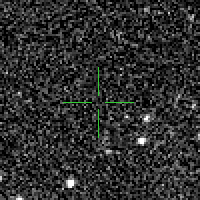
One of the most intriguing PTF discoveries, the object known as "PTF09dh" (above, right)appeared in a blank patch of sky and brightened as PTF watched from Palomar Observatory. The PTF collaboration is packed with supernova experts, but this discovery already has the team stumped--and excited. "For a cosmic explorer like me, the stream of curve balls served up by the universe makes for good job security. I take this as a sign there is plenty more waiting to be discovered.", said Robert Quimby, PTF's Software Lead.

Credit: PTF Collaboration
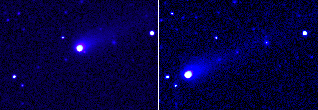
Comet 65P (Comet Gunn) as seen by PTF. The moving, and well known, comet was detected as a changing object by PTF on several nights, and was one of the first system verification images.

Credit: PTF Collaboration
Friday, May 22, 2009

HPWREN: the Movie

If you are wondering what HPWREN is and why it is important to Palomar Observatory you should watch this short movie. Ok, even if you weren't wondering it is worth your time. Be warned, I am in the movie.

Embedding it didn't work so well, so here is a direct link to the movie.
As I have said before, HPWREN gives us astronomical bandwidth, allowing the astronomers who use the observatory to do things they never could before.

Wednesday, May 20, 2009

Standard Candles


We didn't get a mention, but the folks at Berkeley's Nearby Supernova Factory put out a press release: Cosmology's Standard Candles Get Even Better. IT is cool stuff and worth the read. Much of the work is based on observations obtained using Palomar's 48-inch Samuel Oschin Telescope and beamed out via HPWREN.

Saturday, May 16, 2009

QUEST Moves South

Last fall we bid good bye to the QUEST camera which from 2003 - 2008 was the instrument on the Samuel Oschin Telescope. The camera has a new home and a new network to help it transmit data. You can read all about it here.

Wednesday, April 29, 2009

The Big Picture


Today's 365 Days of Astronomy podcast feature's The Big Picture. The image was captured with Palomar's 48-inch Samuel Oschin Telescope & the QUEST camera, beamed to Caltech via HPWREN and on display at Griffith Observatory. For more and a video (available May 1) visit the Spacewriter.

This & That

Check out this news update from HPWREN to see some of what I have been up to lately.

If you've got the time & are in the area you might think about attending the open house at the Jet Propulsion Laboratory this weekend. It should be fantastic.

The Around the World in 80 Telescope folks have archived the live broadcasts. You can find them here or here. You can see the Palomar webcast here.

By the way, 429 people attended one of our public tours of the Hale Telescope in the month of April. That up from just 192 last year. Remember you can get a tour of the 200-inch on most Saturdays & Sundays (until November) at 11:30 a.m., 1:30 p.m., & 2:30 p.m.

Friday, March 20, 2009

Around the World in 80 Telescopes

Have I mentioned that it is the International Year of Astronomy? Oh yeah, about 1,000 times.

There is some seriously cool IYA stuff coming just around the corner. April 2 - 5 is the 100 Hours of Astronomy event, a four day, round-the-world star party. Click on the link and find a star party near you. Then go out and look through some telescopes. Its just that easy.

Embedded within the 100HA event is Around the World in 80 Telescopes. It is a 24-hour live webcast event that will take place from the control rooms of research telescopes located around the globe. Included in the mix will be . . . . . you guessed it . . . . Palomar Observatory.


Most people have no idea what happens during the night at a research observatory. The expectation is that astronomers are looking through telescopes – a concept that is 100 years out of date. The Around the World in 80 Telescopes event will give people an inside look to what really happens by letting them take their own trip to observatories located across the globe (and in space too).

Scheduled to participate are observatories in 15 countries—spanning every continent (including Antarctica), and 11 observatories located in space.

The final stop in this around-the-world tour of observatories will be Palomar Observatory, run by the California Institute of Technology. I will be hosting Palomar's segment and along with the astronomers using Palomar’s 200-inch Hale Telescope that night we will be answering questions and explaining the research underway that night.

Palomar Observatory’s participation in the event is only possible through its high-speed data connection provided by the High-Performance Wireless Research and Education Network (HPWREN). HPWREN provides 155 megabits per second (OC-3 capacity) terrestrial microwave links that network Palomar Observatory to the rest of the world. This high-speed connectivity is essential for current and future research programs at Palomar, but it also provides the necessary bandwidth to allow for this and other live broadcasts to take place from the observatory.

The live webcast will begin on 3 April 2009 at 02:00 a.m. Pacific Daylight Time (09:00 UT) with the telescopes on Mauna Kea in Hawaii, before moving westwards around the planet. The event ends on 4 April 2009, 02:00 a.m. Pacific Daylight Time (09:00 UT). Palomar Observatory’s portion of the event is scheduled to begin at 1:40 a.m. PDT on April 4th. The live video webcast will be available on the 100 Hours of Astronomy website at
http://www.100hoursofastronomy.org/.


Thursday, February 26, 2009

Podcast on Sky Surveys

My latest podcast for the 365 Days of Astronomy is up. You can check it out from their site directly or download it via iTunes too.

Error Correction: For some reason in the podcast I said the QUEST camera was 196-Megapixels. It was really only 161-Megapixels. Sorry about that.
Here are some links to go with the show:
Palomar's Samuel Oschin Telescope - Where it all happens

Second Palomar Observatory Sky Survey (aka POSS II) - some details on the second survey.

Google Sky & WorldWide Telescope - two ways to surf the sky from your desktop.

SkyFactory - home of some great images produced from the Second Palomar Sky Survey

High-Performance Wireless Research and Education Network
- The high-speed network that allows astronomers to work remotely, far from Palomar.

Palomar-QUEST Survey - info on the survey completed last fall

Dwarf Planet Eris - Mike Brown's page on the world that "killed" Pluto

Wednesday, September 24, 2008

Hale Telescope Shakedown

Every once in a while you need to give your telescope a shakedown just to make sure that everything is exactly the way you want it and that it will not move during the night. We gave the Hale Telescope just such a shakedown last week.

And here's a really short movie of the shakedown taken by the Hale Telescope web cam and put together by the good folks at HPWREN.


Tuesday, August 19, 2008

The Difference Engine

The good folks over at the High Performance Wireless Research and Education Network do some cool stuff with the images that come out of the Hale Telescope's webcam. They grab and archive an image every three minutes and produce time-lapse animations from them. An interesting twist on the Hale Telescope webcam is the differential image that is produced by subtracting the newest image from the previous one. Sometimes the results are pretty cool looking.

Here's a webcam shot taken in morning twilight from Monday. The differenced image is below. From that you can tell the the telescope is slowly tracking across the sky & that the mirror cover closed.