Showing posts with label laser-guide star. Show all posts

Friday, September 25, 2009

New Vistas in Adaptive Optics


The folks over at SPIE have produced a new video: New Vistas in Adaptive Optics. Click on over to have a look. When you do you'll see adaptive optics expert Bob Tyson (University of North Carolina at Charlotte), Antonin Bouchez and Christoph Baranec from Caltech and a whole bunch of images from and footage of the 200-inch Hale Telescope at Palomar.

Cool stuff!

Monday, August 10, 2009

M15 with Adaptive Optics

We are just finishing up a few nights of adaptive optics observations of galaxies using the laser-guide star system on the Hale Telescope.

In honor of that, here is a mosaic of images made using the adaptive optics laser-guide star system from year ago this week showing globular star cluster M15.

The image shows the central portion of the cluster. Click on the image to see it in full resolution.


If you are interested you might want to compare the view of M15 with this one of globular cluster M3 taken with the Hale Telescope's wide-angle camera.

Sunday, August 9, 2009

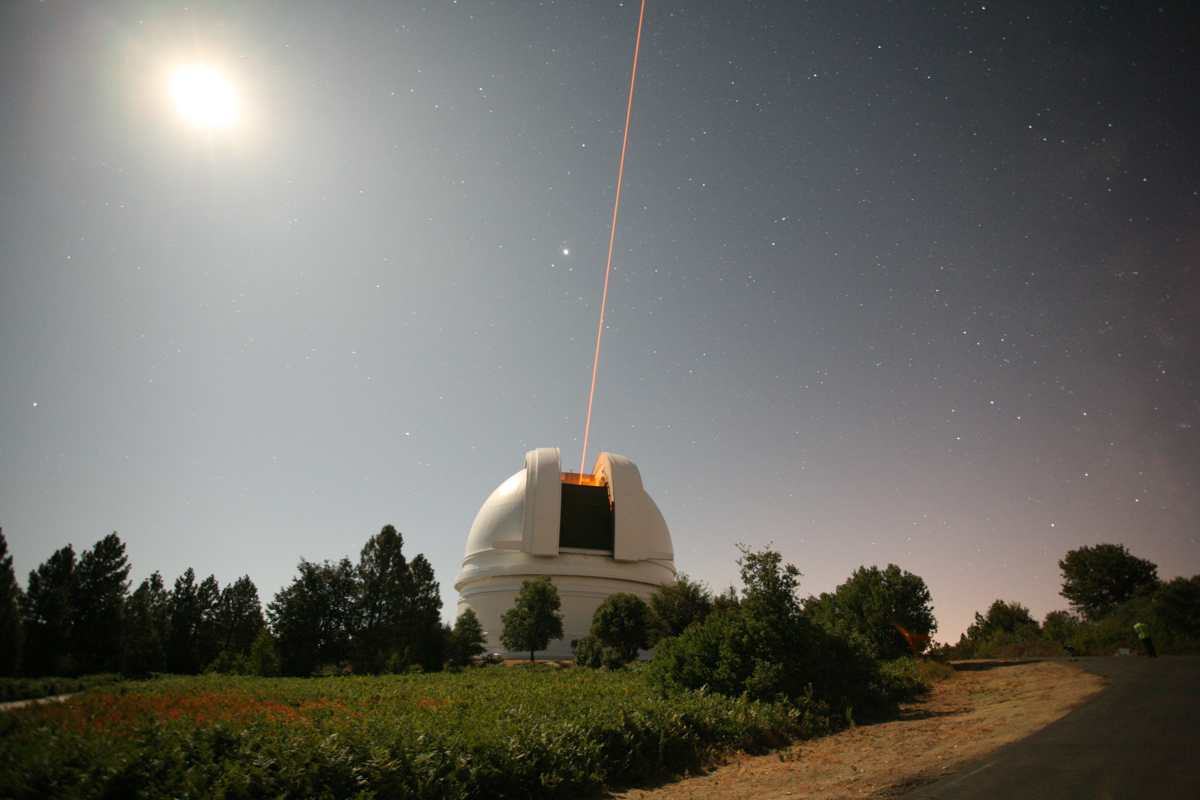
Moon, Jupiter, Laser & Hale Telescope

Here is how things looked last night on Palomar:

Inside the SWIFT team from Oxford was studying disk formation in galaxies.

Friday, June 19, 2009

Hale Telescope in National Geographic

The July 2009 issue of National Geographic Magazine is now out and (while I haven't seen it yet in actual print) you should be able to find a beautiful image taken by photographer Joe McNally of the Hale Telescope with its laser-guide star. The article, Cosmic Vision, was written by Timothy Ferris and is available on line. The NGS website has an online photo gallery that includes 2 images of the Hale, which is also featured in their interactive time-line.

Here's a taste of what the inside photo looks like:

You'll have to visit one of the links above to see the rest.

UPDATE: I have not yet seen it on newsstands, but got my issue in the mail today (6/24). The image of the Hale Telescope fills 2 pages (134 & 135) and looks wonderful.

Friday, January 16, 2009

January Laser

Last night: Clear skies. January stars. Hale Telescope. Adaptive optics. Laser guide-star.

Thursday, August 14, 2008

Return of Laser-Guide Star

This week saw the return of the laser guide-star program to Palomar. In case you missed it I described the program in an earlier post to this blog.

Our laser is back after some work that was done to it back at its birthplace, the University of Chicago. A new laser-launch telescope was also installed and operated for the first time this week.

Three nights engineering time was granted to the laser guide-star team. Engineering time is basically time to work on and improve the performance of the system. The team was very happy with the performance of the system this week and further science operations will take place as scheduled.

Below are a few photos that I took Tuesday night through Wednesday morning this week. As always, you can click on the image for a higher-resolution view.

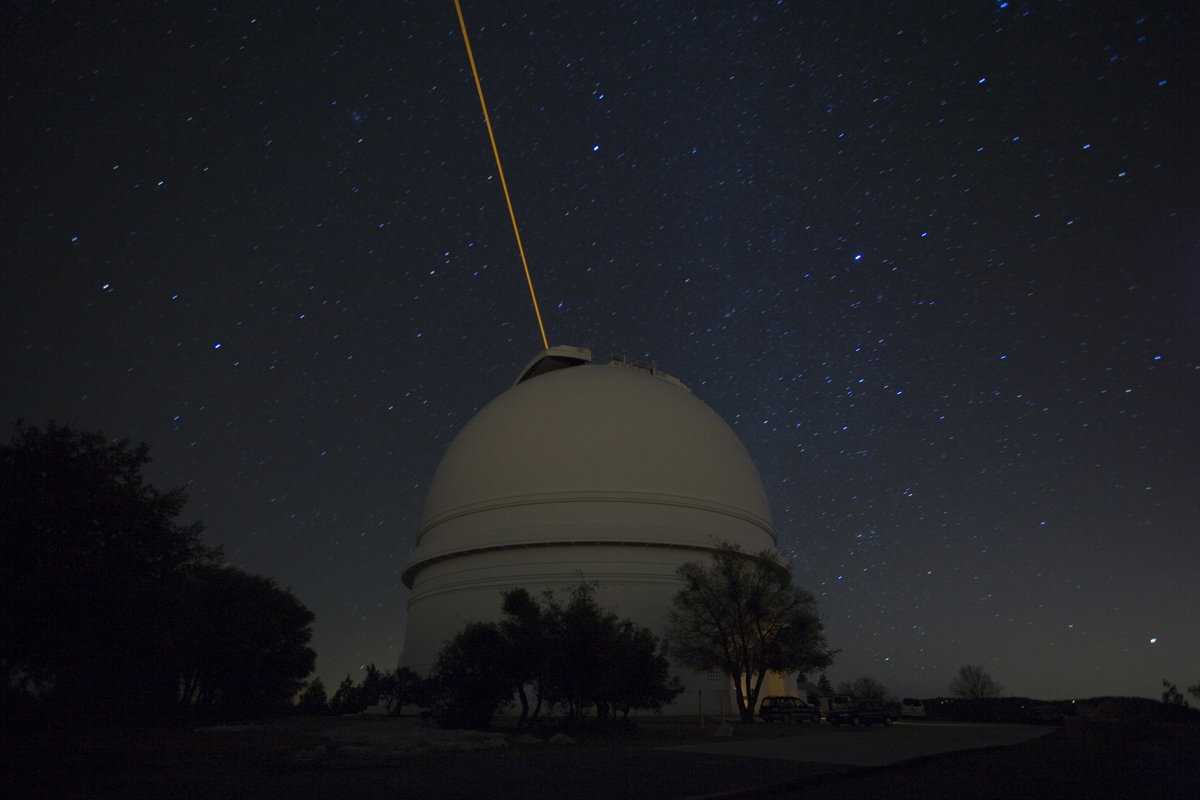
The view from outside the dome with the laser pointed at Zenith. The setting moon is just out of view to the right, but it provides illumination for some high cirrus clouds.

Here is the interior view with the laser pointed at zenith. The laser is located in the old coude room, it is reflected up the side of the telescope to prime focus. There the beam encounters the laser-launch telescope which broadens the beam and sends it skyward.

Here is the view with the telescope pointed west of zenith.

I was stationed inside the dome where I took over 300 images for the purpose of putting together a time-lapse movie. The laser was operating at 7.5 Watts and eye protection is required at all times.

I was set up right next to the Hale Telescope's webcam which managed to catch me in the act of making an adjustment to my camera. The safety goggles look great, don't they?

Below is the time lapse-movie from this week. You can also view it as a higher resolution Quicktime movie here.

Saturday, April 5, 2008

Clearing the Air

Ground-based telescopes are entering into a new era with adaptive optics (AO) technology providing sharper views of the universe than ever before. AO allows astronomers to remove the blurring effects of Earth's atmosphere in real time.

The adaptive optics program at Palomar is more than a decade old. In October 2004 we added a new dimension to the program and achieved first light with the laser-guide star (LGS) system. LGS allows astronomers to create an artificial star and use AO in a much larger fraction of the sky.

To do this they shine a narrow sodium laser beam up through the atmosphere. At an altitude of about 60 miles the laser makes a small amount of sodium gas glow. The reflected glow from the glowing gas serves as the artificial guide star for the AO system. The laser beam is too faint to be seen except by observers very close to the telescope, and the guide star it creates is even fainter. It can't be seen with the unaided eye, yet it is bright enough to allow astronomers to make their AO corrections.


The technology is involved. Early on all the time devoted to it is what we call engineering time. Basically that is time on the telescope to tinker, measure and improve all in the name of getting ready for the real astronomical observations that are to follow.

Following that is what is known as shared-risk science. During this time astronomers come to use the LGS system to do real astronomical observations, but with the knowledge that there will still be some time devoted to engineering mixed into the night.

One year ago today was the first night of shared-risk science with Palomar Observatory's laser-guide star adaptive optics program. Caltech professor Lynne Hillenbrand and graduate student Adam Kraus where here to use laser and natural guide Star adaptive optics to conduct a high-resolution imaging survey of young low-mass stars and brown dwarfs in several nearby young associations.

JPL astronomer Patrick Lowrance was back later in the month for another LGS night to study L, T, and brown dwarfs. The time-lapse movie below shows approximately 3 hours of LGS operations during a night as photographed from outside the Hale Telescope dome.


Each frame in the silent movie was a 30-second exposure. Along with the laser, stars and airplanes are visible in the sky.

More photos, movies and information is available on the Palomar Observatory Adaptive Optics page.