Sunday, March 9, 2008

Get Lucky

Last summer, the ol' 200-inch Hale Telescope obtained some of the highest-resolution visible-light images ever obtained from Earth or space by making use of adaptive optics and something known as LuckyCam. LuckyCam went on to be named one of Time Magazine's Best Inventions of 2007, along with such products as the iPhone.

Caltech's Nicholas Law will be giving a free public lecture on adaptive optics, LuckyCam and what is to follow it on Saturday, March 15 at 7:00 pm. The talk will be held downstairs at Oceanside Photo & Telescope, located at 918 Mission Avenue in Oceanside. (Click here for a map.) No reservations will be needed to attend the lecture, but seating will be limited.

Above, the Cat's Eye Nebula. Below a comparison of the Hale Telescope (left) vs. the Hubble Space Telescope (right):

Notice that the Hubble sees more stars than the 200-Hale. Why? Its darker up there. However, you should be able to tell that the size of the stars is smaller in the Palomar image. After we successfully correct for the distortions caused by the atmosphere our larger telescope actually obtains higher-resolution images.

Want to know more about this? Attend the talk on Saturday night which is brought to you by the Friends of Palomar Observatory and the Oceanside Photo & Telescope Astronomical Society.

Saturday, March 8, 2008

On Top of the World, Part 2

I finally got around to putting the rest of the photos together that I shot from on top of the dome for the 200-inch telescope back on February 9. The first two panoramas are posted here.


From left to right this panorama shows the Palomar Crestline area (southeast); the ridge along State Park Road; French Valley, with its pond and Morgan Hill behind it; and the dome of the Palomar 24-inch telescope. Directly behind the dome is the Temecula Valley area and Mount Wilson in the distance behind it. At the right-hand portion of the image we are looking to the north towards Hemet.

Thursday, March 6, 2008

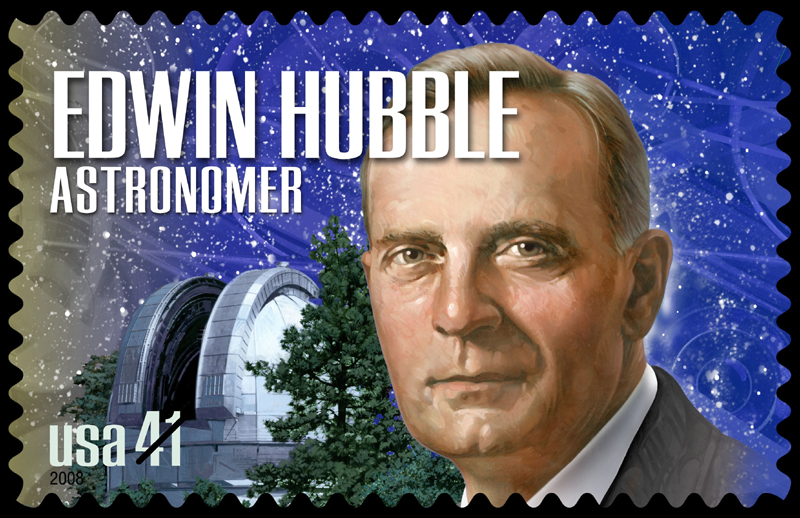
Edwin Hubble: the man, the legend, the stamp

Today astronomer Edwin Hubble is honored by the U.S. Postal Service as a part of their American Scientists stamps series. Also immortalized is theoretical physicist John Bardeen, biochemist Gerti Cori and structural chemist Linus Pauling. Here is the description that the U.S. Postal Service provided for Hubble:

Astronomer Edwin Hubble (1889-1953) played a pivotal role in deciphering the vast and complex nature of the universe. His meticulous studies of spiral nebulae proved the existence of galaxies other than our own Milky Way, paving the way for a revolutionary new understanding that the cosmos contains myriad separate galaxies, or “island universes.”


Image © 2007 USPS. All Rights Reserved.


Most of the great successes of Hubble's career were achieved not at Palomar but at Mt. Wilson. So it is only fitting that the dome of the 100-inch Hooker Telescope be shown behind him. The "spiral nebulae" referred to in the USPS description are what modern astronomers refer to as spiral galaxies.

Back in the 1920s no one was certain if they were part of our own Milky Way Galaxy or separate galaxies unto themselves. In 1923 Hubble used the 100-inch telescope to resolve and measure Cepheid variable stars in the Andromeda Galaxy (M31). Cepheid stars vary in brightness in a regular way that is directly proportional to their brightness. Once it is known how bright they really are and how bright they appear, it is possible to determine their distance.

Hubble found that the Cepheids in M31, and thus the galaxy itself, are 1 million light-years distant. (Modern figures put the distance at 2.9 million light years.) The only conclusion was that M31 and the other "spiral nebulae" were separate galaxies, completely distinct from our Milky Way.

Hubble pushed the bounds of known space even further with his 1929 discovery that the universe is expanding. This had a profound influence on cosmology and was the first clue pointing towards the Big Bang.

Hubble didn't get a lot of observing time at Palomar. The 200-inch telescope project took a long time to complete and Hubble passed away just five years after its dedication

If you are interested in reading about the life of Edwin Hubble I strongly recommend that you track down a copy of Gale E. Christianson's Hubble biography Edwin Hubble: Mariner of the Universe. If you are in a hurry, or just need something more right now you can read his biography posted on the Hubble Space Telescope website.

Saturday, March 1, 2008

Happy Birthday George Abell

Astronomer George Abell (1927 – 1983) was born 81 years ago today. He had a short, yet remarkable career in the world of astronomy.

As a Caltech graduate student in the 1950s, George Abell was one of the principle observers on the National Geographic Palomar Observatory Sky Survey, the first detailed photographic survey of the northern skies. Performed using the Palomar 48-inch Schmidt Telescope (now known as the Samuel Oschin Telescope), images were captured on large (14-inches on a side), square photographic plates that each covered an area of sky 12 times the width of the full moon.

Abell used the data from the survey to produce the first major catalog of clusters of galaxies. His catalog included thousands of galaxy clusters and it the basic reference in this field. It served as the one of the starting points for observational cosmology. He also showed how the brightness of certain galaxies within a cluster could be used to determine the distance to the galaxy cluster, allowing astronomers to map the large scale structure of the universe.


Here is a sky-survey image of a portion of Abell 2151, also known as the Hercules Cluster. The cluster is around 500 million light years distant and is part of the larger Hercules Supercluster.

Abell also studied the planetary nebulae that were revealed by the sky survey. Along with Peter Goldreich he correctly concluded that planetary nebulae evolve directly from red giant stars.


Here’s a sky-survey image of the planetary nebula now known as Abell 39. It is located about 7,000 light years away in the constellation of Hercules.

In addition to his astronomical work George Abell was a noted educator and popularizer of astronomy.

George Abell was honored by having an asteroid, 3449 Abell, named for him. The asteroid was discovered at Palomar Observatory by Eleanor Helin and S. J. “Bobby” Bus.

Friday, February 29, 2008

Monster Telescopes


Waiting in the mail yesterday was the April (!) issue of Sky & Telescope magazine. The cover features TMT in an article entitled "The New Monster Telescopes". Jonathan Lowe's article gives a great overview of the TMT, GMT and E-ELT projects.

Casey Reed provided some great illustrations to give a sense of scale for the projects, but what really caught my eye was this one (above), with the shadow of a monster (for the monster telescopes in the article) on a dome that very much reminds me of the dome for the 200-inch. :)

Monday, February 25, 2008

You are Invited

You are invited to participate in the Globe at Night program. It is a free and easy way to help measure light pollution. You don't need any special knowledge or fancy equipment. All that you need to do is find the constellation of Orion and count the stars you can see there. If you can't find Orion, the Globe at Night website can teach you where and what to look for.

Participating in Globe at Night is a great excuse to get out and enjoy the night sky. Last year there were over 8,400 measurements made from 60 countries. Be sure to add your observations into this year's program it is easy and fun.


Can you find Orion in this photo?

Thursday, February 21, 2008

In the Shadow of a Giant

George Ellery Hale died 70 years ago today. From Ronald Florence's The Perfect Machine:
A few days prior to his death he felt well enough to be wheeled outside. He looked up at the sky and said, "It is a beautiful day. The sun is shining and they are working on Palomar."
While Hale missed seeing the completion of the mighty 200-inch telescope, his vision and determination made the telescope a reality. That's why it has carried his name since 1948.


Hale's shadow looms large even 70 years later. Modern-day astronomers are poised to begin a new project that would have made him proud, the Thirty Meter Telescope (TMT).

The TMT will have almost 36 times the light-gathering power of the Hale Telescope and will push astronomy into a new era of giant telescopes. Design work and site selection are still underway, but big things are coming. As Hale said:

Make no small plans. Dream no small dreams.

There's nothing small about the TMT. Stay tuned.

Sunday, February 17, 2008

The Punisher

Just a short post today. Four years ago today 90482 Orcus was discovered using the Palomar 48-inch Samuel Oschin Telescope. Orcus (aka 2004 DW) is a Kuiper Belt Object with a 247-year orbit. In mythology Orcus was the punisher of broken oaths.

Here's the discovery images:


More information is available from Wikipedia and Chad Trujillo's 2004 DW page.

Saturday, February 16, 2008

Speaking of Fritz Zwicky and Supernovae . . . . .

I mentioned earlier this week that Fritz Zwicky used the Palomar 18-inch Schmidt to make the first surveys of the night sky. Dr. Zwicky's hunt for supernovae (exploding stars) began on September 5, 1936 but he didn't catch his first supernova until five months later. On February 16, 1937 he discovered a supernova in spiral galaxy NGC 4157, located in the constellation of Ursa Major.
NGC 4157 is shown above with Zwicky's 1937 supernova arrowed.

According to his article published in the Publications of the Astronomical Society of the Pacific:

From September 5, 1936, until the end of May, 1937, about 300 photographs were obtained covering as often as possible the Virgo cluster of nebulae as well as its northern and southern extensions into Coma Berenices, Canes Venatici, Ursa Major, Hydra, and Centaurus, respectively. In addition, some of the nearby nebulae, such as the great nebula in Andromeda, Messier 33, 51, 80, 81, 101, NGC 55, 247, 253, 2403, 2366, 4236, IC 342, 1613, etc., were frequently photographed. It is estimated that, in the period mentioned, between 5000 and 10,000 nebular images were carefully searched for new stars.
Before anyone knew what a galaxy was it had been the convention call them "nebulae". Today the word "nebula" refers to a cloud of gas in space. At the time of his writing Zwicky knew that the "nebulae" he was referring to are all what we call galaxies. Edwin Hubble's discoveries about galaxies was less than a decade earlier and the term was a holdover from that previous age.

Thursday, February 14, 2008

Happy Birthday Fritz Zwicky Part II

Recently I have had the honor to correspond with Dr. Barbarina Zwicky, the daughter of Fritz Zwicky. In honor of the occasion of his 110th birthday she has sent to me her words to mark this day. Thank you Barbarina!

In Memoriam Fritz Zwicky 110th Birthday

Fritz Zwicky was a scientific prophet, who pronounced the amazing theory of Dark Matter, Dunkle Materie, more than 80 years ago, which was rejected during his lifetime. His genius and stunning theories still benumb the senses of the scientific community and challenge their professional expertise. History tells us that prophets are rejected and persecuted during their lifetime, only to have their theories and prophecies confirmed after their passing. So it is with my father, who endured persecution during his lifetime only to have his theories be accepted and verified years later. Literary assaults against him became as common as grains of sand, but were equally as unstable, holding no structure, thus becoming dissolute with the tide and time. My father’s theories continue to withstand any challenge and hold true, and remain forever as restorative truth against a such egregious and errant compass. It was in fact, the scientific community that hindered important advancements in astronomical discovery for decades, by rejecting the very concepts of my father’s super theories that they now so readily embrace. There is no doubt, that his scientific work and super theories encompass some of the most important work in astronomy today.

Supernova, Haupt Nova, was his coinage and he was the first to conduct a systematic search for Supernovae without the aid of computers and modern technology, and yet he holds the record for discovering the most supernovae as an individual. He was the pioneer of the sky survey technique and documented thousands of galaxies in the Catalogue Of Selected Compact Galaxies And Of Post-Eruptive Galaxies, The Red Book, Zwicky Galaxy Database. The introduction identifies my father’s methodology: “I consequently engaged in the application of certain simple general principles of morphological research, and in particular the method of Directed Intuition that would allow me to predict and visualize the existence of as yet unknown cosmic objects and phenomena.”

He was research director at Aerojet Engineering Corporation (1943 - 1949) and he developed some of the earliest jet engines. He holds important patents in Jet Propulsion, Two Piece Jet Thrust Motor, Inverted Hydro Pulse, Ram Jet and Jet-Assisted Take-Off (JATO). He received the Presidential Medal of Freedom in 1949 for his wartime efforts. The Zwicky Lunar Crater and Zwicky Asteroid 1803 are named in his honor.

The Friendly Guide To The Universe, by Nancy Hathaway, captured my father’s essence. Harvard astronomer, Cecilia Payne-Gaposchkin, wrote an obituary in the May 1974 issue of Sky & Telescope that equally identified his true persona with sagacious and kind insight.

I was the youngest daughter of three daughters, and was as such, particularly blessed. Fritz Zwicky was a great father, concerned, kind, caring, generous and great fun. There was always great conversation during our long lunches in Switzerland, accompanied by much laughter in our house. I was able to travel the world with my family and meet many of the world’s greatest minds. I particularly remember the Delos Conference, Greece, when I accompanied my parents and embarked on a wonderful ocean journey. The ship’s passenger list encompassed the world’s Who’s Who, among them, Arnold Toynbee, Buckminster Fuller, and Margaret Mead. I cherish a sterling silver baby cup from Andrew Haley, Founder of Aerojet Engineering Corporation with Theodore von Karman, and President and Chief Counsel of American Rocket Society, which he had engraved to me with a beautiful dedication. The birthright privileges are many, but so also are the burdens. I continue to encounter a core resentment against my father’s genius and this often translates into a lack of recognition and a failure to interpret the true meaning of his work. Many self-appointed experts seek recognition for their “expertise” regarding my father’s work, while failing to mention him as pioneer of the discoveries. My son, Christian, has pledged to follow the same path of rectifying the injurious inequity against my father, and those who seek credit for his work will continue to be exposed, as the future generation now gives voice in his defense. My father stated: “The fact that, except for some outstanding exceptions like George Ellery Hale, the members of the hierarchy in American Astronomy have no love for any of the lone wolves who are not fawners and apple polishers was made clear to me and to my independent friends on many occasions. Thus credit for my discovery of the first dwarf galaxies would have been lost for me if the following statement by Dr. E.P. Hubble had not appeared in THE SCIENTIFIC MONTHLY 52, 486 (1941).” The letter describes the matter of why nomenclature is so important. My father further notes that: “Many in American Astronomy appear to be free to appropriate discoveries and inventions made by lone wolves and nonconformist, for whom there is never any appeal to the hierarchies and for whom even the public Press is closed, because of censoring committees within the scientific institutions.” Not all are propelled to rectify such injurious inequity in the sciences. However, by enjoining in a joint venture with commissioned journeymen, the Herculean effort will be successful to correct this deficit, thus restoring conciliation to an astronomer’s memory and safeguarding his rightful place in history.

Dr. Barbarina Zwicky, h.c.