 The bubble of gas was given off by the star at the center of the nebula. This photograph was taken with Palomar's 48-inch Schmidt telescope which is now known as the Samuel Oschin Telescope.
Friday, June 11, 2010
Astrophoto Friday - A Bubble in Aquila
This week's astrophoto is another vintage shot (copyright 1965). It shows a planetary nebula in the constellation of Aquila (the Eagle) known as NGC 6781.
 The bubble of gas was given off by the star at the center of the nebula. This photograph was taken with Palomar's 48-inch Schmidt telescope which is now known as the Samuel Oschin Telescope.


Wednesday, June 9, 2010
Pics from last weekend's TMT event at Palomar
Last Saturday at Palomar we had a talk by TMT scientist Tony Travouillon on the process of choosing the site for the Thirty Meter Telescope. About 90 people were able to attend.
That's Tony below near the end of his talk:
 Photo by Richard Garcia
 Left to right: TMT Project Manager Gary Sanders, TMT Telescope Research Engineer Warren Skidmore, Palomar's Scott Kardel, TMT Environment Control Scientist Tony Travouillon. Photo by Richard Garcia.
After the talk attendees were invited to a star party on the grounds of the observatory's outreach center under clear, dark skies.
 Photo by Ben Orchard.
 The people are blurred, while this PlaneWave Instruments telescope seems to be motionless in this time-exposure photo by Ben Orchard. In reality the telescope was moving too as it slowly tracked to counteract Earth's rotation.
Monday, June 7, 2010
Palomar History Photo of the Week - June 7, 2010
The Hale Telescope has been the focus of many of our history photos of the week. It is time to have a look at some of the other telescopes and locations at Palomar Observatory.
The Oscar G. Mayer Memorial Building, which houses Palomar's 60-inch telescope, was built in 1968-69. Here is an aerial photograph showing the construction site before any work had begun on assembling the dome.
 The photo comes from Robert Gandolfi. Back in the day he worked for Western Gear Corporation, one of the contractors on the project.
To put things in perspective, here is a modern aerial photo showing the completed building and dome:

Saturday, June 5, 2010
Palomar Zoo

The Galaxy Zoo is coming to Palomar on Sunday night. If you are not familiar with the program here is a short introduction from their website:
The original Galaxy Zoo was launched in July 2007, with a data set made up of a million galaxies imaged with the robotic telescope of the Sloan Digital Sky Survey (SDSS). With so many galaxies, the team thought that it might take at least two years for visitors to the site to work through them all. Within 24 hours of launch, the site was receiving 70,000 classifications an hour, and more than 50 million classifications were received by the project during its first year, from almost 150,000 people.
Sunday night the 200-inch Hale Telescope will be used to follow-up on what some of the Galaxy Zoo team has discovered. Specifically, the team will be looking to confirm gravitational lens candidates. A gravitational lens is produced when the mass of an object, like a galaxy cluster, bends and magnifies the light of a more distant objects behind behind it. Here is an illustration to show how that happens:
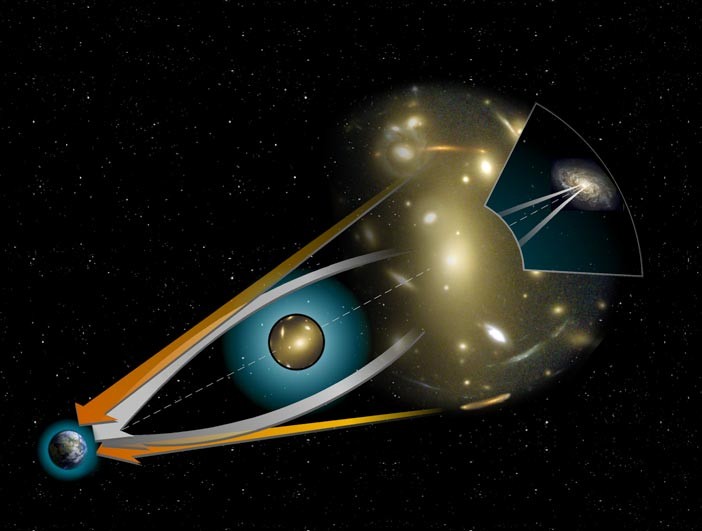
By carefully studying how the light of the distant objects is bent/magnified/distorted it is possible to map out the distribution of matter and dark matter. For more information have a look at their Zooite Guide to Strong Gravitational Lenses.
From the research team observing at Palomar:
Through visual inspection of ~900,000 galaxies in the SDSS, Galaxy Zoo participants are discovering potential lens candidates at a prodigious rate. Our sample includes blue arcs and multiply imaged sources around early-type galaxies. The data will provide key constraints on the dynamics and mass distribution of both luminous and dark matter in a large sample of intermediate redshift elliptical galaxies.The Zoo project also running The Hunt For Supernovae which is helping to discover supernovae and transients first photographed with Palomar's Samuel Oschin Telescope via the Palomar Transient Factory project. Head on over to check it out.
Friday, June 4, 2010
Astrophoto Friday: Quaoar Discovered
Eight years ago today Caltech astronomers Chad Trujillo and Michael Brown, using Palomar's 48-inch Samuel Oschin Telescope, discovered the object now known as 50000 Quaoar.
Today's Astrophoto Friday image is an animated gif of three discovery images that show Quaoar's motion against the background of the sky.
 Quaoar is part of a population of objects that lie out beyond the orbit of Neptune that make up what is known as the Kuiper Belt. The artwork below illustrates the sizes of the largest known worlds of these icy bodies, with a section of Earth at the bottom for scale.

Quaoar has one known moon, Weywot. Studies of Weywot's orbit about Quaoar have led to estimates of its mass an density. Surprisingly, Quaoar has a density more like rock than ice.
Monday, May 31, 2010
Palomar History Photo of the Week - May 31, 2010
Eighty two years ago last week (May 25) the quest to build a 200-inch telescope began as the Rockefeller International Education Board appropriated “not more than $6,000,000” to the California Institute of Technology for the purchase of a site and the construction of an observatory including a 200” reflecting telescope.
Palomar Mountain was eventually chosen as the site for the observatory and as plans were still being finalized for the big telescope a new concept was discovered. This new design, the Schmidt camera, was a wide-field telescope gave crisp star images all the way to the edge of the field of view. The design was not implemented for the big telescope, but it was for Palomar's first telescope - the 18-inch Schmidt.
 Here is the almost-completed 18-inch Schmidt telescope in the shops at Caltech on April 16, 1936. The telescope saw first light a few months later on September 5 as Fritz Zwicky began his surveys for supernovae. Across the years this telescope was used by many astronomers to discover asteroids, comets supernovae, galaxies, galaxy clusters and more.
The 18-inch Schmidt is now retired, but it proved to be very successful. So much so that a larger version was built, the 48-inch Schmidt. Now called the Samuel Oschin Telescope, the 48" is still used nightly and is the backbone to the Palomar Transient Factory survey that is discovering supernovae in record numbers.
Friday, May 28, 2010
Congratulations to SOFIA
Congratulations are in order to the team behind NASA's new airborne observatory SOFIA, the Stratospheric Observatory for Infrared Astronomy, which had "first light" earlier this week.
This new flying observatory sports a 2.5 meter telescope. One of its instruments, FORCAST (Faint Object infraRed CAmera for the SOFIA Telescope), was first tested on Hale Telescope back in 2006. It was built by Terry Herter and his team at Cornell.
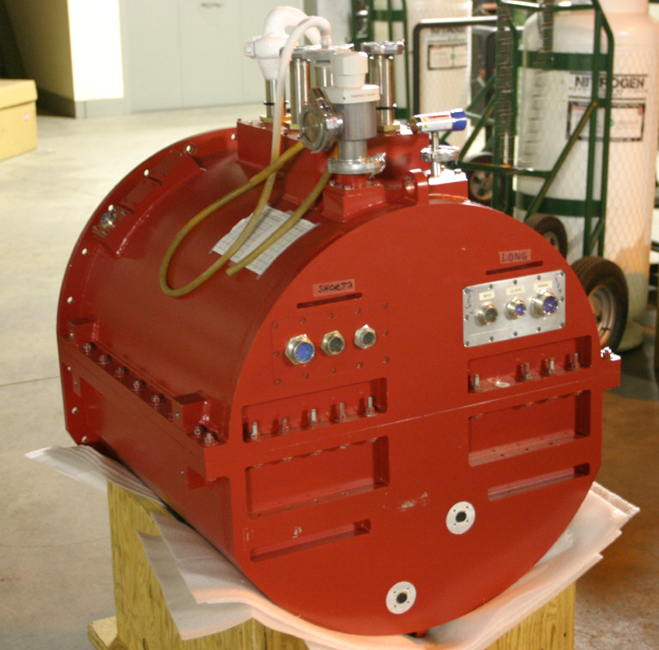
Below is FORCAST, before it was attached to the telescope's Cassegrain cage.

Below, right is how FORCAST saw Jupiter:

According to their news release:
"The crowning accomplishment of the night came when scientists on board SOFIA recorded images of Jupiter at wavelengths unobservable by either ground-based observatories or current space telescopes," said USRA SOFIA senior science advisor Eric Becklin. “The composite image from SOFIA shows heat, trapped since the formation of the planet, pouring out of Jupiter's interior through holes in its clouds.”
This new flying observatory sports a 2.5 meter telescope. One of its instruments, FORCAST (Faint Object infraRed CAmera for the SOFIA Telescope), was first tested on Hale Telescope back in 2006. It was built by Terry Herter and his team at Cornell.
Below is FORCAST, before it was attached to the telescope's Cassegrain cage.
Below, right is how FORCAST saw Jupiter:

According to their news release:
"The crowning accomplishment of the night came when scientists on board SOFIA recorded images of Jupiter at wavelengths unobservable by either ground-based observatories or current space telescopes," said USRA SOFIA senior science advisor Eric Becklin. “The composite image from SOFIA shows heat, trapped since the formation of the planet, pouring out of Jupiter's interior through holes in its clouds.”
Astrophoto Friday: A Comet and a Meteor
Astrophoto Friday: Comet Halley and a Meteor. January 1986.

Here is the press caption from when this photo was released:
"This photo of Halley's comet was taken just as a meteor streaked across the sky above Caltech's Palomar Observatory. The photo was taken at 7:11 p.m., PST on January 7 by JPL astronomer Eleanor Helin using the 18-inch Schmidt Telescope at Palomar. The two-minute exposure shows the comet and tail, as well as the sharp streak of a meteor from the Quadrantid meteor shower."
This week hasn't given me much of a chance for blogging even though there are interesting things to share. Hopefully, you'll be seeing more here soon.
Friday, May 21, 2010
Astrophoto Friday: The Rosette Nebula
This week for Astrophoto Friday we have the Rosette Nebula.
 The Rosette Nebula is located about 5,200 light years away in the direction of the constellation of Monoceros, the Unicorn. It is a large star-forming region of hydrogen gas with a young star cluster (NGC 2244) at its center.
This photograph was made using Palomar's 48-inch Schmidt telescope (now called the Samuel Oschin Telescope). It was taken (possibly in 1965) by William C. Miller who was experimenting with the color astronomical photography. Be sure to check out this 1959 article from LIFE Magazine - The Hues of Heaven - In new Mount Palomar photographs man sees the stars in true color for the first time.
Also, there are some great photos of William C. Miller on the Google LIFE archive. You can check them out here. From that archive here is a photo of him in front of the dome of the Hale Telescope.

Wednesday, May 19, 2010
Mighty Palomar
This is one of two ads that I know of from Dietzgen to feature Palomar's 200-inch Hale Telescope.

It looks like this full-page ad ran various times in different publications from the late 1949 to mid 1950.

It looks like this full-page ad ran various times in different publications from the late 1949 to mid 1950.
Subscribe to:
Posts (Atom)

 Posts

