Showing posts with label astrophotos. Show all posts

Friday, July 15, 2011

Astrophoto Friday - A Marvel in the Darkness

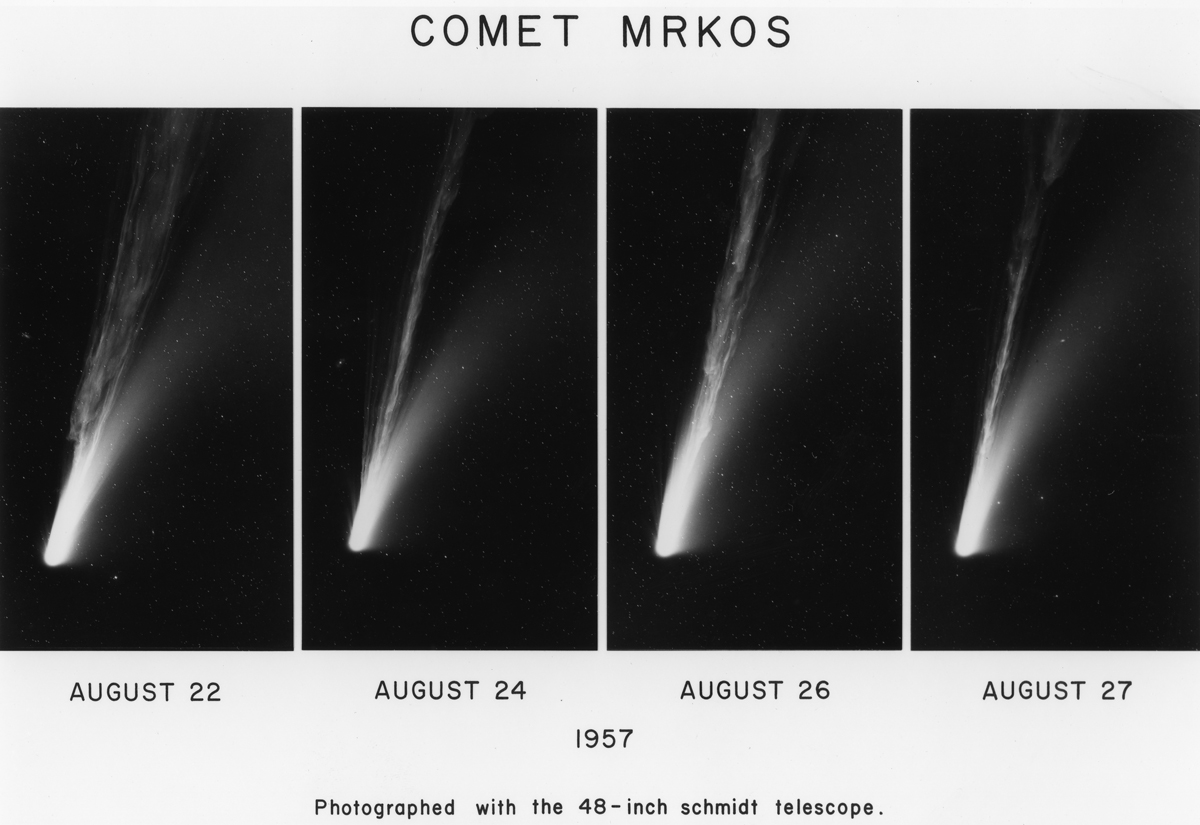
Antonin Mrkos discovered seven comets. These photos of his brightest comet (1957 D) were taken in August 1957 with Palomar Observatory's 48-inch Schmidt Telescope (now called the Samuel Oschin Telescope) by Charles Kearns, George O. Abell and Byron Hill.


Be sure to click on the image to make it larger to see the wonderfully detailed structure of the comet's tail.

Friday, July 8, 2011

Astrophoto Friday - Colliding Galaxies

This pair of spiral galaxies are on a collision course with each other. The galaxies lie some 90 million light years from our Milky Way Galaxy. Collectively they are known as Arp 271 and individually as NGC 5426 and NGC 5427. Over the next several million years they will continue the slow gravitational dance that may eventually cause them to merge into one galaxy.


This image of Arp 271 was captured using the wide-angle 48-inch (1.2-meter) Samuel Oschin Schmidt Telescope. This is a crop of a much larger image. It was taken as a part of the Palomar Transient Factory (PTF) survey and comes to us from Jason Surace and the PTF collaboration.

For a much more detailed shot, taken by a much larger telescope, be sure to check out this image of Arp 271 taken with the 8-meter Gemini South Telescope.

Friday, July 1, 2011

Astrophoto Friday - Crab Nebula

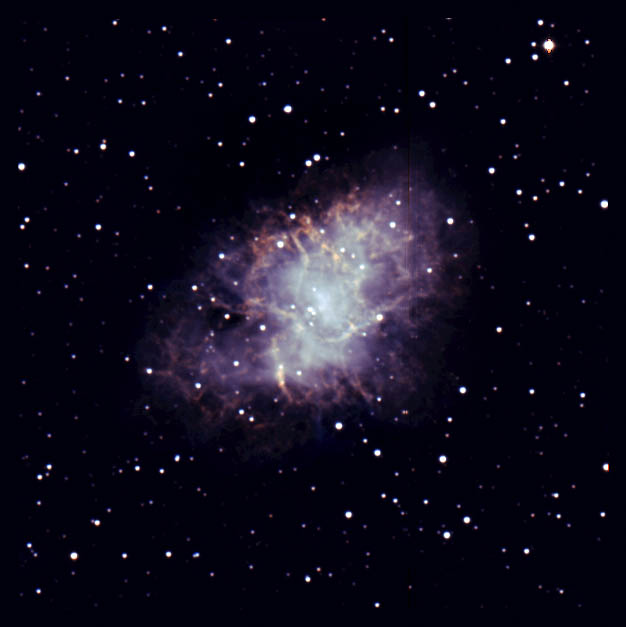
It is nearly Independence Day here in the States. That is traditionally a time for fireworks. It also seems to be a tradition of mine to post a Palomar photo of the Crab Nebula which was created by one of nature's biggest fireworks displays - the collapse and explosion of a massive star (See my post from 2009 and 2010).

The supernova explosion that produced what is now known as the Crab Nebula was first observed on July 4, 1054 A.D. - 722 years before the American Declaration of Independence.


This image of the Crab Nebula was captured using the wide-angle 48-inch Samuel Oschin Schmidt Telescope. This is a crop of a much larger image. It was taken as a part of the Palomar Transient Factory (PTF) survey and comes to us from Jason Surace and the PTF collaboration.

Friday, June 24, 2011

Astrophoto Friday

It is the return of Astrophoto Friday!

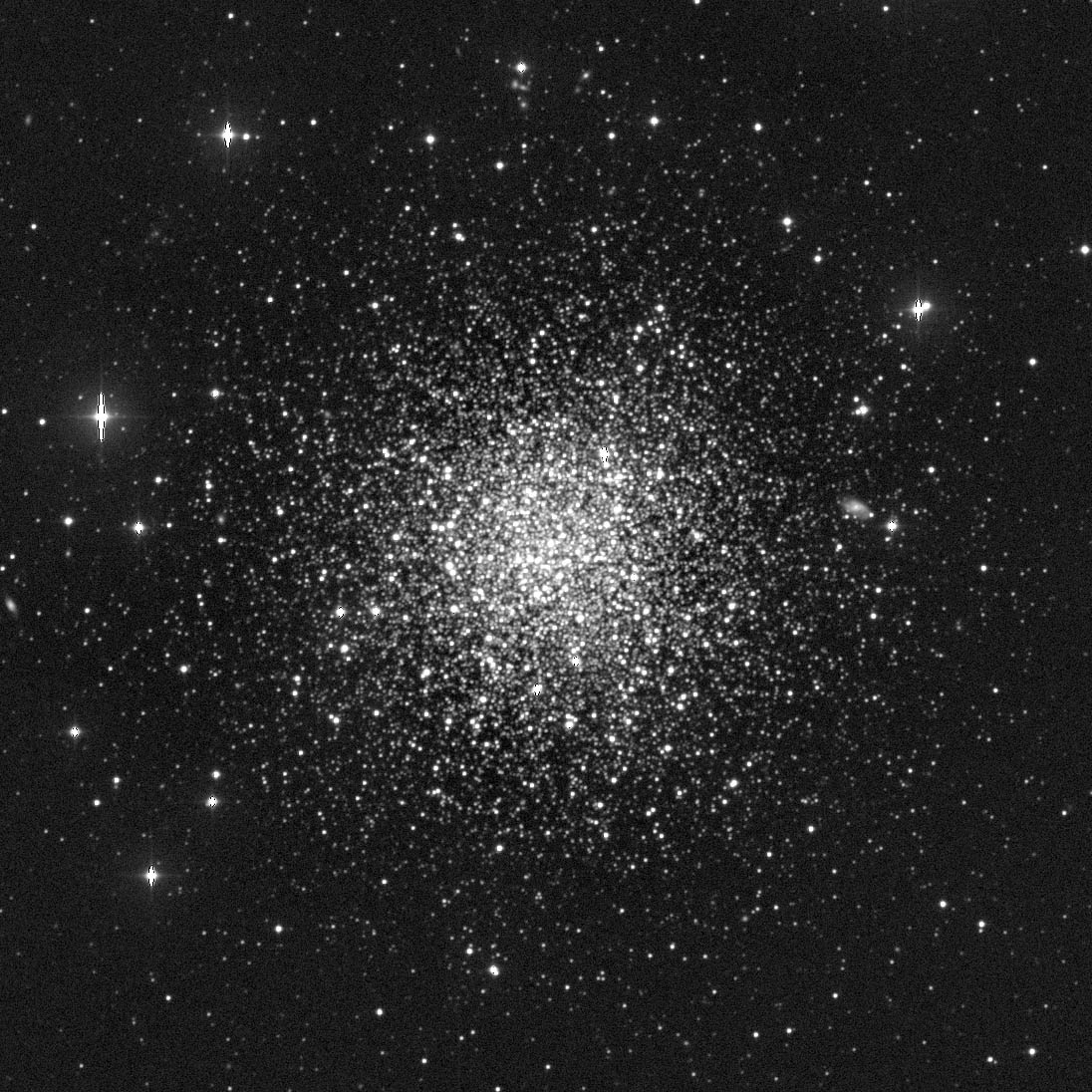
The image is of the globular star cluster known as NGC 288.

This image was captured using the wide-angle 48-inch Samuel Oschin Schmidt Telescope. This is a crop of a much larger image. It was taken as a part of the Palomar Transient Factory (PTF) survey and comes to us from Jason Surace and the PTF collaboration.

Friday, June 10, 2011

Press Coverage for Supernova Story & A Pretty Pic

The supernova story is making the rounds. In addition to reading about it here on Palomar Skies it has been picked up by Space.com, the LA Times, Physorg, National Geographic, The Republic, Daily India, the San Diego Union Tribune, Universe Today, IO9, HPWREN, Sky & Telescope and others.

Now to make your Friday more special, check out this photo by Caltech astronomer Evan Kirby:


It is a beautiful shot of the "summer" Milky Way taken from next to the dome of the Hale Telescope. For more on what is shown here be sure to check out this posting over at the Bamboo Shoots Photography Blog. There you will find a fully labeled version and an explanation of some of the cool objects in the picture.

Friday, June 3, 2011

Breaking News - A Supernova in M51

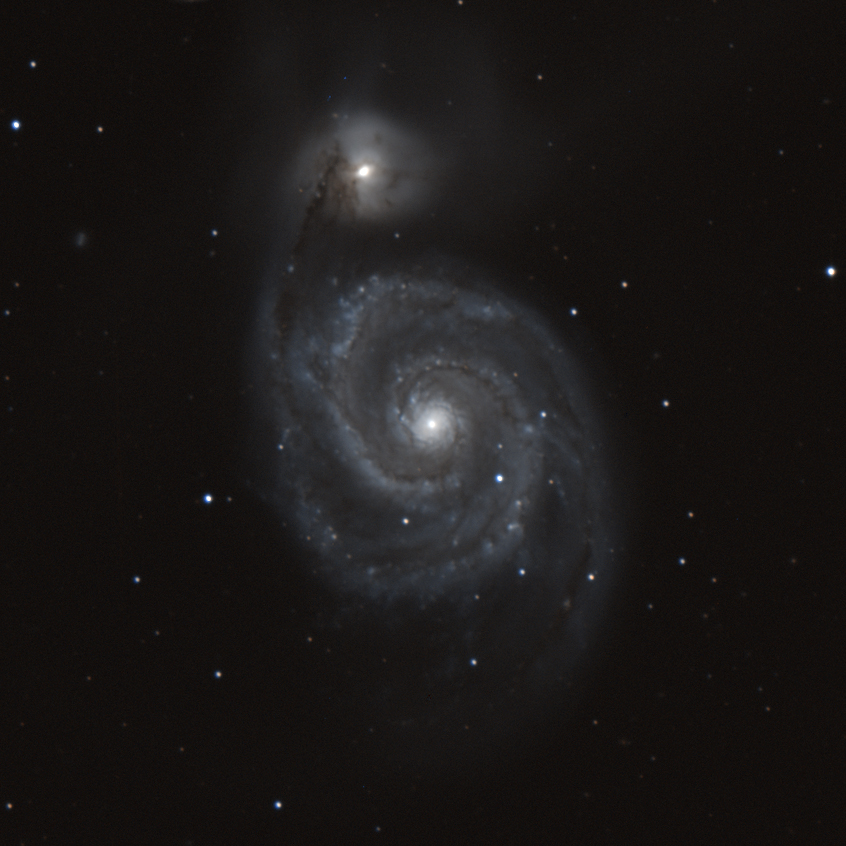
Astronomers with the Palomar Transient Factory are reporting the discovery of a supernova in the Whirlpool Galaxy (M51).

It has been classified as a Type II supernova, which means that it is the result of the collapse and explosion of a massive star. The classification was performed using the Keck I telescope in Hawai'i. The magnitude of the star was estimated at 13.5, which makes it bright enough for amateur astronomers to see and image. It should be noted in the discovery report that the "exact magnitude uncertain due to saturation" - meaning that the supernova was too bright for astronomers to measure. Of course they were using one of the largest telescopes on the planet.

I am checking to see if there will be images to post, but in the meantime here is a shot of M51 taken well over a year ago by Palomar's 48-inch Samuel Oschin Telescope as a part of the Palomar Transient Factory Survey:

I am sure that there will be more news on this in the coming days and weeks, so stay tuned.
Saturday, May 28, 2011

Milky Way Over Palomar

Astronomer Iair Arcavi comes to Palomar Observatory to use the Hale Telescope to study supernovae as part of the Palomar Transient Factory survey. The survey is going quite well with over 1,110 supernovae discovered so far.

Iair also manages to find the time to do some nighttime photography with his digital SLR camera. I have posted some of his work here before (See his shot of the Milky Way over the Hale Telescope, his 2 Nights at the Palomar Observatory video and his composite of the Perseid meteor shower).

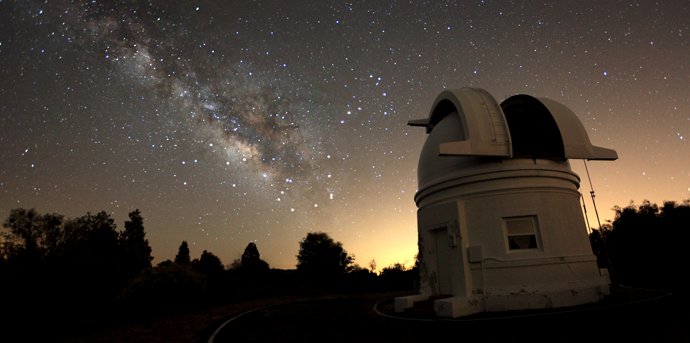
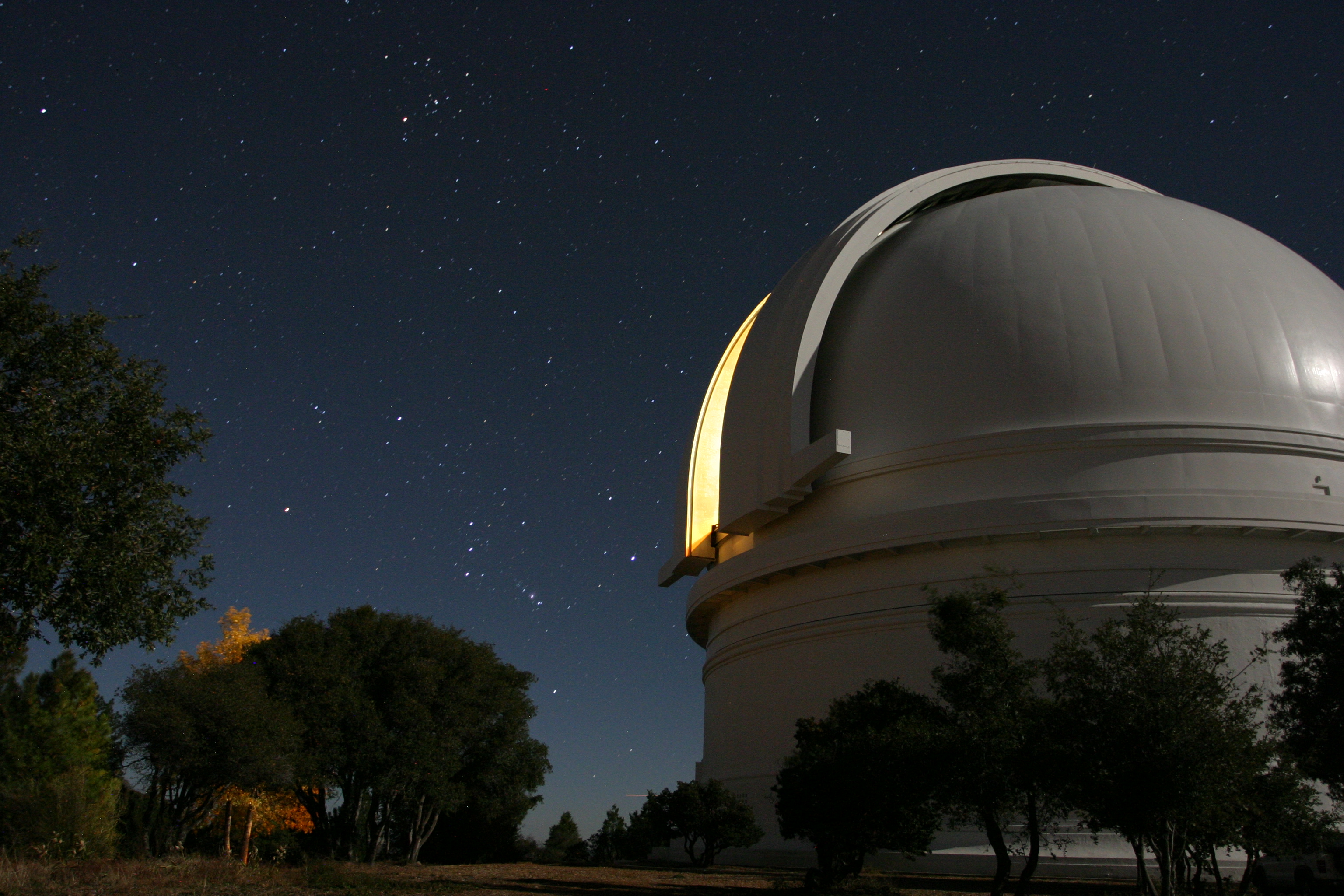
He managed to shoot some more dramatic images of our Palomar Skies just this last week. Both images nicely show off our domes, the heart of the Milky Way Galaxy and how light pollution is brightening our skies.

This image shows the dome that used to house the 18-inch Schmidt, Palomar's first telescope. The constellation of Scorpius can be seen just to the left of the dome. Note the bright sky glow to the southwest.
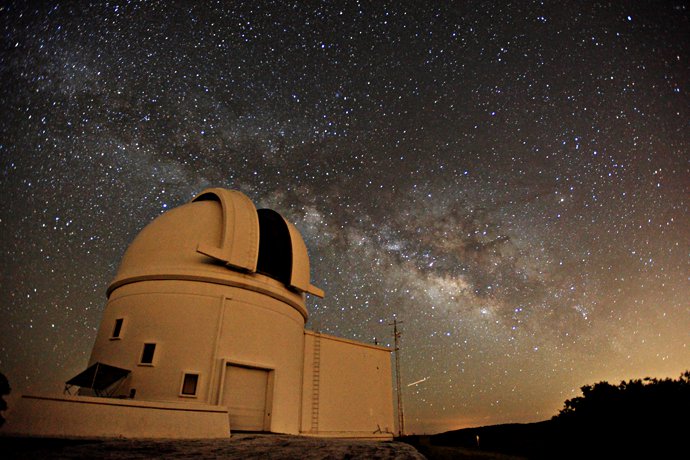
The 18-inch Schmidt is now retired but in its lifetime it was used for a tremendous amount of important work. For instance, just yesterday was the anniversary of that telescope being used to make the 1992 discovery of asteroid Braille (1992 KD). Astronomers Eleanor Helin and Kenneth Lawrence found the asteroid as a part of the Palomar Planet-Crossing Asteroid Survey. Just seven years later Braille was photographed as NASA's Deep Space 1 spacecraft flew past it.

Another of Iair's photos shows the Milky Way behind the dome of Palomar's automated 60-inch telescope. The 60-inch telescope is used nightly to perform follow-up observations on the new transient sources discovered through the Palomar Transient Factory survey. It also is a rapid-response telescope that gives astronomers a look at the optical glow of gamma-ray bursts.
Sunday, January 16, 2011

Night Lights

Here is something you don't see very often. The lights on inside the dome of the Hale Telescope at night.

I have always liked this shot because of the mix between moonlight (illuminating the dome), starlight (can you spot Orion and Taurus?) and the interior lights. It is the only photo that I have taken ever to appear on the cover of a phone book
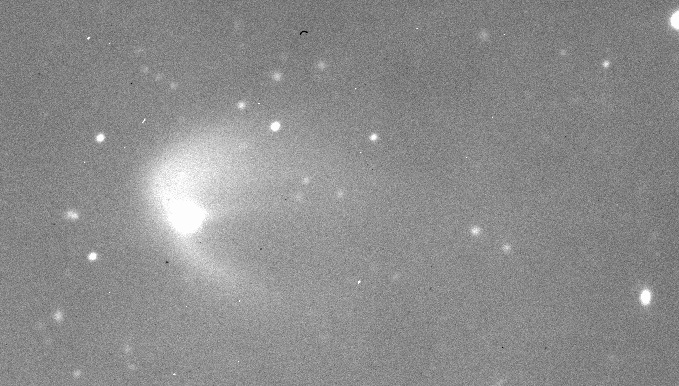

This picture was taken in the fall of 2004 during some engineering time. The lights were on while some new equipment was being prepared for use later that night.

I have uploaded this photo at a higher resolution than I normally do. Click on the image to see it in a much larger size.

Monday, December 13, 2010

Asteroid 596 Scheila Becomes a Comet

Over the weekend it was reported that main-belt asteroid 596 Scheila was experiencing a comet-like outburst. Solar system astronomers Michael Hicks and Kenneth Lawrence from the Jet Propulsion Laboratory happened to have observing time on Palomar’s 200-inch Hale Telescope last Saturday night and early Sunday morning they captured this image of "asteroid" 596 Scheila looking very much like a comet:


The two main ideas behind Scheila’s cometary outburst are that it is either a rare comet with an orbit inside the asteroid belt that started out gassing or that it has recently suffered a collision like the one in 2009 that befell an asteroid known as P/2010 A2.

Stay tuned.

Thanks to Mike & Ken for being kind enough to share this raw image of the event so soon after it was acquired!

For a related post see also, The Asteroid that Became a Comet and the Comet that Became an Asteroid.

Friday, November 12, 2010

Palomar's Beautiful Universe

You may remember Wally Pacholka's panorama of the Milky Way & the dome of the Hale Telescope. It was an Astrophoto Friday image here back in June.

The editors of Sky & Telescope have chosen to place a cropped version of Wally's picture on the cover of the 2011 edition of their Beautiful Universe publication.


You can buy it directly from S&T's online store and it should be in your local newsstands next week.

Friday, November 5, 2010

Tonight's Delta II Launch - as seen from Palomar

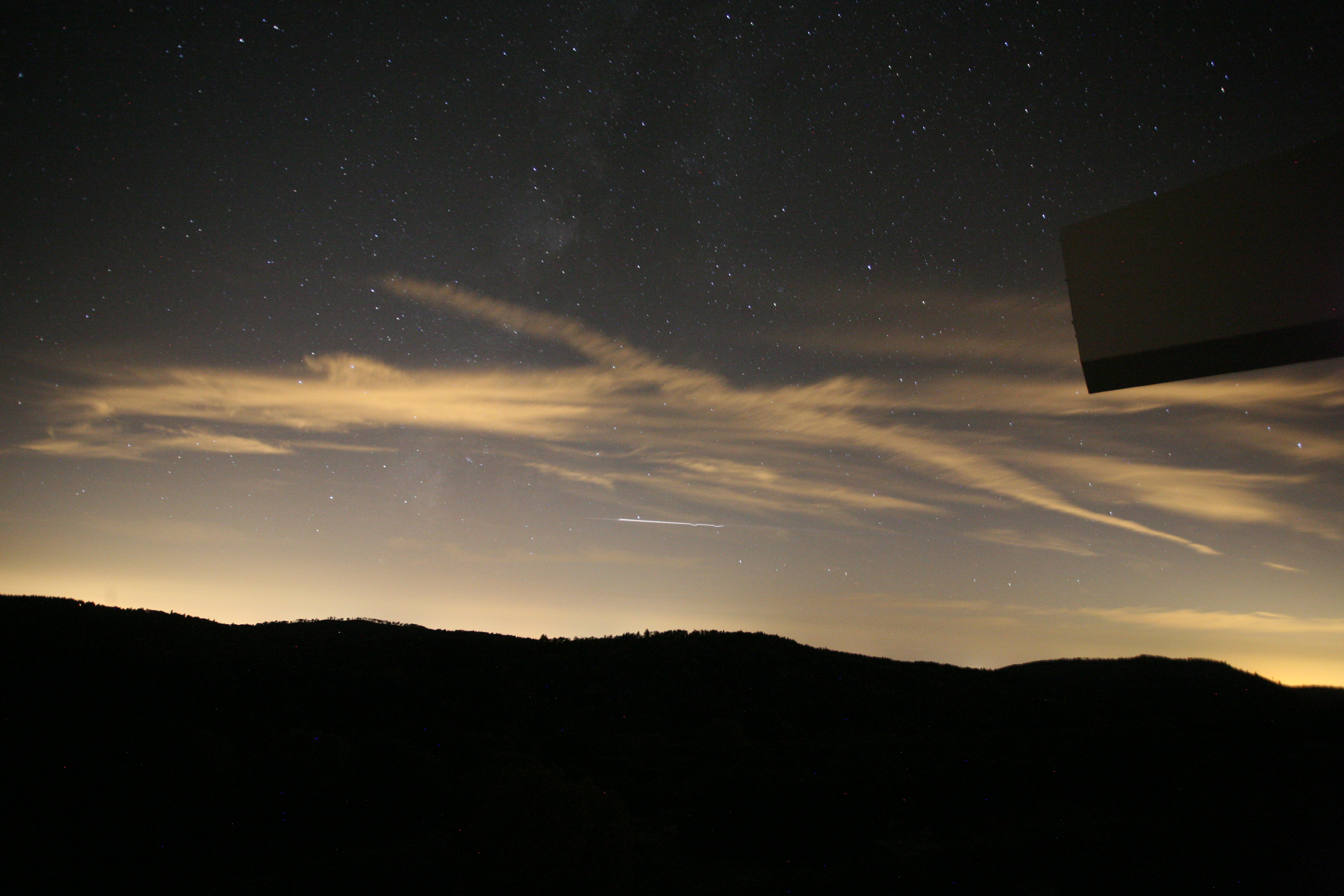
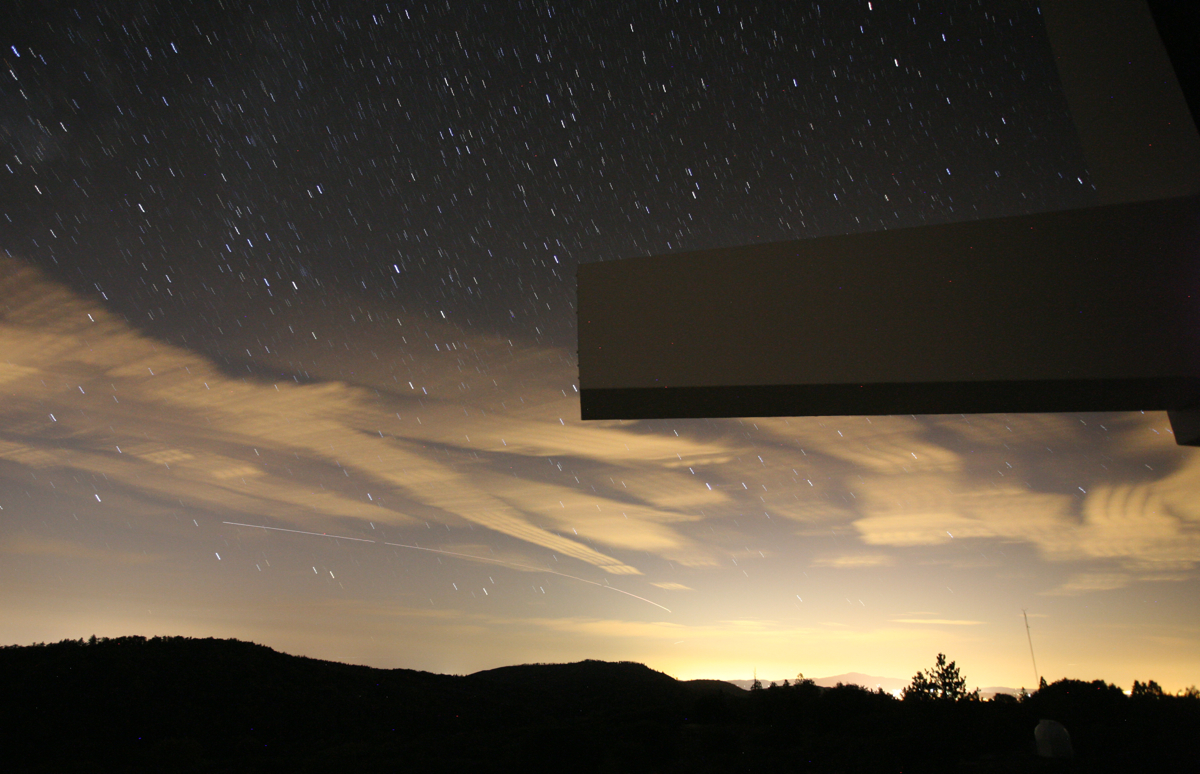
A Delta II rocket was launched tonight from Vandenberg Air Force Base. Here is the view from the catwalk of the 200-inch Hale Telescope:


Click to embiggen (full resolution version is here). Light pollution and cirrus clouds dampened the view somewhat. The top photo is 3 30 second exposures combined. The rocket trail is the line beneath the clouds.


This one is just a 30-second exposure. A higher resolution version of the image is here.

Astrophoto Friday - the Whirlpool Galaxy

M51, the Whirlpool Galaxy, is 37 million light years distant but still a jewel of the heavens. Here it is as captured by the Palomar Transient Factory (PTF) survey using Palomar's 48-inch Samuel Oschin Telescope.


For those keeping score, the PTF survey has discovered 882 supernovae.

The Whirlpool Galaxy can be found in the northern constellation of Canes Venatici (the hunting dogs).

Friday, October 29, 2010

Astrophoto Friday - Witch's Broom Nebula

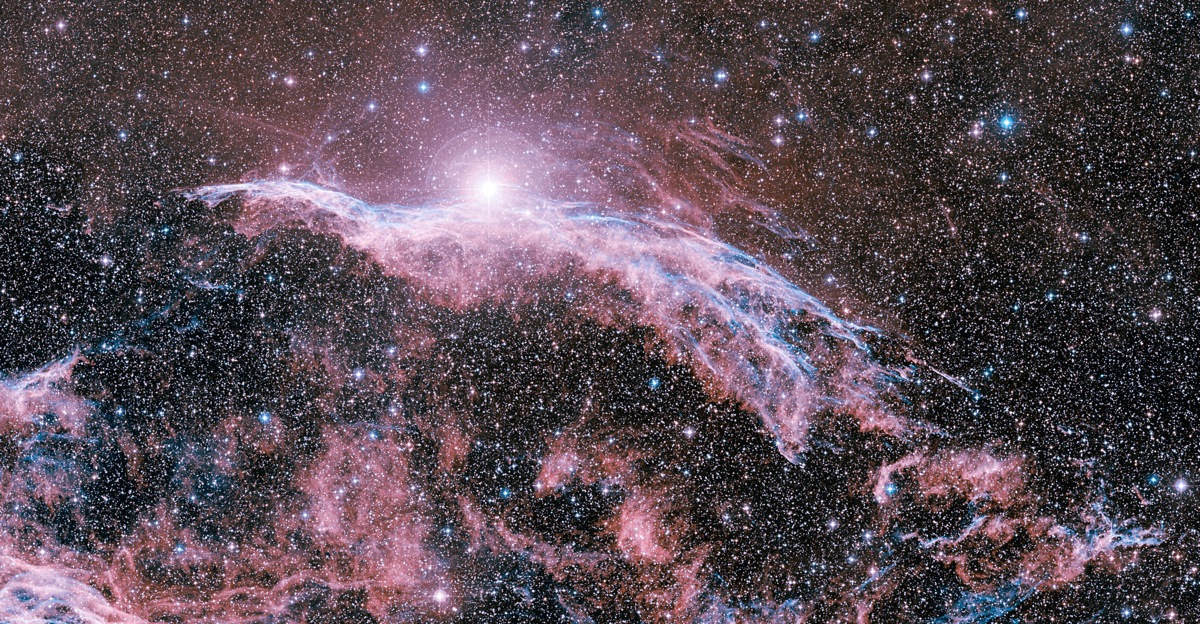
It is Astrophoto Friday again and almost Halloween, so today we give you the Witch's Broom Nebula.


The Witch's Broom Nebula (a part of the Veil Nebula supernova remnant) is about 1,400 light years distant in the direction of the constellation of Cygnus the Swan.

This image was produced from several photos taken with Palomar's 48-inch Samuel Ochin Telescope as a part of the Second Palomar Observatory Sky Survey. The image was processed by Davide De Martin. You can check out many more great images that he has produced at his SkyFactory website.

Friday, October 22, 2010

Astrophoto Friday - Uranus with Adaptive Optics

Once again it is Astrophoto Friday. Last week's choice was Neptune as seen by the Hale Telescope with adaptive optics. This week we move inward to bring you the planet Uranus.


This image of Uranus was taken on 11 August 2006 with the Palomar Observatory's 200-inch (5-meter) Hale Telescope and its Adaptive Optics system. The Adaptive Optics system removes the blurring effects of Earth's atmosphere to produce very high resolution images.

Don Banfield of Cornell University collected and processed the data to produce this false color image. The image was recorded in three near-infrared wavelengths: "J" centered at 1.250 microns, "H" at 1.635 microns, and "Ks" at 2.150. The images were combined as red, green, and blue to create this false-color image. Several cloud features can be seen at Uranus' atmosphere. The planet's rings (seen nearly edge-on) show up as the red area off of the planet's disk.

Friday, October 15, 2010

Astrophoto Friday - Neptune with Adaptive Optics

It is Astrophoto Friday! For your enjoyment this time is the planet Neptune.


This image of Neptune was taken on 11 August 2006 with the Palomar Observatory's 200-inch Hale Telescope and its adaptive optics system. The adaptive optics system removes the blurring effects of Earth's atmosphere to produce very high resolution images.

Don Banfield of Cornell University collected and processed the data to produce this false color image. The image was recorded in three near-infrared wavelengths: "J" centered at 1.250 microns, "H" at 1.635 microns, and "Ks" at 2.150. The images were combined as red, green, and blue to create this false-color image. A wide assortment of clouds can be seen at Neptune's atmosphere. The multi-colored object passing above Neptune is one of its moons which moved during the exposures.

Saturday, October 9, 2010

LCROSS Impact Anniversary

Today marks the one year anniversary of the impact of the LCROSS spacecraft into the Moon.

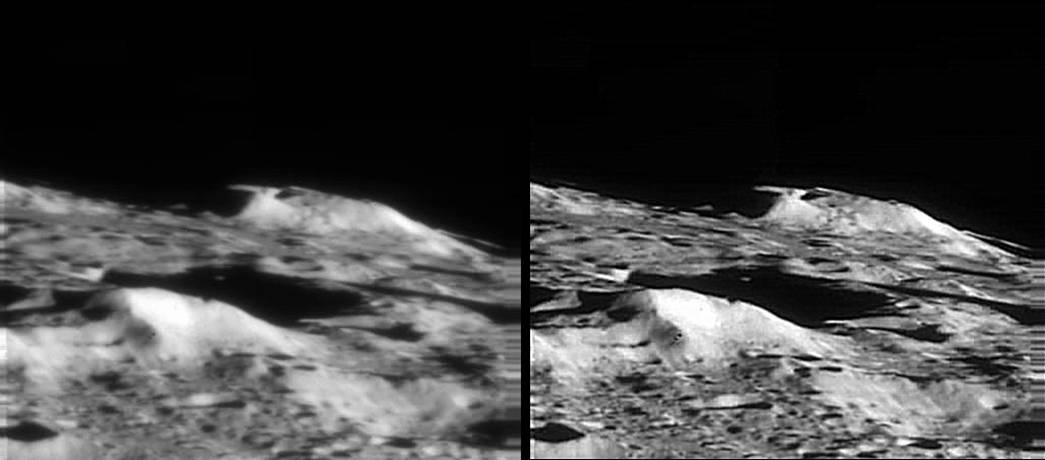
Palomar Observatory observed the event with the 200-inch Hale Telescope's adaptive optics system. While the impact plume was not observed the research team that used the Hale returned some pretty impressive images. The images were the best from any telescope that observed the event. A short video was produced from the frames taken before and after the impact.

UK amateur astronomer Paul Coleman recently took the individual frames from the movie and combined them with the image processing program Registax. In the process Paul took a good image and made it even better.

The adaptive optics corrected image from the 200-inch is on the left and the result of combining many frames is on the right.
Thanks go out to Paul for doing this and allowing me to share it with everyone here.

Friday, October 8, 2010

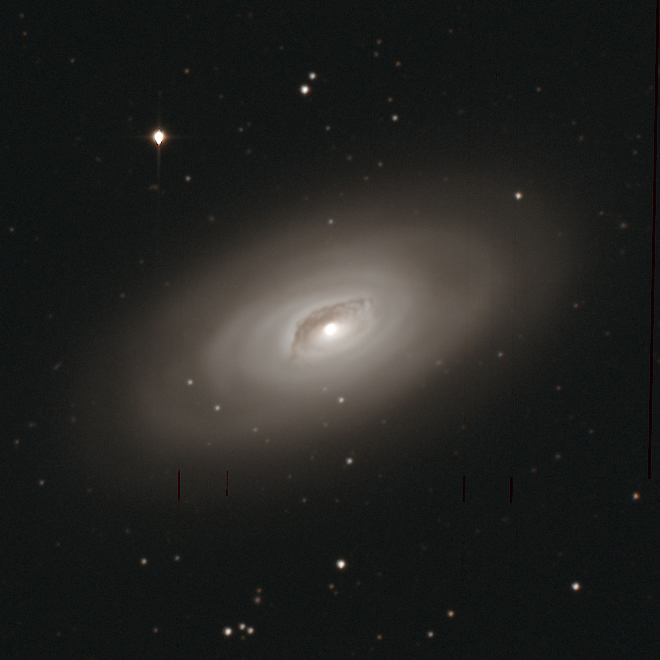
Astrophoto Friday - the Blackeye Galaxy

This week's astrophoto is of the Blackeye Galaxy, also known as M64. M64 is spiral galaxy located about 19 million light years distant in the direction of the constellation of Coma Berenices.


The image was captured by the Palomar Transient Factory team using Palomar's 48-inch Samuel Oschin Telescope.

Friday, October 1, 2010

Astrophoto Friday - the Milky Way & Light Pollution

You may recall that back in August I posted a photo of the Perseid Meteor Shower over Palomar's Hale Telescope taken by astronomer Iair Arcavi. You might also recall his Two Nights at the Palomar Observatory YouTube video.

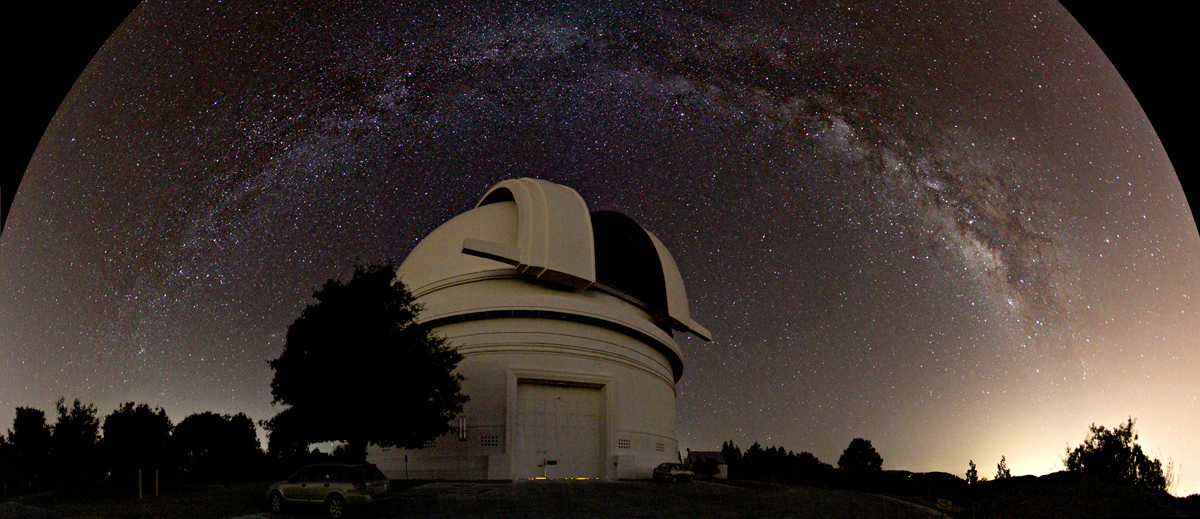
Iair has processed of some the imagery he shot those two nights to produce this dramatic panorama of the Milky Way over the Hale Telescope.

His composite image is made from 14 separate exposures.
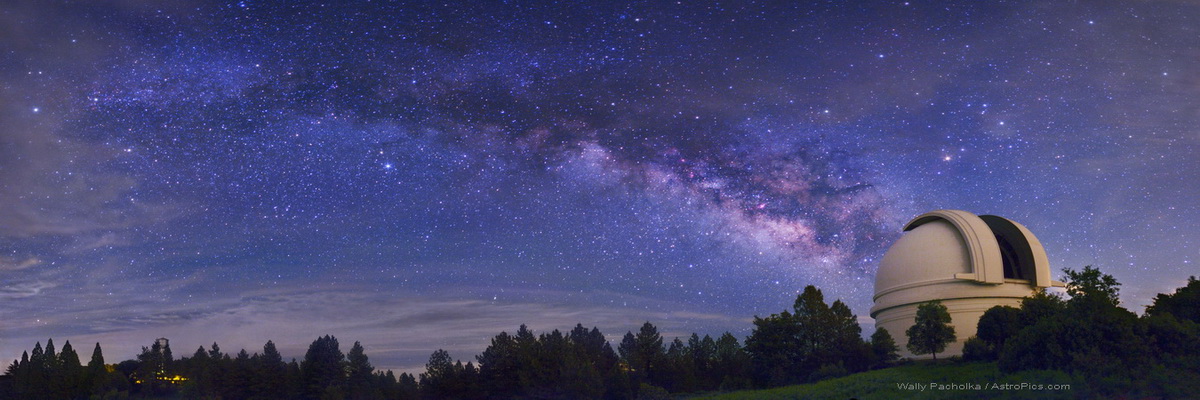
Compare it to the other panorama image of the Hale and the Milky Way - Wally Pacholka's Milky Way over Palomar you'll notice some dramatic differences.


Apart from the way the the two images were processed, the weather was very different on the two nights.

In the image taken by Wally there were a few clouds in the sky and a vast sea of them below Palomar Mountain. The low clouds are not visible in his image, but they effectively dimmed the city lights.

Iair's image there were no low clouds blocking the city lights making the ugly glow of light pollution easily visible. Notice how the light of the Milky Way galaxy is vanquished by the bright glow of the many lights in San Diego and Riverside Counties. There is even a smaller glow on the right produced by the lights of Palm Springs.

Because Nature does not always bring in the low clouds that protect Palomar Observatory's view of the universe, we ask all our neighbors to help do their part by making sure that nighttime lights are properly shielded and turned off when not absolutely needed.

Sunday, September 26, 2010

Minotaur Launch

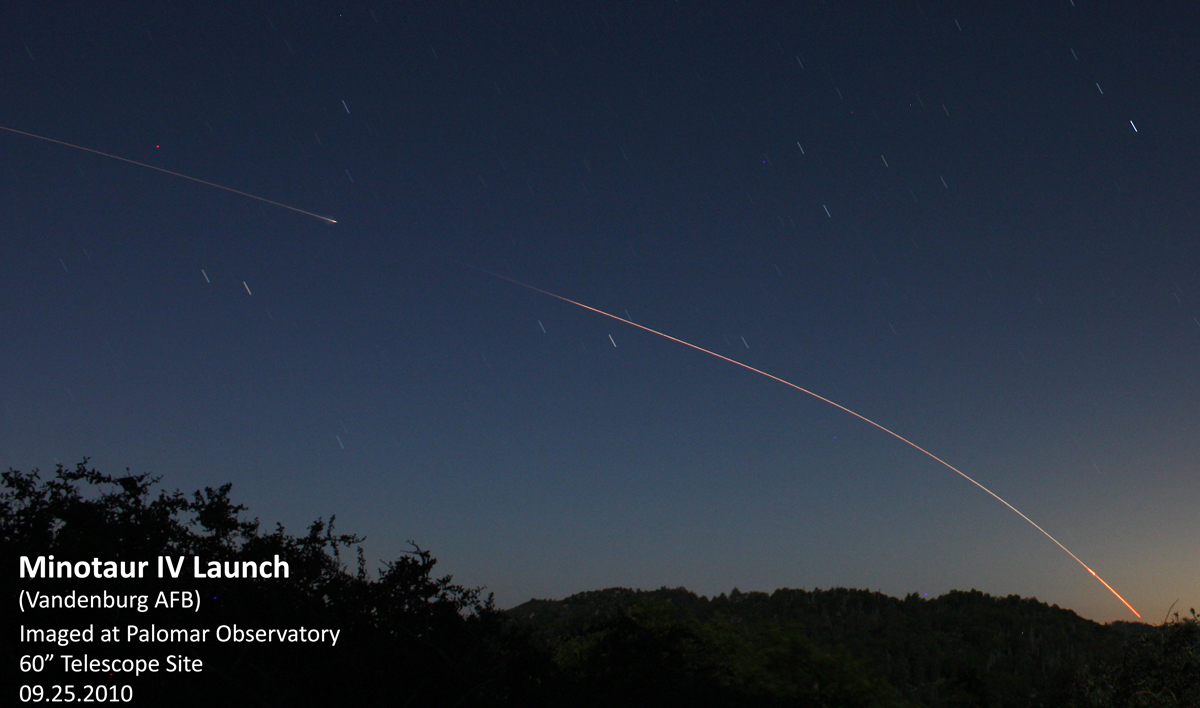
Check out this photo of last night's Minotaur IV launch:


It was a beautiful display that was captured nicely with this 119-second exposure photo taken by Mark Lane from the parking lot of the Palomar 60-inch telescope. The launch was the perfect end to a Friends of Palomar Observatory event that took place last evening.

Click to embiggen and you should notice that Mark's photo nicely captured the two staging events of the launch. The rocket was launched from Vandenberg Air Force Base.

If you are interested in seeing events like this in the future, be sure to check out the updates that are posted at spaceflightnow.com.

Friday, September 24, 2010

Astrophoto Friday - The UFO Galaxy

As of their last web update the Palomar Transient Factory (PTF) has so far discovered 752 supernovae. The heart of the PTF survey is Palomar's 48-inch Samuel Oschin Telescope - a wide-field Schmidt camera. It operates in robotic mode, taking a new image of the night sky every 90 seconds.

Most of the time the images are optimized to hunt for supernovae and are not cleaned up to make them visually appealing. Thankfully some of the PTF team has taken the time to produce some nice shots, which I will be sharing here from time to time. Our first one is of a galaxy known as NGC 2683.


NGC 2683 is a nearly edge-on spiral galaxy located some 16 million light years away in the direction of constellation Lynx. NGC 2683 is nicknamed the UFO Galaxy.