Wally Pacholka just sent me this video from PBS' News Hour on The World at Night. If you don't get a chance to see one of the exhibitions in person, this will give you a flavor of what they are like.
Side show:
News story:
Wednesday, September 30, 2009
PATS Redux
A lot happened at PATS last weekend, this is just my first post on some of what took place.
On the evening before PATS began I got to speak to Dave Doody who works on the Cassini mission. He wasn't there to speak about Cassini, but rather Planet Trek. Planet Trek is to be a scale model solar system for the City of Pasadena. It is am ambitious plan, and they are still needing money to make it happen (anyone?), but it looks to be a great project where everything will be set to the same scale. That is very important because it is the only way for people to use to model to learn how vast the solar system is (of course it is tiny when compared to everything else!).
After learning about Planet Trek I went over to the gallery which was displaying photos from The World at Night project. If you haven't been to their website, block out a few hours of time and prepare to be amazed. Some of the work featured was captured by Wally Pacholka. That's Wally below. He was one of the speakers at PATS and from his booth you could buy reproductions of his amazing photographs.

The keynote speaker at PATS last weekend was former Apollo 9 astronaut Rusty Schweickart. That's Rusty (in the yellow) when he stopped by our Palomar booth.
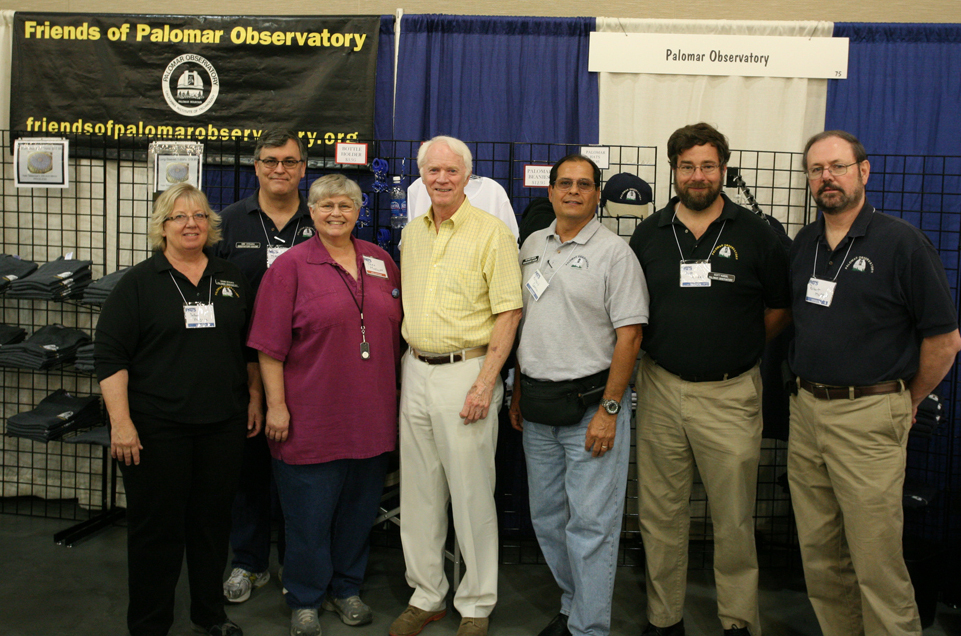
Rusty wasn't at PATS to retell the story of his spaceflight. He's got more exciting things to talk about. His talk was entitled: Prevent Impacts? Yes we can. He is very much aware of the damage that an asteroid impact could inflict on civilization and as such he is involved in the B612 Foundation which wants to demonstrate our ability to alter, in a controlled fashion, the orbit of a near-Earth asteroid.
It is an ambitious, but perhaps someday, necessary program. Be sure to follow the link to the B612 Foundation to learn more about it.
On the evening before PATS began I got to speak to Dave Doody who works on the Cassini mission. He wasn't there to speak about Cassini, but rather Planet Trek. Planet Trek is to be a scale model solar system for the City of Pasadena. It is am ambitious plan, and they are still needing money to make it happen (anyone?), but it looks to be a great project where everything will be set to the same scale. That is very important because it is the only way for people to use to model to learn how vast the solar system is (of course it is tiny when compared to everything else!).
After learning about Planet Trek I went over to the gallery which was displaying photos from The World at Night project. If you haven't been to their website, block out a few hours of time and prepare to be amazed. Some of the work featured was captured by Wally Pacholka. That's Wally below. He was one of the speakers at PATS and from his booth you could buy reproductions of his amazing photographs.
The keynote speaker at PATS last weekend was former Apollo 9 astronaut Rusty Schweickart. That's Rusty (in the yellow) when he stopped by our Palomar booth.
Rusty wasn't at PATS to retell the story of his spaceflight. He's got more exciting things to talk about. His talk was entitled: Prevent Impacts? Yes we can. He is very much aware of the damage that an asteroid impact could inflict on civilization and as such he is involved in the B612 Foundation which wants to demonstrate our ability to alter, in a controlled fashion, the orbit of a near-Earth asteroid.
It is an ambitious, but perhaps someday, necessary program. Be sure to follow the link to the B612 Foundation to learn more about it.
Tuesday, September 29, 2009
The Last 200" Photographic Plate
20 Years ago tonight the last glass photographic plate was shot with the 200-inch Hale Telescope. Astronomer Sidney van den Bergh (then of the Dominion Astrophysical Observatory) recorded a 1-hour exposure of 3C 58, a supernova remnant in the constellation of Cassiopeia.
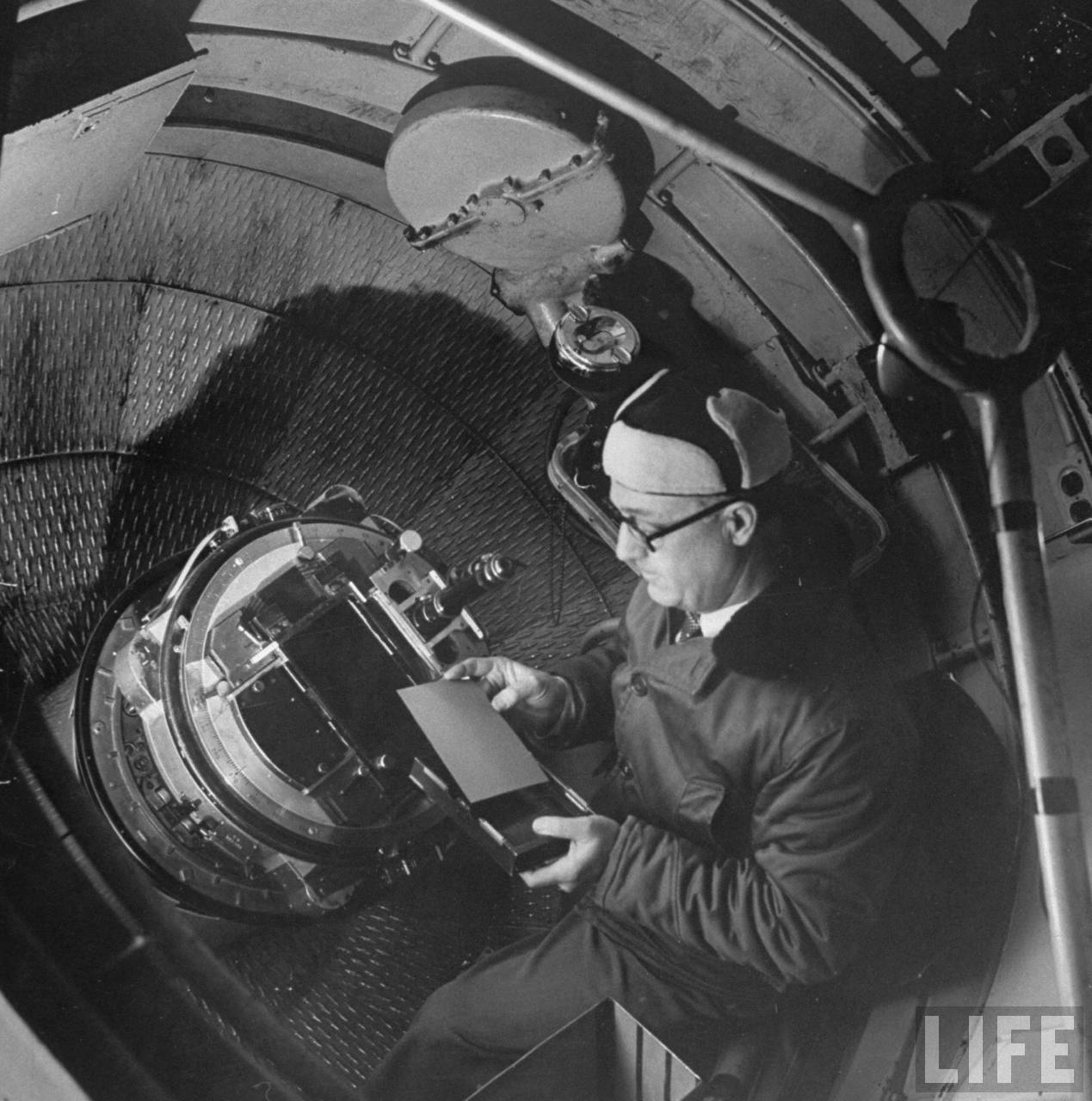
For reference, astronomer William Miller is shown at prime focus with a photographic plate in this late 1940s-era image from the Google LIFE image archive.
Sky & Telescope magazine reported on the milestone in the News Notes of their February, 1990 issue. The exposure marked the end of nearly 40 years of such work. S&T described the passing of photographic emulsions like this:
Photographic plates have been entirely replaced by CCDs, which were first used at Palomar in 1976. Glass plates were used on the 48-inch Samuel Oschin Telescope up until 2000. While we no longer expose new plates they aren't entirely a thing of the past as we are still storing a great many glass plates on site and get requests from time to time from researchers who need to see a particular image.
For reference, astronomer William Miller is shown at prime focus with a photographic plate in this late 1940s-era image from the Google LIFE image archive.
Sky & Telescope magazine reported on the milestone in the News Notes of their February, 1990 issue. The exposure marked the end of nearly 40 years of such work. S&T described the passing of photographic emulsions like this:
So, after a century of faithful service to astronomers, it appears that plates will soon be things of the past at professional observatories, just like oil lamps, pendulum clocks, and slide rules.
Photographic plates have been entirely replaced by CCDs, which were first used at Palomar in 1976. Glass plates were used on the 48-inch Samuel Oschin Telescope up until 2000. While we no longer expose new plates they aren't entirely a thing of the past as we are still storing a great many glass plates on site and get requests from time to time from researchers who need to see a particular image.
Friday, September 25, 2009
New Vistas in Adaptive Optics

The folks over at SPIE have produced a new video: New Vistas in Adaptive Optics. Click on over to have a look. When you do you'll see adaptive optics expert Bob Tyson (University of North Carolina at Charlotte), Antonin Bouchez and Christoph Baranec from Caltech and a whole bunch of images from and footage of the 200-inch Hale Telescope at Palomar.
Cool stuff!
Help Mt. Wilson Observatory
I am in Pasadena for PATS and it was comforting to be able to look up and see the domes and solar towers up on Mt. Wilson. Most of the readers of this blog know that the observatory there just survived a major wildfire.
They have some major recovery work to get through and they could use your help.
From their website:

They have some major recovery work to get through and they could use your help.
From their website:
As a result of the events of the still active Station Fire in the Angeles National Forest, we are going to be sorely pressed for resources to take care of cleanup and further preparation and mitigation activities. If you are interested in helping us with the process of transitioning back to normal operations, we welcome your tax-deductible donation in any amount. Donations can be sent to: The Mount Wilson Institute, Fire Recovery Program, P.O. Box 1909, Atlanta, GA 30301-1909 or you may donate on line using the Amazon Simple Pay Donation system.For more information and the donation link visit mtwilson.edu
Thursday, September 24, 2009
PATS is this Weekend
 The Pacific Astronomy and Telescope Show hits Pasadena, CA this weekend (Sept. 26-27) and Palomar Observatory will be on hand. If you attend, you might want to stop on by and say "hi". We will have a booth and I'll be giving a talk at 10 am on Saturday.
Tuesday, September 22, 2009
Its Hip to Be Square

This image of "The Red Square", named for its color and form, was made while studying a hot star. The star, known as MWC 922, is located about 5000 light-years from Earth in the constellation Serpens (the Serpent). The image combines adaptive optics data from the Palomar Hale Telescope and the Keck-2 Telescope. Adaptive optics removes the blurring effects of Earth's atmosphere to produce very high resolution images. It was taken in near-infrared light (1.6 microns) and shows a region 30.8 arc seconds on a side around MWC 922. As the outer periphery of the nebula is very faint compared to the core, the image has been processed and sharpened to display the full panoply of detail and structure.
The startling degree of symmetry and level of intricate linear form make the Red Square nebula around MWC 922 the most symmetrical object of comparable complexity ever imaged. The overall architecture displays a twin opposed conical cavities (known as a bipolar nebula), along the axis of which can be seen a remarkable sequence of sharply defined linear rungs or bars. This series of rungs and conical surfaces lie nested, one within the next, down to the heart of the system, where the hyperbolic bicone surfaces are crossed by a dark lane running across the principle axis.
The image was created by Peter Tuthill, a researcher in the School of Physics at the University of Sydney, Australia and James Lloyd, an assistant professor at Cornell University Astronomy Department.
For more on the Red Square Nebula have a look at this.Friday, September 18, 2009
Observatory is Open
 It looks like the maintenance work on the observatory's roads has been completed and we are now back on our regular hours open to the public daily from 9:00 a.m. until 4:00 p.m.


Thursday, September 17, 2009
The Web Cam Difference
I have posted about this before (see The Difference Engine), but if you look at HPWREN's display of the Hale Telescope webcam you can get some cool displays when there is activity going on in the dome.
Here is a shot from a few minutes ago:
 and the resulting differential image:
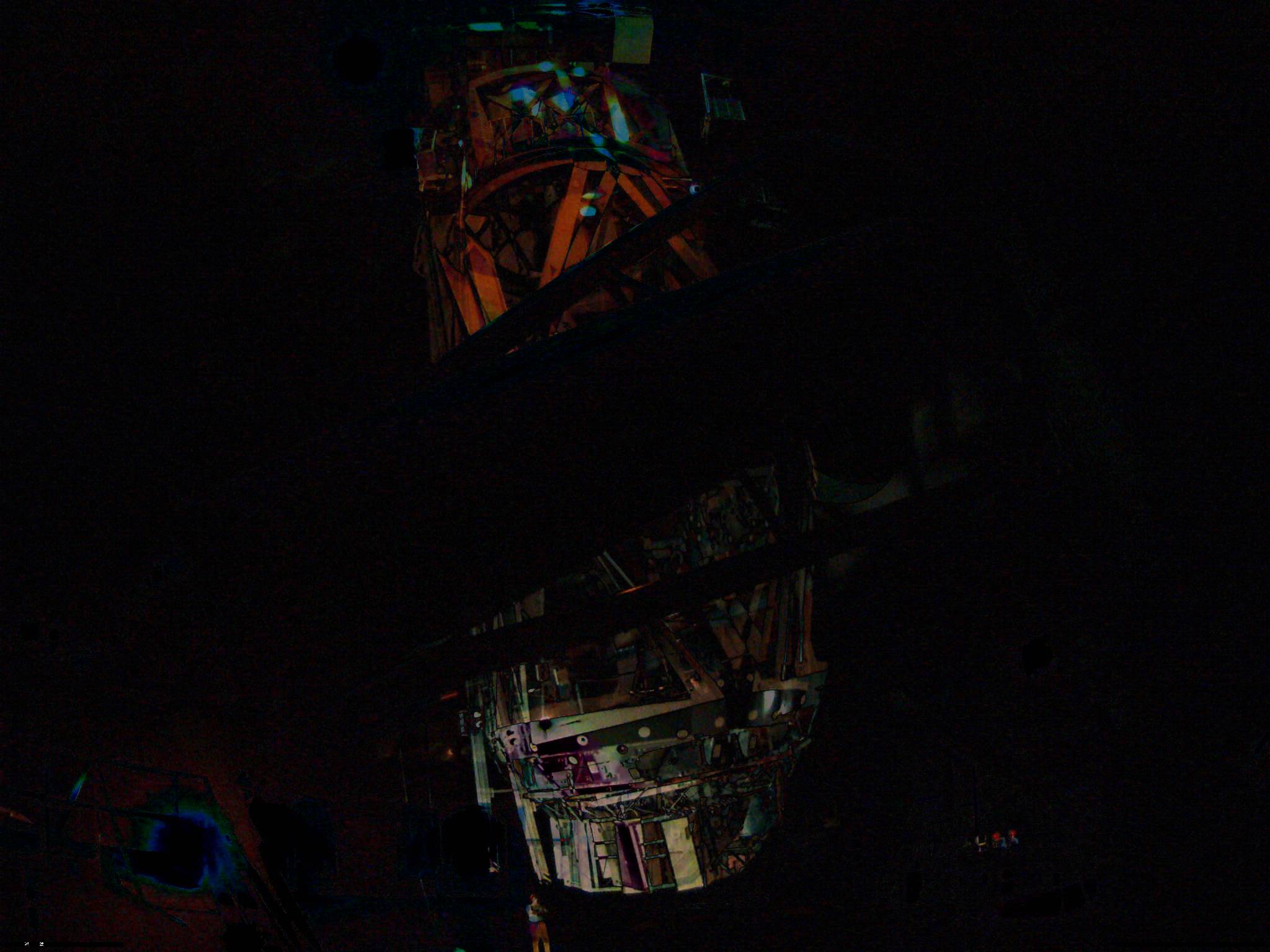
The differential image is produced by subtracting the newest image from the previous one. This is the same technique that is used by the Palomar Transient Factory (PTF) as they hunt for supernovae and other other variable sources. See my post What Does a Transient Look Like? for details on how that works.
Here is a shot from a few minutes ago:
and the resulting differential image:The differential image is produced by subtracting the newest image from the previous one. This is the same technique that is used by the Palomar Transient Factory (PTF) as they hunt for supernovae and other other variable sources. See my post What Does a Transient Look Like? for details on how that works.
Tuesday, September 15, 2009
Palomar's Star in Hollywood
In the Palomar Observatory gift shop we sell a coffee mug with the photo of a globular cluster on it and the words:
Yet there is one person from the movie business who has a star on the Hollywood's Walk of Fame and is pretty famous in the astronomical world too. That person is Mark Serrurier. For those in the telescope business, Mark Serrurier is well known for his invention that is commonly called the "Serrurier truss".
The open framework that makes up the "tube" of the Hale Telescope was the first application of Mark Serrurier's truss and it has been used on a great many telescopes since. The Serrurier truss was invented for the 200-inch telescope to solve the problem of bending or flexing steel. The telescope is so large that the steel beams it is constructed of bend under gravity. Serrurier's remarkable truss allows for this but still keeps the telescope's optical elements in perfect alignment and focus.
Serrurier did this design work for Palomar in the 1930s a few years after his father invented the Moviola, a tool for editing movies. After World War II he returned to the family business of editing movies and greatly improved his father's invention. It obviously worked out well for him because in 1979 he accepted a special Academy Award for Technical Achievement.
If you are looking for Mark Serrurier's star you can find it at 6667 Hollywood Blvd. If you can't make the trip to see it for yourself, here is how it looked when I visited it earlier this month:

Palomar Observatory - More Stars than Hollywood
Yet there is one person from the movie business who has a star on the Hollywood's Walk of Fame and is pretty famous in the astronomical world too. That person is Mark Serrurier. For those in the telescope business, Mark Serrurier is well known for his invention that is commonly called the "Serrurier truss".
The open framework that makes up the "tube" of the Hale Telescope was the first application of Mark Serrurier's truss and it has been used on a great many telescopes since. The Serrurier truss was invented for the 200-inch telescope to solve the problem of bending or flexing steel. The telescope is so large that the steel beams it is constructed of bend under gravity. Serrurier's remarkable truss allows for this but still keeps the telescope's optical elements in perfect alignment and focus.
Serrurier did this design work for Palomar in the 1930s a few years after his father invented the Moviola, a tool for editing movies. After World War II he returned to the family business of editing movies and greatly improved his father's invention. It obviously worked out well for him because in 1979 he accepted a special Academy Award for Technical Achievement.
If you are looking for Mark Serrurier's star you can find it at 6667 Hollywood Blvd. If you can't make the trip to see it for yourself, here is how it looked when I visited it earlier this month:
Subscribe to:
Posts (Atom)

 Posts
Posts

