Showing posts with label asteroids. Show all posts

Monday, December 13, 2010

Asteroid 596 Scheila Becomes a Comet

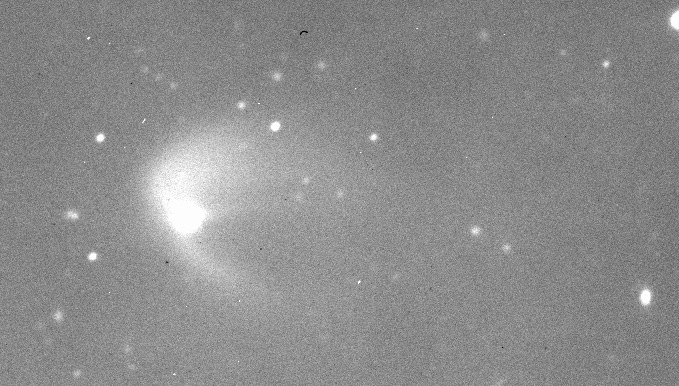
Over the weekend it was reported that main-belt asteroid 596 Scheila was experiencing a comet-like outburst. Solar system astronomers Michael Hicks and Kenneth Lawrence from the Jet Propulsion Laboratory happened to have observing time on Palomar’s 200-inch Hale Telescope last Saturday night and early Sunday morning they captured this image of "asteroid" 596 Scheila looking very much like a comet:


The two main ideas behind Scheila’s cometary outburst are that it is either a rare comet with an orbit inside the asteroid belt that started out gassing or that it has recently suffered a collision like the one in 2009 that befell an asteroid known as P/2010 A2.

Stay tuned.

Thanks to Mike & Ken for being kind enough to share this raw image of the event so soon after it was acquired!

For a related post see also, The Asteroid that Became a Comet and the Comet that Became an Asteroid.

Saturday, August 28, 2010

Asteroid Discovery Video

Check out this cool video by Scott Manley of asteroids as they are discovered from 1980 to the present time. Many thousands of the ones shown here were discovered at Palomar Observatory (and lots of other places too).


Check out the full resolution version here at YouTube. You can get the full text there, but note that most of asteroids are discovered in the opposite direction of the sun. That is until the very end when a new set of discoveries shows up, those asteroids discovered by the Wide-field Infrared Survey Explorer.

Saturday, July 17, 2010

Asteroid Cronkite


On the night of November 18, 1990 astronomer Elanor Helin, using Palomar's 18-inch Schmidt telescope, discovered an asteroid (arrowed above) that was later found to have an orbit that carried it across the orbit of Mars. Almost exactly six years later the asteroid was named for journalist Walter Cronkite and is now officially known as 6318 Cronkite.

Walter Cronkite passed away one year ago today, just days ahead of the 4oth anniversary of the Apollo 11 landing on the moon. Cronkite famously covered the moon landings and for many of us old enough to remember them it is hard to separate the events that took place in space from the coverage he provided.

It has been a year, but so long Walter you are missed.

Wednesday, February 3, 2010

The Asteroid that Became a Comet and the Comet that Became an Asteroid

Once in a while an asteroid comes along that changes things.

On January 6, 2010 the Lincoln Near Earth Asteroid Research team discovered a main-belt asteroid that was experiencing an outburst making it look like a comet. Comets aren't normally found in the asteroid belt and early indications suggested that this was an asteroid that had suffered a collision, which produced it's comet-like outburst and tail. A photo released yesterday (below) taken by the Hubble Space Telescope reveals that the object's tail does not resemble that of a normal comet and that the bright star-like nucleus is strangely offset from the tail itself. All of this tends to support the idea that this display is the result of the collision of two asteroids - an event never before witnessed.


Seeing an asteroid have a comet-like outburst reminds me of the case of a comet that apparently converted into an asteroid. Back in November 1949 Albert Wilson and Robert G. Harrington were using the 48-inch Schmidt (now called the Samuel Oschin Telescope) taking photos for first Palomar Sky Survey when they discovered a comet. Comet 107P/Wilson-Harrington was photographed by the duo over three nights but there was great uncertainty in the orbit and it was eventually lost.

Thirty years later, in November 1979, Eleanor Helin was observing at Palomar when she discovered a new asteroid temporarily dubbed 1979 VA. You can see it as the streak in the center of the image below.


In the early 1990s it was determined that Comet Wilson-Harrington and asteroid 1979 VA were the same object. The asteroid is now known as 4015 Wilson-Harrington and is thought to be a comet that lost all of its icy volatiles, or in essence a "burned out" comet. For more on the discovery of Wilson-Harrington have a look at this page over at Cometography.

Why do astronomers think that Wilson-Harrington is a dead comet and not an asteroid that had a collision back in 1949? It's orbit.


Notice that Wilson-Harrington's orbit is elliptical like a typical comet. At its farthest point from the Sun it is out in the asteroid belt, but at its closest point it comes in a little closer to the Sun than Earth is. Just like a typical comet, this one had its 1949 outburst when it was close to the Sun and its heating.

By the way, as of a few days ago the count of the total number of asteroids discovered at Palomar Observatory stood at 23,366.

Wednesday, July 15, 2009

Asteroid Update


Once a month the Minor Planet Center updates their list of Minor Planet Discovery Sites. The total number of minor planets, which most people call asteroids, discovered at Palomar Observatory is split between those found through the Near-Earth Asteroid Tracking program and others found here on site. The total between the two, which was updated just last week, now stands at 21,609.

Tuesday, April 28, 2009

Astronomy Podcasts Keep on Coming


I am having a hard time keeping up with the 365 Days of Astronomy podcasts, but there have been some good ones recently. Here are three from recent days that might catch your interest.

My podcast about the naming of the asteroids to the Luiseño People.

The Good, the Bad, and the Ugly of Outdoor Lighting from the National Park Service's Night Sky Team.

Will the World End in 2012?
(Quick Answer: NO!) by Cameron Hummels of Columbia University.

There's lots more good stuff too.

Friday, April 10, 2009

New Asteroids Honor Luiseño People Native to Palomar

Earlier this week I was honored to play a small role in a ceremony here at Palomar Observatory's Outreach Center as three asteroids were named to honor the Luiseño People who are native to Palomar and the surrounding area.

The asteroids, were discovered by my friend and 200-inch telescope operator Jean Mueller. Jean found the asteroids years ago while operating the Samuel Oschin Telescoope as part of the Second Palomar Observatory Sky Survey.

During the course of the sky survey, she scanned most of the plates under high magnification. She looked closely at the images as they were developed searching for comets, supernovae (exploding stars) and fast moving asteroids. In the course of her work, Mueller discovered 15 comets, 107 supernovae and 14 asteroids!

The rules for naming comets and supernovae don't allow the discoverer to have any say in their names, but for asteroids the discoverer has the honor to bestow names. Asteroids, also called minor planets, are first "numbered" after accurate orbits have been determined. Many of the asteroids that she discovered are Apollo-type asteroids. Apollo asteroids have orbits that cross the orbit of Earth and have the potential to someday impact Earth. There are rules to naming Apollo asteroids that are governed by the 15-person Committee for Small-Body Nomenclature of the International Astronomical Union. It was only recently that cultures such as the Luiseño could be honored in this way.

The new asteroid names honor figures from the Luiseño creation stories. The names selected were Tukmit (Father Sky), Tomaiyowit (Earth Mother), and Kwiila (black oak).

At Tuesday's ceremony we heard from Jean who said "It has been a dream that I could follow through with the naming of these asteroids for the Luiseño people and to honor their culture and history. I started thinking about this probably 15-20 years ago and took my first steps toward this back in 2003."

That is Jean above. Below is Chris Devers, Chairman of the Pauma Band of Luiseño Indians. (holding plaque at left) some of the Pauma kids, myself & Jean (holding a plaque at right).

Chairman Devers had this to say during the ceremony, “On behalf of the Pauma Band of Luiseño Indians, I would like to thank Palomar Observatory and Miss Mueller. And we appreciate her dedication to her field and her recognition of our people, our history and our culture." He spoke about the meaning of the names from their creations stories and the "great connection between the stars and the Tribe".

After the presentation of the asteroid plaques the kids gave a wonderful thank you blessing.

The students also brought along some of their artwork depicting the asteroids and/or their interpretation of the asteroids' names. Scroll on down to have a look at their efforts. Some of it is quite good, far exceeding my feeble skills.


This last one looks scary to me!

Here are photos of the asteroids, along with more information on their names and their discovery information.

Asteroid (12711) Tukmit was discovered January 19, 1991. Tukmit is Father Sky in the Luiseño creation story. He was made from nothingness and together with Tomaiyowit bore the First People. The First People became all the people, animals, plants, and inanimate objects of the earth, the basis of Luiseño existence. (Orbit Diagram)

Asteroid (11500) Tomaiyowit was discovered October 28,1989. Tomaiyowit is Earth Mother in the Luiseño creation story. She, together with Tukmit gave birth to the First People, which are all things and features of the earth forming the basis of Luiseño existence. (Orbit Diagram)

Asteroid (9162) Kwiila was discovered July 29, 1987. Kwiila is one of the First People in the Luiseño creation story. Kwiila means black oak, which is indigenous to Palomar Mountain where the Luiseño traditionally gathered acorns during the summer months. (Orbit Diagram)

My next podcast for the 365 Days of Astronomy will include some of the sounds from the naming ceremony. But until then look for the song on this page.

The story got some nice coverage from the San Diego Union Tribune, and was even on the front page of the North County Times the Valley Roadrunner newspapers. The story has also been picked up by Indianz.com and Kumeyaay.com.
Thursday, February 26, 2009

Glo-ing Words about Eleanor Helin


In my previous post, I mentioned that Eleanor "Glo" Helin has died. Here are some words from Shri Kulkarni, the director of Caltech Optical Observatories (which includes Palomar):


Dear Colleagues:

I learnt today that Eleanor [3267] "Glo" Helin passed away. Those who have been around or used Palomar Observatory since the seventies and until the mid nineties would have met Glo at Palomar. She was a tireless observer and passionate about asteroids (being responsible for the discovery nearly a thousand minor bodies). She was a big fan of Palomar Observatory and an ardent admirer of Caltech.

Her love for Caltech shows up in the names of many asteroids for scientists at Caltech, JPL and friends of Caltech. A selection follows:
3449 Abell (main belt)
3848 Neugebauer (main belt)
4103 Chahine (main belt)
4597 BruceMurray (amor)
5678 DuBridge
5870 Baltimore (Mars crossing)
8013 Gordon Moore (amor)

For more details about Glo please see
http://en.wikipedia.org/wiki/Eleanor_F._Helin

Glo and her husband Ron Helin supported the Observatory financially (to which we are truly grateful).

Those of who you used to know Glo may wish to contact her son Bruce Helin (address in this link)

We at COO are planning a memorial symposium to commemorate Glo's enthusiasm and dedication to the study of asteroids and her love for Palomar. We will announce the details once our plans are clear.

Sincerely

Shri Kulkarni
Director, Caltech Optical Observatories

Sunday, February 22, 2009

Eleanor "Glo" Helin Passes

Sadly, Planetary defense is reporting that astronomer Eleanor "Glo" Helin has passed away:

"Eleanor "Glo" Helin passed away in late January. She was one of the pioneers of the search for Near Earth objects (NEOs) and established and led the NEAT Project at JPL. The NEAT Program discovered hundreds of NEOs, many comets, and 64 Potentially Hazardous Asteroids (PHAs). Glo is survived by her son. If you would like to send him a note or card, his address is: Bruce Helin, 210 E. Elm St., Flagstaff, AZ 86001."

Dr. Helin performed the bulk of her work at Palomar Observatory. I will post a tribute here in the future, but readers may now wish to read this 1998 profile of her over at Women In Technology International and her entry at Wikipedia.

Wednesday, July 9, 2008

Palomar on TV

You can see Palomar Observatory & JPL's Near-Earth Asteroid Tracking program profiled tomorrow night on the History Channel's Modern Marvels show. It is scheduled to air Thursday, July 10 from 9:00 - 10:00 p.m., but check your local listings.

From the show's website:

Explore collisions that shake our world from the astronomic to the subatomic. Discover breakthroughs that could make the deadly sport of professional auto racing safer and visit a motorcycle crash test facility and examine two-wheeled accidents in detail. Meet a skydiver who survived a crash to earth from 11,000 feet. An asteroid crashing to earth could destroy our planet--watch as NASA's Near Earth Asteroid Tracking team hunt down dangerous asteroids. Finally learn about scientist's who are creating crashes with colliding subatomic particles in the world's largest machine. Will they unlock the secrets of the universe--or accidentally open a black hole?
Yikes! "An asteroid crashing to earth could destroy our planet" ?! Not really, folks. That's just hype to get (scare?) you to watch the show.

Monday, June 30, 2008

Tunguska Remembered

100 years ago today a small asteroid or comet fragmented and exploded in the atmosphere above Siberia. Everything directly below the explosion was incinerated while trees were flattened for hundreds of square miles around the event.

This account is from the June 2008 issue of Scientific American:

June 30, 1908, 7:14 a.m., central Siberia—Semen Semenov, a local farmer, saw “the sky split in two. Fire appeared high and wide over the forest.... From ... where the fire was, came strong heat.... Then the sky shut closed, and a strong thump sounded, and I was thrown a few yards.... After that such noise came, as if . . . cannons were firing, the earth shook ...”
More information is at the link above and here from JPL.

An explosion like the one that occurred at Tunguska would be a disaster beyond all measure if it happened today over a large population center. Astronomers using telescopes at Palomar and elsewhere are working to discover new asteroids and uncover any threats that might be out there. Luckily there is no known asteroid headed for certain impact with Earth.

Wednesday, May 7, 2008

Asteroid San Diego

24 years ago this week the City of San Diego was honored for its efforts in helping to control light pollution. The honor came as an asteroid was named "as a celestial tribute to the City of San Diego in appreciation of the city's responsiveness and cooperation in the campaign to restore dark skies of astronomers probing the universe."

We hope that commitment will continue well into the future as new lighting technologies come into use. Preserving dark skies might help us to find any potential dangerous asteroids before they become a threat


Asteroid 3043 San Diego (the streak above) was discovered at Palomar by astronomer Eleanor Helin on September 30, 1982.

Speaking of dark skies, the effort continues in Borrego Springs to make it the next International Dark-Sky Community. Yesterday, Dennis Mammana, was on KPBS radio's These Days speaking about light pollution. You can listen to the archived version of the show here.

Monday, March 17, 2008

Honoring a Planetary Geologist


Eight years ago yesterday NASA's Near-Earth Asteroid Rendezvous (NEAR) spacecraft was re-
named NEAR Shoemaker to honor the late Dr. Eugene M. Shoemaker. Gene Shoemaker was legendary and inspirational planetary geologist who had a remarkable career. He was instrumental in organizing and performing many comet and asteroid surveys in the past century. He was perhaps most famous for finding, along with Carolyn Shoemaker and David Levy, Comet Shoemaker-Levy 9 with the Palomar 18-inch Schmidt in March 1993. The comet had broken up with a previous close encounter with Jupiter and collided with it in spectacular fashion in July 1994.

After a year in orbit about the asteroid Eros NEAR Shoemaker became the first spacecraft to perform a landing on an asteroid. Here is a sequence of images taken during one orbit about Eros:


Monday, January 7, 2008

Here Comes the Sun

22 years ago (January 7, 1976) Eleanor "Glo" Helin discovered asteroid 2062 Aten with the Palomar 18-inch Schmidt.

Aten was the first asteroid found that orbits almost entirely inside Earth’s orbit. As such Aten defined a new class of asteroids. Its semi-major axis (roughly the average distance from the Sun) is smaller than Earth's. In mythology Aten is the Egyptian god of the Sun.

Astronomers made radar measurements with the Goldstone antenna in 1995 to determine its diameter (0.9 km) and found that Aten has an unusually long period of rotation - nearly 41 hours.


Tuesday, January 1, 2008

A Look Back

2008 will mark the 60th anniversary of the dedication of the Hale Telescope (1948 - 2008). Over the course of the year I'll be presenting some historical highlights from the observatory's past.

January 1, 1801 —Long before the birth of the Palomar Observatory Ceres, the first asteroid, was discovered by Guiseppe Piazzi. For a time Ceres was thought to be a planet. With the discovery of other asteroids, and the asteroid belt, it was eventually realized that Ceres is better described as the largest member of the asteroid belt.

This same sort of sequence was repeated with Pluto. It was discovered in 1930 and classified as a planet. In the 1990s came the eventual discovery of the Kuiper Belt, a collection of icy bodies in the outer solar system. 2005 brought the discovery of distant Eris, a world larger than Pluto. Eris was discovered using the Palomar Observatory's Samuel Oschin Telescope. Its discovery called into question the planetary status of Pluto.

In 2006 Ceres, Pluto and Eris were re-classified and given a new status —dwarf planet. The International Astronomical Union (IAU) dropped down to just 8 planets.


Some people are still upset by the IAU's decision to demote Pluto. Others see it as just another step in our understanding of our back yard, the solar system.